


|
By Empress Eve | @ | Tuesday, July 14th, 2026 at 8:00 am |
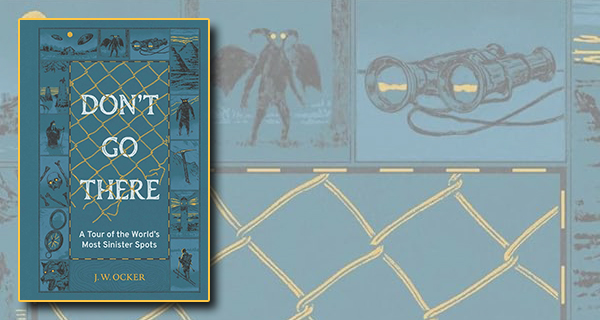
Don’t Go There
A Tour Of The World’s Most Sinister Spots
Hardcover | Kindle
By J. W. Ocker
Publisher: Quirk Books
Release Date: July 14, 2026
When you think of areas not to go to, most people will likely say the Bermuda Triangle, the infamous vortex of legend located in the North Atlantic Ocean off the coast of Miami, FL, where ships and planes have been mysteriously disappearing for over a century. While vanishing off the map is surely a frightening possibility, there are plenty more places around the world that are far worse than the Devil’s Triangle and have even more terrifying histories. In Don’t Go There: A Tour Of The World’s Most Sinister Spots, author J. W. Ocker highlights 30 such locales, bringing some of the planet’s darkest corners into the light through a captivating blend of history, folklore, and little-known facts.
The book consists of 6 chapters categorized by landscape type: Fearsome Forests, Wretched Waters, Insane Islands, Deadly Deserts, Risky Ruins, and Spooky Snowscapes. Some of the listings are more well known and perhaps less daunting, such as the aforementioned Bermuda Triangle, which sees planes fly through every day without incident. There’s also the Pine Barrens, New Jersey’s highly trafficked forested ecosystem, steeped in pop culture thanks to years of reported Jersey Devil cryptid sightings and a memorable TV episode of The Sopranos that featured the area. And then France has its Paris Catacombs, an underground ossuary that remains a popular tourist attraction that sees more than half a million visitors each year. These spooky spots might sport a reputation for the strange, morbid, and unexplained, but at least they pose little real threat, as people safely visit them yearly. But then there are the mysterious, supernatural, and possibly even deadly destinations, such as Ciudad Blanca, the fabled Honduran “Lost City of the Monkey God” that seemingly doesn’t want to be found, and Canada’s Nahanni National Park, dubbed the “Valley of the Headless Men,” which is so inhospitable that it only sees about 1,000 visitors per year (did you catch that nickname?). Oh, and let’s not skip over this hot spot: Japan’s Aokigahara, aka The Suicide Forest, located at the base of Mount Fuji and best known for, you guessed it, suicides.
But what happened to make these specific coordinates so mysterious, bizarre, and sometimes strangely deadly or paranormal in nature, setting them apart from more conventional tourist attractions, like Arizona’s Grand Canyon, Africa’s Sahara Desert, or South America’s Amazon Rainforest, all of which carry inherent risks to travelers? With each site he explores, Ocker examines this very thing: how and why, of all places on Earth, did these particular places become hotbeds for some of the world’s greatest mysteries? Some have logical explanations, while others will likely never be understood.
One of the aspects I love about Ocker’s reference titles published by Quirk Books is how the publisher adds extra touches to make these small, trade hardcover releases really stand out and prime for collecting. For the 288-page Don’t Go There, the attractive cover features a moody blue palette with small drawings representing things discussed throughout, such as skulls, hiking, and creatures, and of course a broken fence as a reminder to “Keep Out.” The front cover’s eye-catching foil accents are an especially nice embellishment, particularly when used on the eyes of creatures and skulls to create a glowing effect. The same moody blue colors are used on the chapter-opening pages, location headings, and boxed feature spreads, as well as in the decorative interior artwork, where beautiful monochromatic illustrations reinforce the eerie atmosphere without overshadowing the content. While the Table of Contents does list each location beneath its corresponding chapter, I think it would have benefitted from also having the city and country/geographical region listed and maybe even an Index page to make searching easier, but that’s just a minor ask.
Despite the titular warning to steer clear of the featured destinations, Ocker’s intriguing tour of the world’s most sinister spots inspires far more curiosity than it does deterrence. The Edgar Award-winning travel writer, who has penned guides about the haunts of Edgar Allan Poe, the legendary master of the macabre; the magic of the witch town of Salem; cryptids in the United States; and cursed objects around the world, is an expert at presenting obscure histories, myths, and all things bizarre in a humorous, yet informative way. With Don’t Go There, Ocker clearly means to entice enthusiasts of weird history and the macabre with this tantalizing anti-travelogue that’s practically a bucket list for adventure-seekers and lovers of dark tourism. After reading this book, even those of us who fall more on the scaredy-cat side of the courage spectrum could start thinking that a trip to Roopkund, India’s “Lake Of Skeletons,” might actually be a fun idea (even though the author expressly suggests crossing this one off your Himalayan bucket list, although I suspect that’s just more of his reverse psychology at work here).
And I should clarify that when I previously mentioned Ocker’s explorations, I mean he actually visited many of these places himself, sometimes even accompanied by his three daughters, who, he revealed, remained his enthusiastic travel companions despite being completely aware that this was a quest to find the strange and unusual. The fact that they turned work research into a fun family adventure and lived to tell about it is proof enough that maybe you can ignore the multiple advisories throughout this book, including its back-cover caution: “Travelers Beware: Read This Guide At Your Own Risk.” So go ahead and read Don’t Go There, and as soon as you get the chance, definitely go there… well, except for maybe the forest with the suicides and anything with “headless” in its nickname (use your own discretion when choosing destinations). But even if travel isn’t in your future, Don’t Go There allows you to live vicariously through Ocker’s sinister tour from the safety of your own home.
Embark on a guided tour of 30 of the most dangerous and mysterious locations that we simply cannot stay away from.
Have you ever visited a forest or an abandoned building and gotten a bad vibe? There are places that are rife with rumors of hauntings, monsters, and sinister phenomena that can’t be explained. And there are just as many sites that are the confirmed home of disasters, murders, and man-made mistakes. Everyone’s heard about the Bermuda Triangle, but do you know these chilling sites?
– Roopkund: There’s a lake tucked high in the frozen Himalayan Mountains . . . and it’s full of skeletons.
– Mount Shasta: This mysterious mountain in California inspired the I AM cult and is said to host UFOs, bigfoots, and lizard people.
– Nahanni National Park: Called the “Valley of the Headless Men,” this national park in northern Canada is famous for legends of a hidden gold mine . . . and a series of decapitated miners.
– Pine Barrens: Best known as the home of the Jersey Devil, this desolate pine forest has also hosted pirates, the mafia, and moonshiners.
– Ciudad Blanca: This fabled pre-Columbian “Lost City of the Monkey God” in Honduras doesn’t want to be found, and explorers seeking it have met violent ends.
Award-winning travel writer and dark history expert J. W. Ocker explores these and many more locales around the world in this fascinating illustrated compendium that will ignite curiosity . . . and perhaps inspire some dubious travel plans.
|













 English (US) ·