
Greg Hunter | July 21, 2026
When Olivier Schrauwen’s collected Sunday arrived in 2024, comparisons to James Joyce’s Ulysses became an immediate critical cliché, appearing across multiple pieces. In following a Belgian font designer (and his inner monologue) through one misspent day, Sunday does court these comparisons. They were inevitable; that does not make them useful. Some writers began at the book’s time span and ended at its considerable size. Chris Ware, in The New York Review, made the case best: “[I]t does — somewhat like Ulysses — attempt to capture the thoughts, experiences, memories, musings, and mania of one man over the minutes and seconds[.]” But critics’ reflexive, not reflective linking of Sunday and Ulysses has ignored the books’ most meaningful similarities and differences: their positions as post-colonial works. The comparison, followed through, provides for a rich, unsettling read of Sunday.
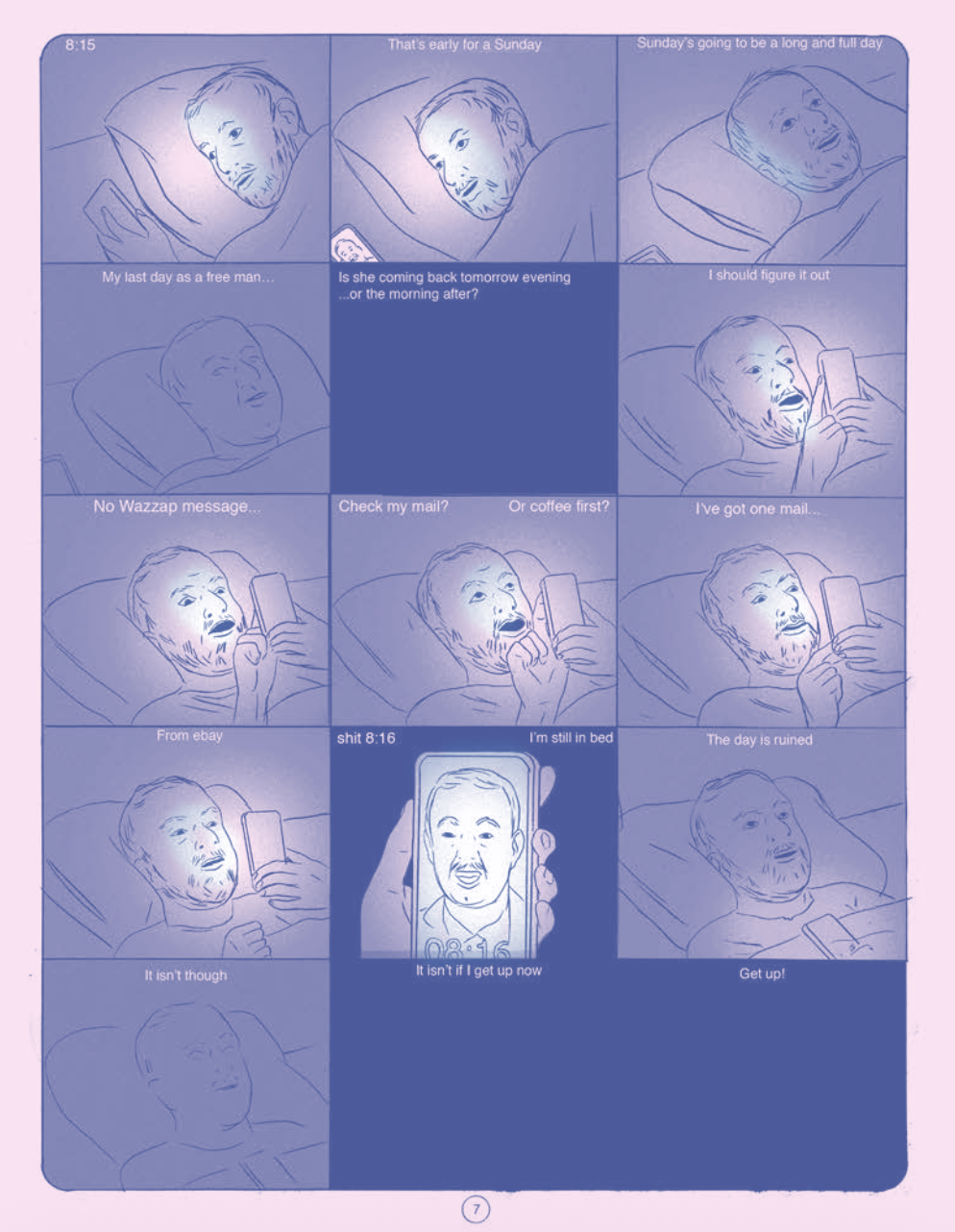 This book, like Schrauwen’s breakthrough comic Arsène Schrauwen, applies creative license to the artist’s family tree. In his foreword to Sunday, Schrauwen introduces Thibault, his cousin and focal character; Arsène Schrauwen follows its title figure, notionally Schrauwen’s uncle, through a colonial farce. Despite taking place in different centuries, Sunday and Arsène Schrauwen have continuity beyond their characters’ surnames. Thibault lives in the world Arsène made, and placing Ulysses alongside Sunday can make that context more vivid.
Joyce completed Ulysses in 1921, a year before the establishment of the Irish Free State, following British colonial rule. The novel tracks the minds and bodies of Dubliners Stephen Dedalus and Leopold Bloom, among others, through the day of June 16, 1904. Complexly structured, referential, and—yes—long, Ulysses supports a life’s worth of possible readings. The book is awash in intertexts, for example. As Joyce scholar and biographer Richard Ellmann writes in Ulysses on the Liffey, “it makes the major works of western culture [...] tributary it to it as it is tributary to them.” Homer’s Odyssey informs the novel’s structure, with Joyce variously honoring and sparring with Dante, Shakespeare, and numerous others. A reading could also privilege Joyce’s innovative stream-of-consciousness prose, described like so in Ellman’s Four Dubliners: “we have all the lapses and bursts of attention, hesitations, half-recollections, distractions, sudden access or flaggings of sexual interest[.]” But a post-colonial lens, once applied, is nearly impossible to remove, and further illuminates other facets of Ulysses.
Joyce scholar Declan Kieberd approaches Joyce’s prose in post-colonial terms. His introduction to recent volumes of Ulysses mentions Joyce’s fondness for oral traditions and a “distrust of written English.” The novel signals Joyce’s “sense of trauma at the loss, in most parts of Ireland through the nineteenth century, of the native language.” Leavening this feeling of loss is a sense of creation, “the courageous admission that there was no such thing as an Irish identity, ready-made and fixed,” with Joyce willing to face this dilemma in Ulysses. The book’s attention to speech and formal eclecticism reflect the plurality of voices that would make up the nation’s post-colonial identity.
In Inventing Ireland, Kieberd contrasts Joyce with contemporaries, both revivalists and revolutionaries, who attempted to define Irish identity through myths of violence (“the cult of Cuchulainn”). Joyce sensed in this “a country intent on using all the old imperialist mechanisms in the name of a national revival.” His reaction informed the creation of Leopold Bloom, a man of peace supplanting Odysseus, heroic in his everyday motions. Various cues feminize Bloom; despite his fixed place in time, he’s an ambassador from a future “where there could be a celebration of manly women and of womanly men,” with Joyce again rejecting rigidity for eclecticism. Meanwhile, Stephen Dedalus — in Joyce’s Portrait, a proxy for the author — appears in Ulysses as a “provincial intellectual weighted down by the learning of the European literary tradition,” inseparable from the colonial path by which it would have reached him.
Stephen and Bloom eventually meet and commune, with Bloom offering comfort to the dissolute younger man. Their time together, in Kieberd’s reading, involves shared recognition of “the force which oppresses them and prevents them from becoming themselves.” The epiphany that occurs, like other features of Ulysses, has a post-colonial quality, the possible beginning of a new way forward. Under this lens, the contrast between Ulysses and Sunday intensifies. Schrauwen’s book, despite its similarities with Joyce’s, features no such epiphanies, only realizations botched or forestalled.
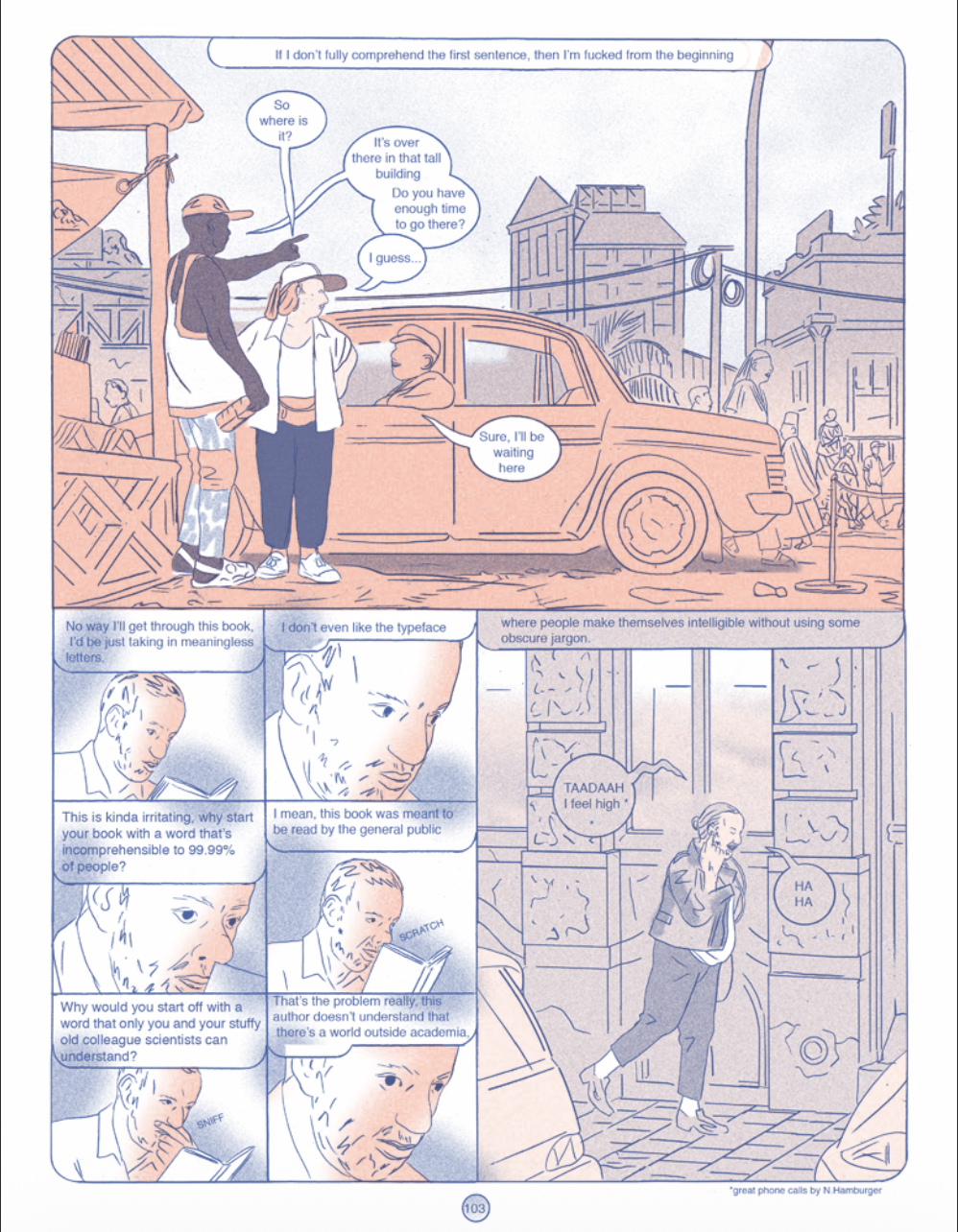 Schrauwen’s novel takes place in 2017, decades removed from a Belgian colonial project that included areas now recognized as the Democratic Republic of the Congo, Rwanda, Burundi, and South Sudan. (In a 1907 lecture, Joyce himself drew parallels between the Belgian pillage of these cultures and British colonial actions: “for so many centuries the Englishman has done in Ireland only what the Belgian is doing today in the Congo Free State.”) This is not an incidental detail; Belgium’s colonial legacy flickers throughout the comic. And while, like Ulysses, Sunday offers readers much to work with (the mechanics of its humor cartooning; the conveying of consciousness through color and line), positioning the books together encourages a conclusion that a lack of epiphanies is the empty inheritance of Schrauwen’s characters.
Thibault begins his Sunday by calling it his “last day as a free man” — he’s waiting for his partner, Migali, to return from a trip that evening. It’s not the last time his interior monologue uses a metaphor with colonial resonance. Later, he worries about becoming “a parasite” on his society, and readers get the impression Thibault’s friends would second that concern. In a memory, his cousin Rik jokes to artists at a care home, ““He’s going to pillage your work, and steal whatever he can for his hipster illustrations!”
Many scenes find Thibault reflecting on his stagnant relationship and frustration around Migali’s lack of texting before her flight. Her current location, The Gambia, impacts his thoughts. He worries she would mistake a nonsensical text for mockery of an African language, tallies safety concerns, and has a crass thought-joke about Ebola. His worries grow rather than recede over the course of his day. Eventually, the gap in communication spurs a daydream of civil war, and later of Migali being forced to wed a local ruler, “Eddie, King of Wakanda,” with imagery from Coming to America rounding out a grotesque pop-culture pastiche. In moments like these, Thibault’s mind draws from a larger white imagining of Africa, his thoughts not unique in their casual racism.
Thibault is a clown (later, readers see him singeing an eyebrow on his stovetop), but not a total fool. He’s fitfully self-aware about his shortcomings, such as having barely read the philosophy books he keeps on his shelves. Sunday also grants him moments of creative inventiveness; while trolling the Instagram photos of an object of lust, he turns shapes from her grid into a series of glyphs, creating a game of decoded messages for himself. Elsewhere in the book, he imagines himself justifying a change in partner to Migali, dismissing the hypothetical charge of having “an exotic fantasy” — he has a notion, at least, to protest being accused of racism. But pages later, he also entertains the fantasy of being a taboo-breaking comedian, tackling “in a smart way [...] Racial humor, gendered humor.” In other words, Sunday finds Thibault ambivalent. He has a sense of liberal custom, if not a strong social conscience, but still feels the pull of a racialized chauvinism. These moments, all of them playing with Thibault’s boorishness, also explore the line between environmental influence and individual choice. Thibault’s internal reproductions of colonial racism are spontaneous, and begin with the input of his surrounding culture; whether he externalizes them is up to him.
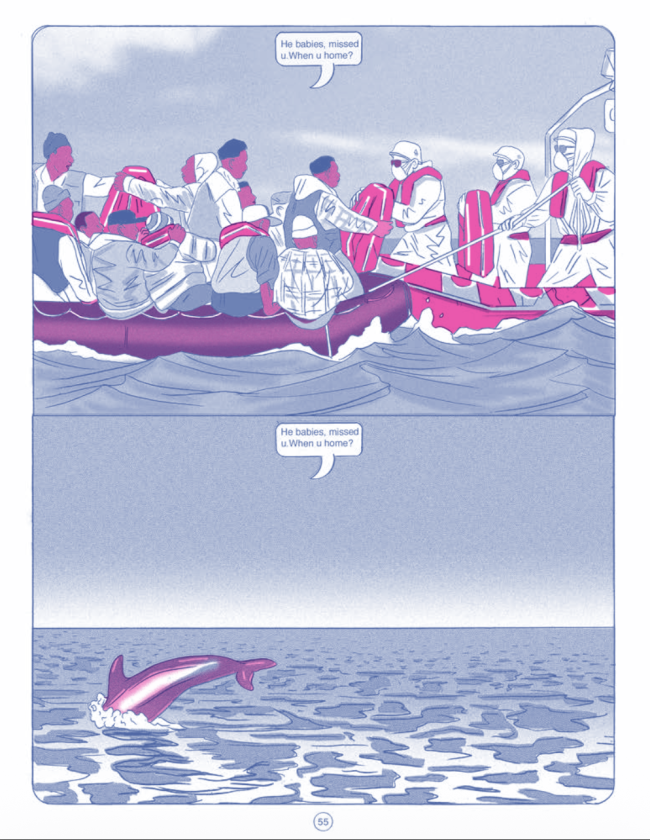 Schrauwen’s layouts often depict spaces well outside the bounds of Thibault’s apartment, even as their captions continue to share his thoughts. Schrauwen sometimes uses this move to reestablish the geopolitical backdrop behind Thibault and his friends. Early and conspicuously, readers see a text from Thibault to Migali cross an ocean to reach her, even passing above a boat of migrants. Migali is a less defined character than Thibault but still an important foil for him, with greater cultural competencies and also a fraught position.
An artist whose medium is chemically treated textiles, Migali has traveled to West Africa seeking materials for her work. Her process of acquiring them appears benign, a departure from Belgium's colonial history, but Sunday undermines ideas about the tidiness of this transition. Moving through airport security, Migali is told “you can’t take a sword on board,” in a moment that’s hard to take as anything other than an echo of colonial plundering (and which falls in the same section where Rik jokes Thibault will pillage others’ artworks). Later, on the plane, Migali and a seatmate bond over their love of baobab juice, quickly asking, “Why isn’t anyone exporting that stuff?” — their enthusiasm mediated by commerce, and shaping a subtle impression of Migali as a culture vulture.
Rik, Thibault’s bohemian cousin, names this phenomenon elsewhere in the book, calling international travel “a neoliberal lie” with a false promise of happiness. His friend Nora mockingly quotes “neoliberal” back to him. The exchange, like most in the book, is humorous — the buzzed loudmouth Rik has a credibility deficit — but the small moment still resonates throughout the pages that follow. This, the Migali scenes, and Thibault’s ruminations on culture and taboo all contribute to a question of whether it’s possible for these characters to imagine something better — or whether they’d have the motivation to seek it.
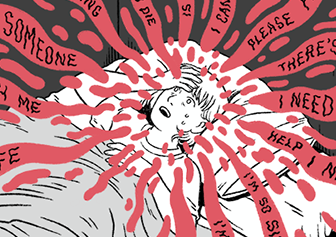
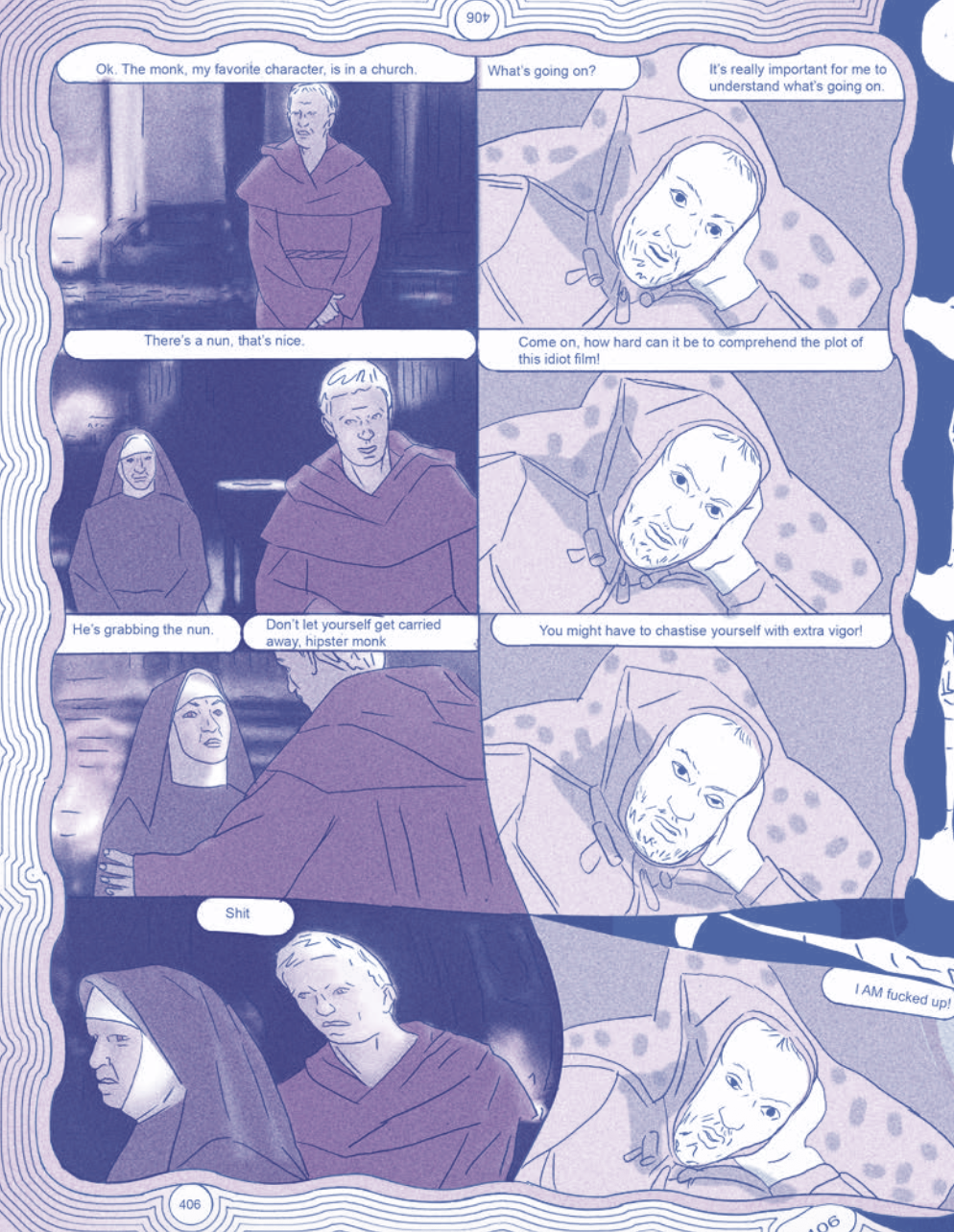 As Sunday advances, Thibault descends into something like existential chafing — not the urge to revolt against the neoliberal status quo so much as an urge to surrender even harder. “No longer do I chase some unattainable dream,” he says as he turns on Netflix after rolling a joint, following a day of procrastination. He needs to “drop the ballast” of his life, he soon reflects during a dull moment in The Da Vinci Code. This movie-watching scene is among the funniest in memory, a comedic tour de force, which is not mutually exclusive with an implication that the trappings of Thibault’s life don’t add up to satisfaction. His reflections degenerate into stoned babble, complemented by distorted page layouts, eventually interrupted by the thought, “Wait a fucking minute! Where is Migali?”
Parallel to this, Rik, Nora, and other friends have been gathering outside Thibault’s home, preparing to surprise him for his birthday. They eventually find him passed out on the couch. Before the group can rouse him, Schrauwen cuts to black, and readers might see the shadow of Ulysses on the page. Thibault ends Sunday like both Stephen Dedalus and Leopold Bloom and like neither of them. He’s a doughy everyman, as well as someone who failed to find meaning in the world of ideas, yet he doesn’t evolve as Stephen and Bloom do, with no epiphany to call his own and his story is over before communion with others can take place.
Joyce, in Ulysses, “turns the unheroic and mock heroic into the heroic, makes commonplace things lyrical,” writes Ellmann in Four Dubliners. In Sunday, the unheroic stays unheroic, then falls asleep. By pairing the novels, readers can find a new take on a familiar idea, that colonialism stole from the colonizers even as it stole more directly and profoundly from the colonized, with ongoing results. The personal is political for Schrauwen’s cartoon cousin, and Thibault’s failure to wake up suggests his colonial inheritance: easy comfort and existential deprivation. Schrauwen has created a hilarious book that, at its darkest, sees a cast of characters technologically dependent and spiritually adrift, and poses the question of whether epiphanies of Joyce’s kind are possible for them at all.
Greg Hunter is the author of New Realities: The Comics of Dash Shaw (Uncivilized Books).









 English (US) ·