

Issue #1 of The Dark Knight Returns, which was really the first Frank Miller Batman comic (he drew a one-off in 1979, but it was written by Denny O’Neil), started a revolution in the world of comic books.
It hit the stands in June 1986, making this it’s 40th Anniversary.
Crap I’m old.
Alongside Swamp Thing and Watchmen, and coming on the heels of Miller’s revolutionary dark work on Daredevil, these books signaled a new era for comics: Grown Up Comics.
(And speaking of Miller’s Daredevil run, fan favorite underworld supporting character Turk Barrett gets a mention in the Dark Knight series…)

Miller’s Batman is old and haunted by his past–a terrific analogy for the entire comic book medium, which had become hugely popular but was having trouble shaking off its reputation for producing disposable kids’ books.

Indies were already doing this (kind of), especially creators like Dave Sim and books like Flaming Carrot, but those were almost universally “funny” or satirical stories–and they played, obviously and outwardly, with the very idea that comics were for kids. (I mean, just those example were about an anthropomorphized aardvark and carrot, respectively.) The Dark Knight Returns was one of the earliest examples of the kind of super-hero realism that eventually led to books like Kick Ass; the hardcore violence that would characterize so many titles (and the entire Marvel MAX line); and the inwardly introspective narrative style that is now common in books like Punisher and, yes, current Batman. It’s important to remember that at the time it came out, Batman had been 29 years old forever and, although his comics tended to be more “street” than any other in the DC line, he still tended to appear in crisply drawn, relatively brightly colored panels. And graphic novels were doing okay, but they weren’t anywhere close to being the commodity for the industry that they are today.
DC had allowed Miller to experiment with a higher-quality paper, thicker cover, and oversize issue format with Ronin. It was a success. So they let him publish The Dark Knight in a set of four, 50+ page “mini graphic novels.” They were gritty and glossy at the same time, and they rocked my world.
Issue #1 was all about suspense. We get to see where Bruce Wayne and Commissioner Gordon have ended up in retirement, with Batman having disappeared after “something” happened to Jason Todd. Joker, too, is in retirement, in an old-folks crazy home for criminals. Wayne is now trying to spend money to improve Gotham, but he doesn’t seem to be succeeding. The first issue focuses on the rehabilitation of Two-Face…And by the end we see how that all went.

In #2, we get the young girl version of Robin—an innovation that Frank Miller admits wasn’t his idea; it came from John Byrne.

This came long before all the attempts to lure in readers of other genders, races and cultures by manufacturing new versions of old heroes. This was definitely NOT stunt-casting. Miller’s Dark Knight has seen too many younger men die on his watch–he needed something like this to shake him up and get through the personal armor he had developd.
There are so many iconic panels in this issue: Batman hanging a crook from a rooftop; Batman holding the body of a dead soldier holding a smoking gun, draped in the American flag; the full pager of Batman, grinning, stepping out his Bat-Tank to take on a Mutant Gang leader mano-a-mano.
The iconic Joker battle happens in issue #3….

I love the way Miller uses color in the narration box to signal that this is big blue thinking, and the way he drills down from way up the clouds, where Superman lives, down closer to the real world of Batman and humans.
I can’t swear to this, but I’m pretty sure the use of colored narration boxes was an innovation used first here to signal multiple narrators. The possibility of more than one “first person” is one of the things that makes comic books, as a genre, unique. Decades later Daniel Way would use it in Deadpool to signal the different voices inside the character’s own mind.

The real story here is the build-up to the big Batman-Superman battle to come, which Batman wins due to his ability to prepare and with some help from friends.

The final issue, the final battle. And I love that Batman is helped by Green Arrow in this—Ollie Queen is pretty much the poor man’s Batman anyway.
By the end of the story, Batman has become the real symbol of humanity and hope—and Superman has become a faded figure who lacks moral imperative. And it all happens organically, and quickly, over the course of these four issues.
And that’s the end of Miller’s first Batman story.
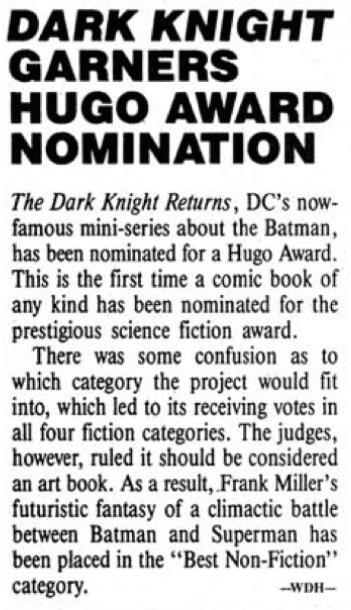
On August 27, 1987, in Brighton, England, Frank Miller’s Batman: The Dark Knight became the first comic book to win Science Fiction’s most prestigious award–a Hugo. Oddly, the win was for “Best Related Non-Fiction Book.”
So, apparently, The Dark Knight is a true story.
It also won the award for second-best Frank Miller comic of all time here.

He tried to do a “Strikes Again” series, but it didn’t work nearly as well.

These two panels exemplify what’s wrong with this book. Batman doesn’t think of what he does as a “job.” Miller isn’t really writing a Batman story here, he’s writing a Sin City story with superheroes and making the famous DC characters fit within his mold. (He did the same thing but much, much better in his original graphic novel Holy Terror.)
Speaking of Sin City, his art in these four issues isn’t anywhere near as appropriate (or good) as it was in The Dark Knight Returns, but he does do some very interesting things by using style to convey mood. Characters will appear cartoonish, oversized, undersized, etc., depending on what is happening in the script.
If the script were better, this would have been really, really interesting. But it wasn’t terrible–just pale in comparison to what preceded it.

In fact, it’s not even a Batman story, really. It’s a Justice League story.
Maybe the reason I didn’t like it so much is that so many writers did pretty much the same thing, only better–like Grant Morrison in JLA Earth 2 and all the folks who wrote great Squadron Supreme stories at Marvel.
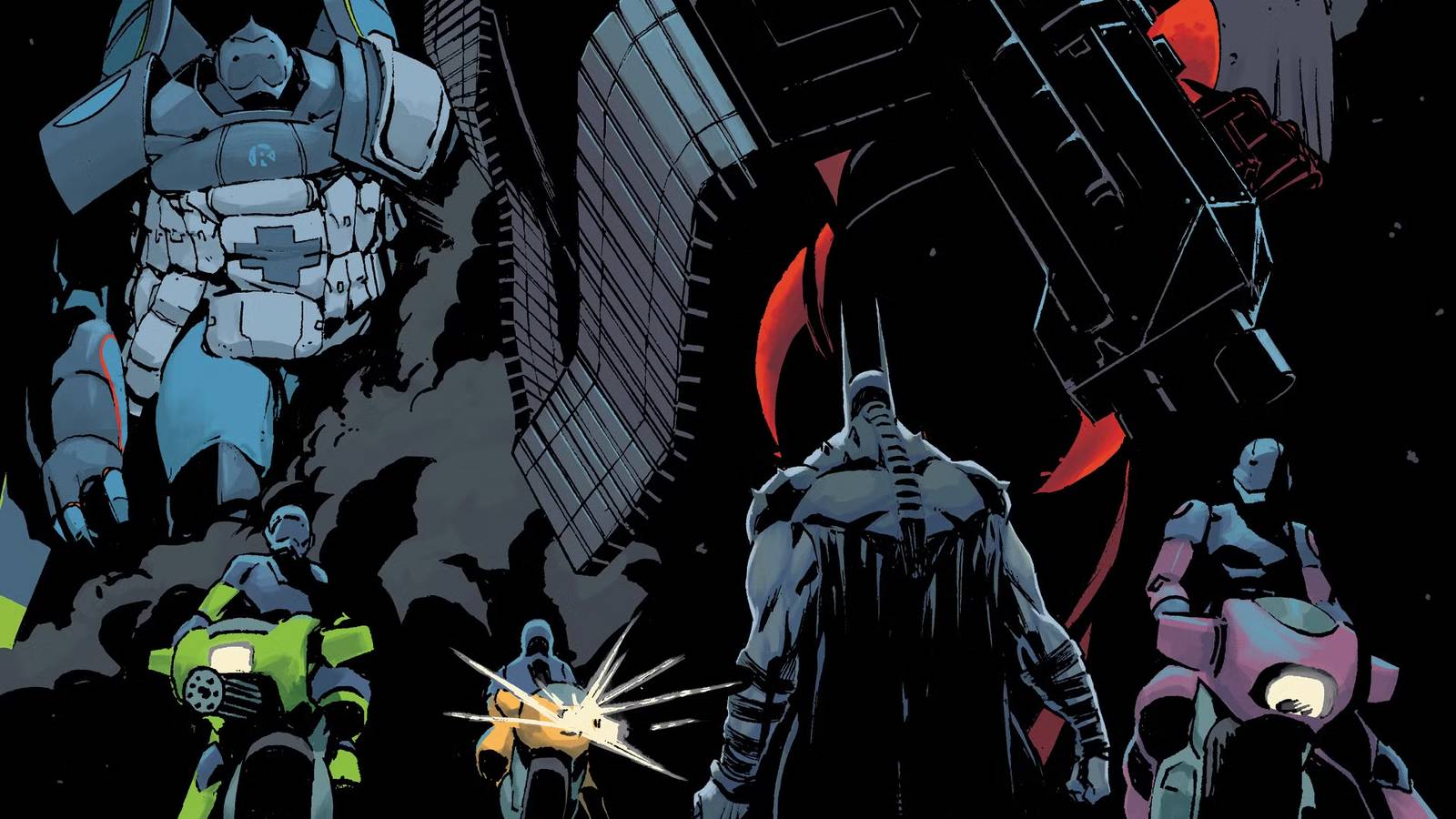
But there’s still much to recommend here. The panel above sets the tone: Strange art, new depictions of classic heroes, deconstruction both through image and text.
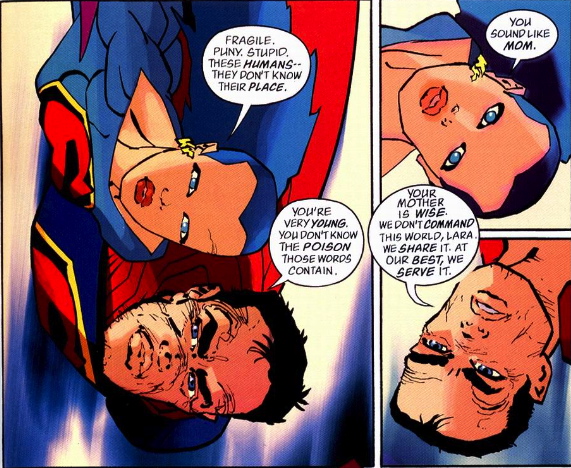
Superman and Wonder Woman had a daughter and they named her Lara. Like I’ve been saying, this really isn’t the Batman story that the title makes it out to be.

In issue #4, Miller’s thesis finally makes sense. He’s playing with the Superman-as-God concept, and trying to tell the story of how a God who won’t accept that he’s a God must embrace his power over humanity, and paralleling it with the story of a human (Batman) who refused to accept that he’s a human, so he keeps boxing with God.

When I re-read this final issue I felt sad that these books weren’t better. They really could have been something great. But overall, they don’t really tell a story all that different from the one in Dark Knight Returns.
A few more Dark Knight “universe” stories came later. I tried to get into them, but the magic was gone. At least for me.





 English (US) ·