
Valerio Stivé | June 8, 2026
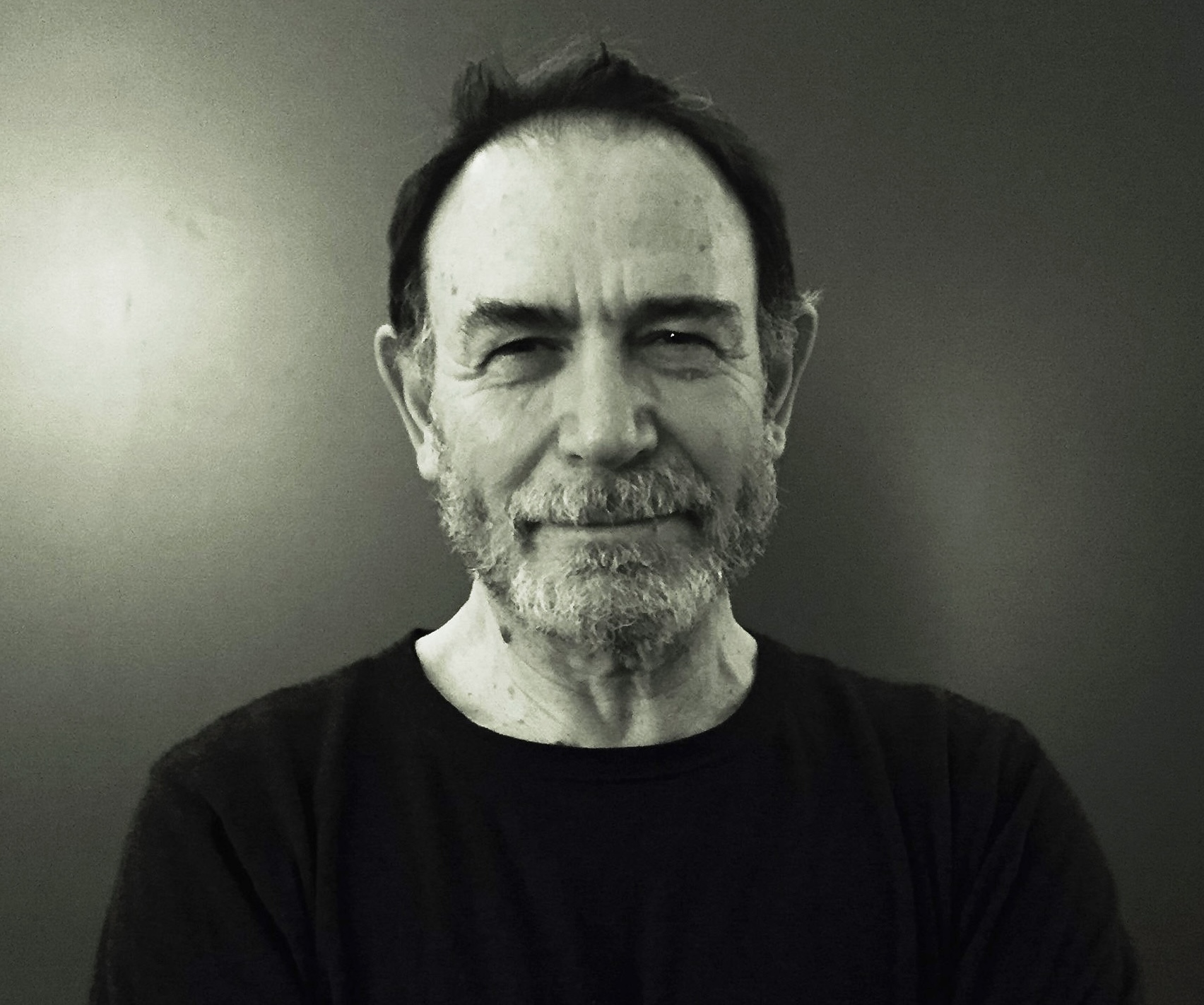
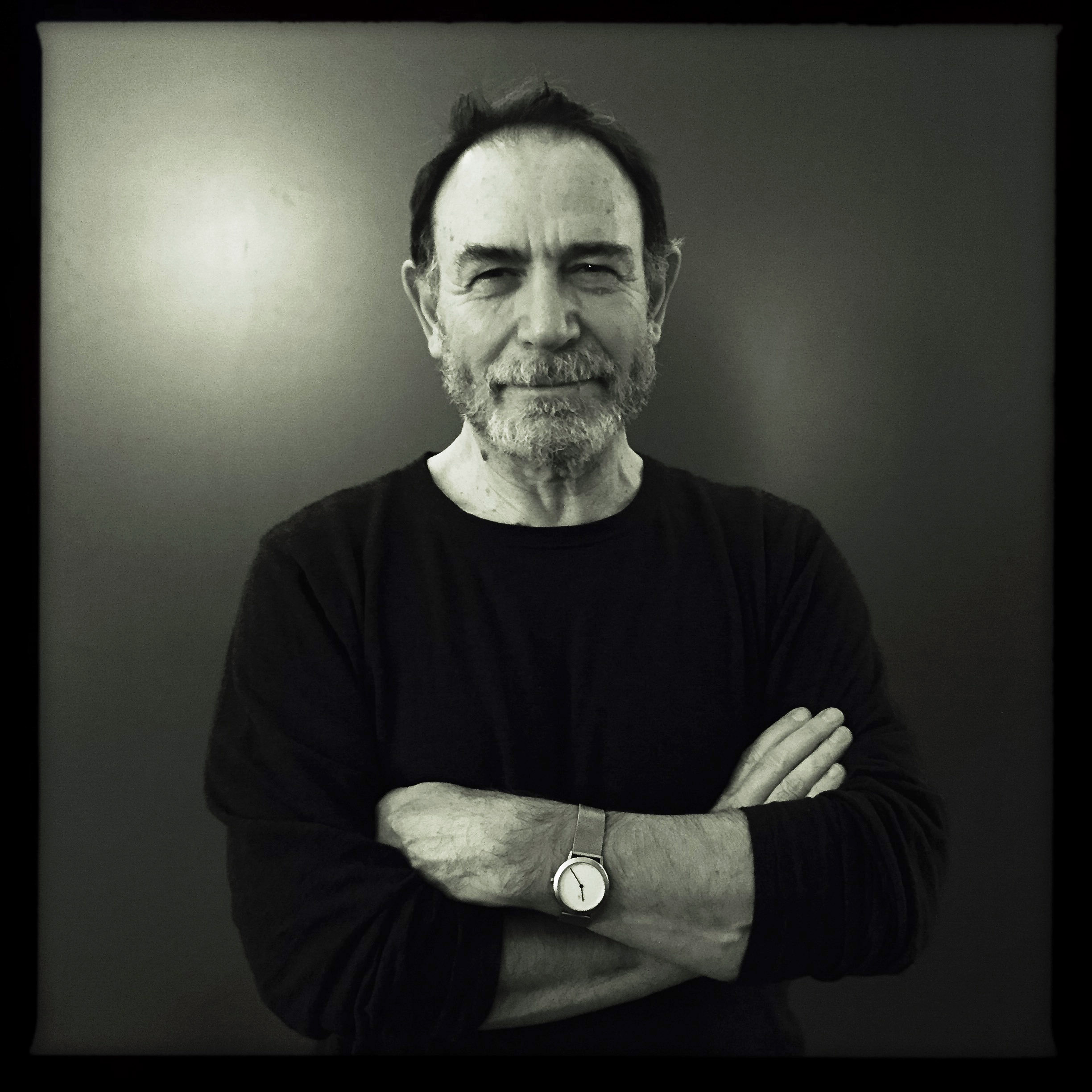 Photo of Lorenzo Mattotti by Jorge Colombo.
It had probably been years since I first thought about interviewing Lorenzo Mattotti. Anyone who does this job and cares about that kind of research-driven art-comics cannot help but see Mattotti as a guiding light, author of groundbreaking works, one above all: Fires.
In 2024, forty years had passed since the first publication of Fires, one of the most important books in the history of European and international comics, a true milestone. And I wanted to take that anniversary as an opportunity to reach out to him. Instead, I found myself listening to him speak about this work at least a couple of times in public, as in a lectio magistralis at the Academy of Fine Arts in Bologna. A genuinely fascinating experience: he spoke at length about the artistic references behind Fires, describing it as a cathartic work in which he brought together numerous different, personal artistic experiences — some of them not immediately apparent when reading the comic — ranging from early twentieth-century painting to progressive rock music. When the lecture ended, I had that feeling of wishing I could keep listening to him talk about Fires and much more. But the thing is he has produced so much that it would be impossible to cover his entire career in a single conversation.
So why not try to reach out to him? I had his email address, kindly provided by the press office of Logos Edizioni, which had published new editions of almost all of Mattotti’s graphic novels before recently ceasing its activity (RIP). Still, I had not yet decided to write to him. Then, while talking about it with Emilio Varrà of Hamelin, curator of the festival Ad Occhi Aperti in Bologna, he told me: come on, don’t hesitate. He’s a friend, I’m sure he’ll gladly do the interview.
You might wonder about all the hesitation. I’m not entirely sure myself; it certainly wasn’t the first time I had interviewed an artist I admire this much. Emilio also mentioned that Mattotti was probably in Italy at the time, since it was summer and he usually lives in Paris, but loves to spend his free time in Tuscany. So I wrote to him, and he kindly agreed to do the interview via video call.
It was late July. I was calling from my studio in Bologna, while he was surrounded by nature in the garden of his home, on a hill not far from the Mediterranean Sea. It’s an area I know pretty well: I was born in Tuscany, used to spend my summer holidays in that locations as a child, and I still try to go back on that part of the coast at least once a year. That setting made me feel an immediate connection. I don’t know his house there, but he was calling from a place that, in some way, feels like home to me.
After a brief introduction, we started talking about Fires — although, as he himself pointed out, there was much more to discuss, and in fact we didn’t only talk about that book. At the end of our conversation, he invited me to visit him in town. I won’t say which town — I suspect that fans of the best kind of comics might otherwise start flocking there on holidays, and I respect his privacy. As I do every summer, I later went to my favorite seaside town, Baratti, not too far from his. By then, though, he was already back in Paris.
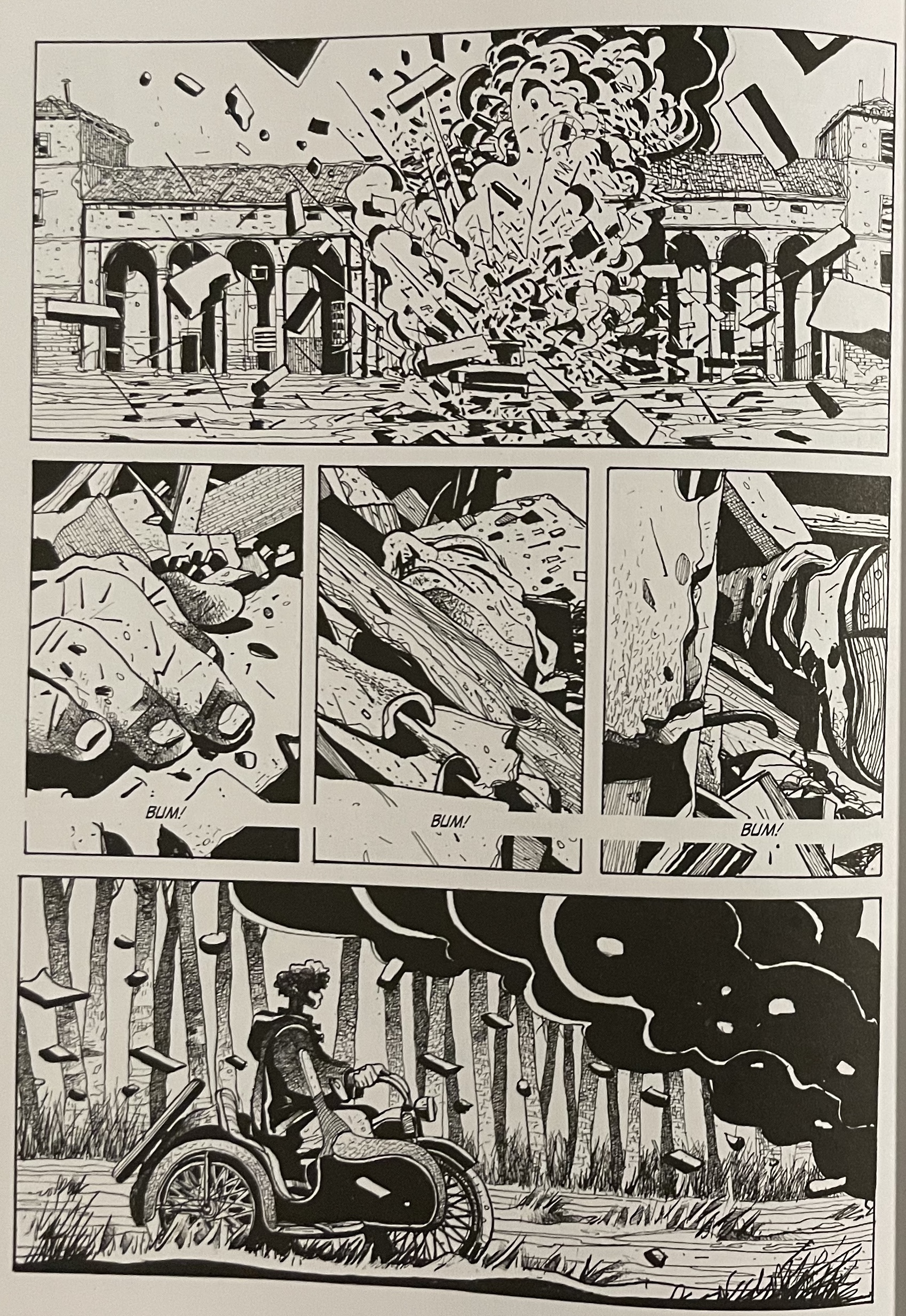 Page from Periferica, a collection of Mattotti's early works published by Rizzoli Lizard in 2021.
Shall we start our conversation with Fires? 2024 marked the fortieth anniversary of its first publication. So much has happened since then, so many books have followed, and yet that one still feels like the beginning of something— even though it was not your first comic at all. You had already created several short stories and the graphic novel Spartaco.
Yes, and longer stories as well. Have you read the anthology Periferica? It was published by Rizzoli Lizard … Do you have it?
Sure, I’ve reviewed it too.
That book sums up my Milan years. But it leaves out the part I did with Fabrizio [Ostani, aka Jerry Kramsky, ed.], all the surreal and visionary material.
That earlier phase was almost psychedelic, in a way.
Yes, almost psychedelic. We were supposed to do a second volume with Rizzoli Lizard, focused entirely on the more underground side— very underground. The stories collected in Periferica are, let’s say, more “realistic.” More accessible. Some of the others are almost unreadable. But we wanted to make a big volume gathering all that remaining material. In the end, it didn’t happen.
That’s a pity.
It would have been for collectors only, after all.
Those were mostly black and white, and then color arrives as well.
With Agatha Blues, with those experimental pages. And then Spartaco [published in 1982].
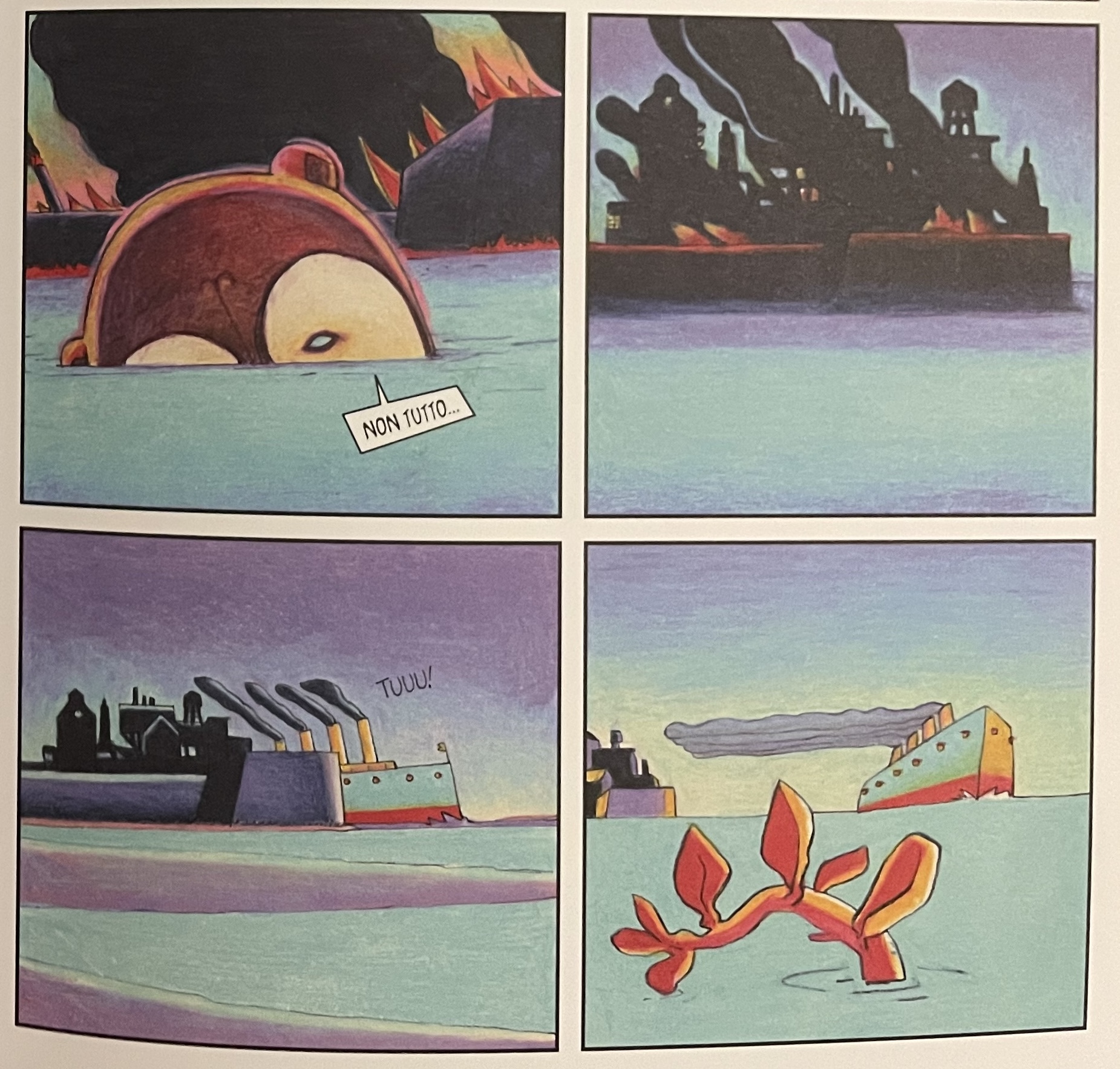 Sequence from Mattotti's Spartaco,<,/i> published in 1982.
When you decided to work on Fires, which felt like something entirely new, what were you doing at the time? Where were you, artistically?
Well, things develop slowly, little by little. Ideas come gradually. For a long time I had wanted to … Well, in Spartaco there’s a lot of irony, a lot of self-irony. It’s very exuberant, very much in the spirit of Valvoline [a group of artists formed in Bologna in 1983 around the magazine Alter, composed by Lorenzo Mattotti, Giorgio Carpinteri, Daniele Brolli, Marcello Jori, Igort, Jerry Kramsky, and Charles Burns as well]. Then came the interlude of Doctor Nefasto [initially serialized in Alter Alter in 1989], where I did a very ironic take on the classic features of the ligne claire tradition, the Belgian school and that kind of storytelling.
But while I was doing that, I was feeling the need to try at something more dramatic. I had wanted for a long time to create a more “dramatic story,” loosely inspired by the atmosphere of Italian comic maestro Dino Battaglia’s L’uomo della legione (“The man of the Legion”), a classic adventure tale. I have always loved Stevenson, and at the same time I have always been drawn to a graphic way of reading, also inspired by Hugo Pratt. Adventure, mystery — those kinds of stories.
My idea was to take inspiration from Battaglia and try to approach that world in my own way. Of course, inside me there was still the whole visionary universe of Nefasto, of Spartaco, all my previous imagery born from my mind. In fact, with Fires, it all started from some drawings I had made for Nefasto: a large boat sailing toward an island to conquer, a rocky shore, towering mountains. I was also influenced by Werner Herzog’s films, especially Fitzcarraldo.
And at the time, I guess Apocalypse Now might have been of great inspiration, with its idea of a single individual drawn into an overwhelming, almost hostile nature, as it happens in Joseph Conrad’s Heart of Darkness.
Yes, of course. Even though I experienced Conrad basically through Apocalypse Now, through its cinematic power. I did read Heart of Darkness, but what really struck me was the force of Coppola’s film. I loved that flow, that way of following a character into his own delirium.
And then there was Tarkovsky — Stalker, and his other films. Their narrative possibilities, the way they depict nature, the presence of silence, wind, light. I felt there was the possibility of doing something similar in comics.
I asked myself: is it possible to convey the mystery of nature in comics? To show the wind, the light, contemplation? Until then my interest had been mostly theoretical. I had never truly confronted that impulse through drawing, but I felt I had to. I needed to, also to confront my own psychedelic experiences, my paranoias. I wanted to place them inside a story, even include personal, autobiographical elements. I wanted to take on the idea of a dramatic narrative and convey a sense of mystery. So I asked myself whether there was room for that in comics.
Alberto Breccia had done it. Battaglia had done it with his Edgar Allan Poe stories adaptations ... the light and the silences. Hugo Pratt had done it in The Ballad of the Salty Sea, which impressed me deeply. And also in L’uomo del Sertão. Pratt was exploring abstraction within comics, through watercolors and ink.
At the time there was a strong sense of effervescence, a desire to conquer new narrative territories. Fires is rooted into that moment. Many artists were experimenting. There was Frigidaire, but they were a different tribe. On one side the Cannibale group [Stefano Tamburini, Massimo Mattioli, Filippo Scòzzari, Andrea Pazienza, Tanino Liberatore], on the other the magazine Alter Alter. The artist of Frigidaire were focused heavily on social issues and the slogans of that period. They were great, but we were different tribes. And that was positive, it allowed each of us to try to give our best.
There was a dialectic.
Yes. Pushing the language forward could be liberating, exploring all its possibilities. It was a remarkable moment for comics in Europe. The language felt more advanced there than anywhere else at the time.
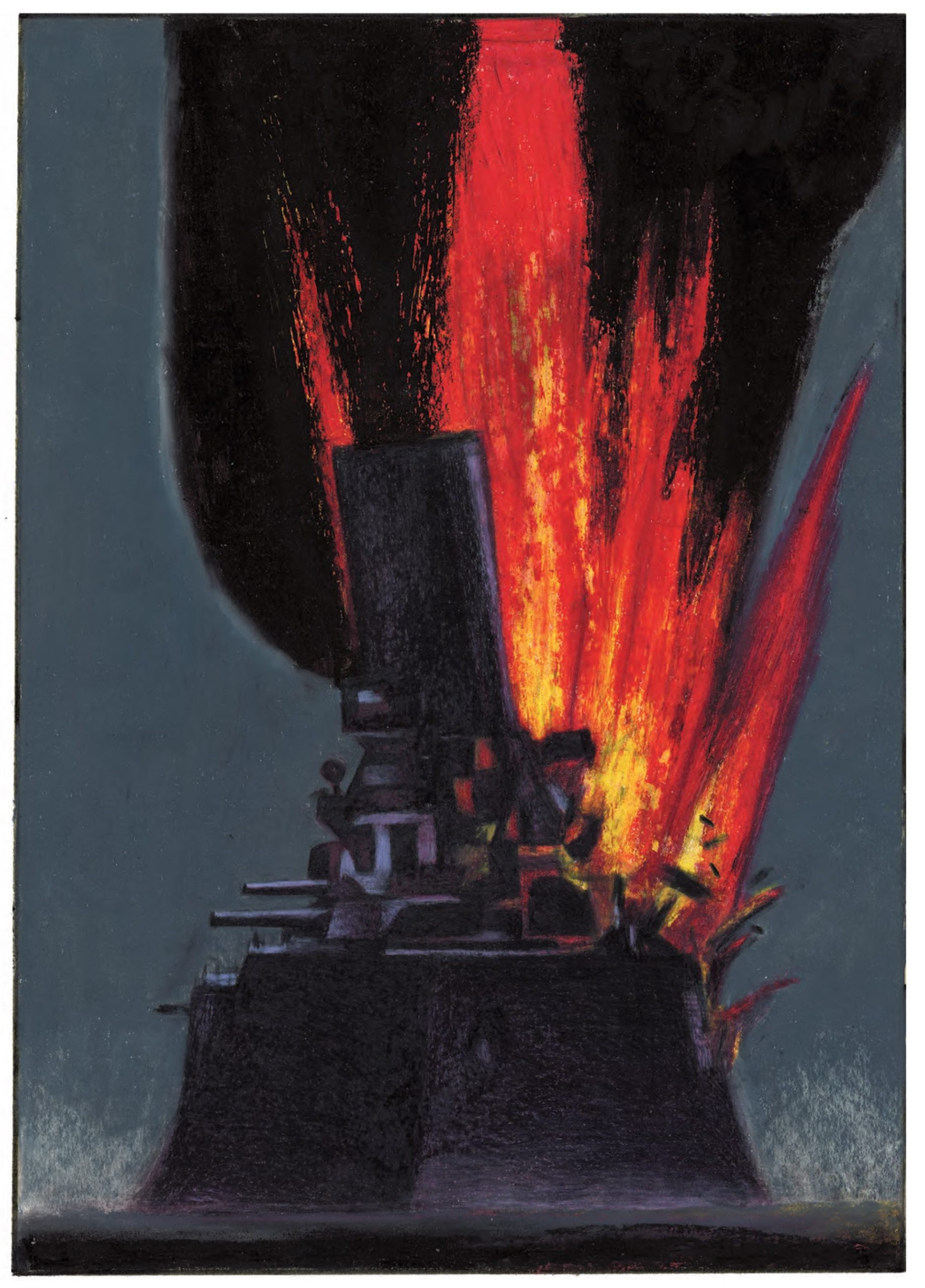 Page from Fires. All images from the comic are taken from the 2017 Dover Press collection, translated by Tom Leighton.
In that climate, Fires felt both rooted in tradition and radically new.
It’s a story that set certain markers. There was a lot of experimentation around. Fires is a balanced mix of storytelling, symbolism, and abstraction. It’s all there. A kind of precarious equilibrium that still holds today. It maintains a constant tension from beginning to end. But I was aware of how fragile it was: one wrong panel, and the whole structure would have collapsed.
One thing I find intriguing in it is its sense of balance. Today, perhaps more than in the past, too many painterly comics tend to overload the page, they lack balance, and rather suffer a horror vacui. So what you were saying about balance must have been a real challenge.
At the time there were tribes, schools, crews. Everyone was working on virtuosity. Moebius had opened the doors — the Moebius who broke the page and the layout. After that, all the artists who could draw, and even some who couldn’t, tried to make spectacular comics. Big, showy pages. Even Andrea Pazienza — extremely talented and intelligent, a true virtuoso — leaned into that direction.
I went through that phase too. If you look at certain pages in Periferica, like “C’è del Maggio nella pioggia,” (“There’s Some May in That Rain”) they date back to 1975 or earlier. That was a period when I also tried the spectacle way. But at a certain point it felt too easy. That was the problem.
With the Valvoline group we said no, we need rigor. We need to stay focused. I worked through subtraction. It wasn’t about technical skill; it was about making sure that every page, every panel, was justified within the story. They had to be linear, in order to create narrative rhythm.
I remember Alberto Breccia once saying — it was an interview or during a conversation with him and Muñoz at a café table — why do we need to open and close all these panels and pages? In cinema, you go to the movies and the screen is always the same, and you are drawn into the story. That stayed with me.
With Valvoline we adopted a strict structure. In Spartaco, for example, we decided that every page would have six panels. If you look at the early stories by Igort, mine, and Carpinteri’s, you’ll see that six-panel grid. It gave the narrative a particular rigor. And later, in Incidenti, the structure is very cinematic as well.
Yes, the story is very straightforward.
Once you have the structure, you can accelerate by adding more panels to a strip, or stretch time, dilute it, slow it down, pause for a moment, and so on. Fires was born from this idea of total rigor. And I was a pain in the ass at the time, really terrible. If there was something in a comic I didn’t like, it was garbage to me. I was constantly searching for rigor within myself.
Fires really is a continuous attempt to maintain rhythm, drama, silence. Everything had to be coherent, otherwise it would collapse. It’s a story without irony. If it wasn’t constructed seriously, everything would fall apart, especially because it’s a completely abstract, completely symbolic story. If the image doesn’t fascinate you, doesn’t pull you in, doesn’t lead you by the hand into these visions, then it’s worthless. You fall out of it, right? You lose it. A lot of people back then were playing with the idea of losing control. If you look at Alter Alter from that period, many young artists would do big, impressive pages, but maybe they weren’t even that skilled at drawing.
Yet on the other hand, it becomes less of a comic. And that happens quite often.
Only Sergio Toppi managed to reach that incredible graphic coherence, where the page structure was also fully functional to the storytelling. A genius, truly a great one.
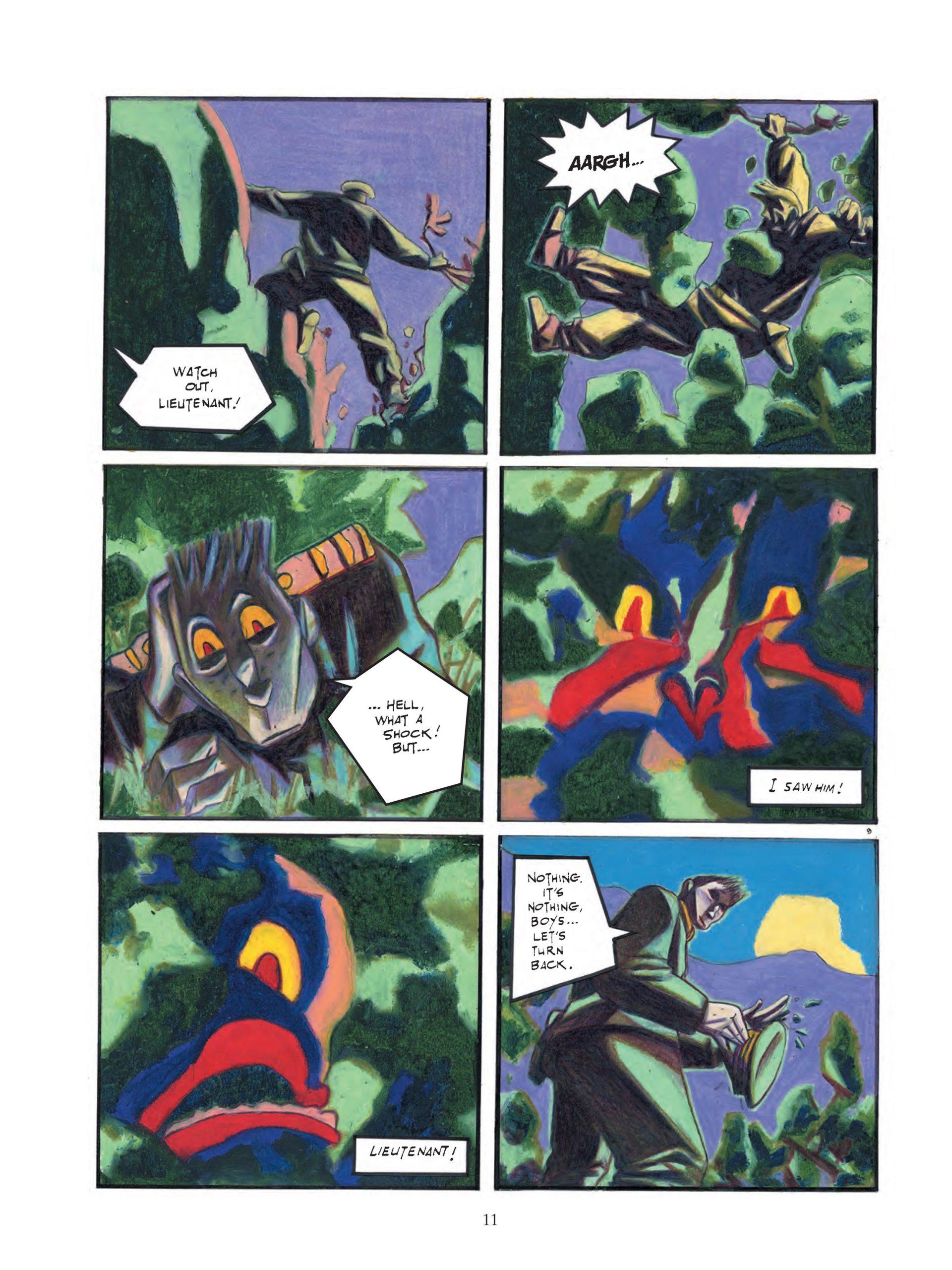 Page from Fires.
You were just talking about Muñoz, and about the idea of being cinematic, right? About stillness. For you, in Fires, but also later, even in Jekyll and Hyde, the panel is a bit like the frame of a painting.
Yes, but it’s still a comics panel. And by that I mean that the image inside it is alive only because before it there is one image and after it there is another. At the same time, a panel has to have the intensity to fascinate, to fuel a sense of mystery. Panels need the intensity of what you might call a “painterly” image. I always hated it when people focused on the “artistic” quality of a story, and most of the time it was just quotation. By that I mean: ah, look, there’s Magritte; ah, look, there’s this, there’s that. Sometimes it’s even done on purpose to show that what they are doing is an art-related, painterly story. But what interests me is having images that are consequential and coherent within the narrative.
I mean, there is a scene where the character runs through the woods. I could have drawn the character just like Tintin when he runs, you know? But I needed something else. And that’s where you start working with pictorial language. Only painting has created truly evocative images; images you can stand in front of for a while, and they summon an entire world: silences, metaphysics, all of that. That’s what interested me in using the language of painting. Painting managed to touch something that cannot be put into words, and that comics, in a way, cannot fully grasp. Comics were often about saying, saying, saying ... explaining, narrating, acting.
Maybe the first real silences came with Krazy Kat. And also Feininger. There’s that wonderful image of the little girl looking at landscapes — one of those things no one ever mentions, I think. And alongside Feininger, there’s McCay, who was the great virtuoso, a kind of baroque master, the great architect of comics. But Lyonel Feininger came from the Bauhaus.
Yes, he was also a painter.
He was German, and he used the language of comics in a completely different way. In his comics there was all that European culture, and he created a series of poetic stories, of a kind that had never existed before. This little girl who looks at the landscape and talks to the train, who sees clouds transforming… For me, he was definitely one of the greats. He laid the foundations for the possibilities of comics. And the work he did is still made of masterpieces today. You can look at them as if they were paintings.
And just like what you were saying before, what we have here in Fires, with the references and the images you were influenced by … they didn’t seem that obvious to me. They don’t feel like self-serving quotation. For example, you were influenced by Hopper’s lighthouses here …
Or there were moments in the more abstract pages — the sea, the clouds, and so on — where my mind turned toward abstraction, and sometimes to American expressionism, and abstract expressionism. At first those pages had no text; they were meant to be almost silent. And back then — this was before the graphic novel format, when stories are at least 150 or 200 pages — I could have used those silent sequences, building an entire section, maybe twenty pages long, with no text at all.
But at that time magazines used to run ten pages a month per author. Fires was even something unusual, because it was published in two or three installments on Alter Alter. Still, I had to deal with page limits. I couldn’t allow myself — well, maybe sometimes here and there — to do four or five pages of clouds changing color, light shifting, and the sea transforming. So at a certain point I had to … well, only one page with abstract images would have slipped past the reader’s eye.
But that, in a way, was the key to that work, because it was precisely the perfect common ground between comics and painting.
Exactly, but where text also plays its part, because there comes a point when text becomes poetry. And that’s where I discovered the power of words in their connection to images. As I was saying, back then you didn’t have computers, or anything else to rely on. You’d write text by hand, cut it out, and glue it onto the page. And this method allowed you to fully understand how the words ...
… how much space they would take.
And whether they were sound, music, or noise. And that was very important for me. There were moments that were crucial for me in truly understanding the essence of the language of comics. Because that was what I was interested in.
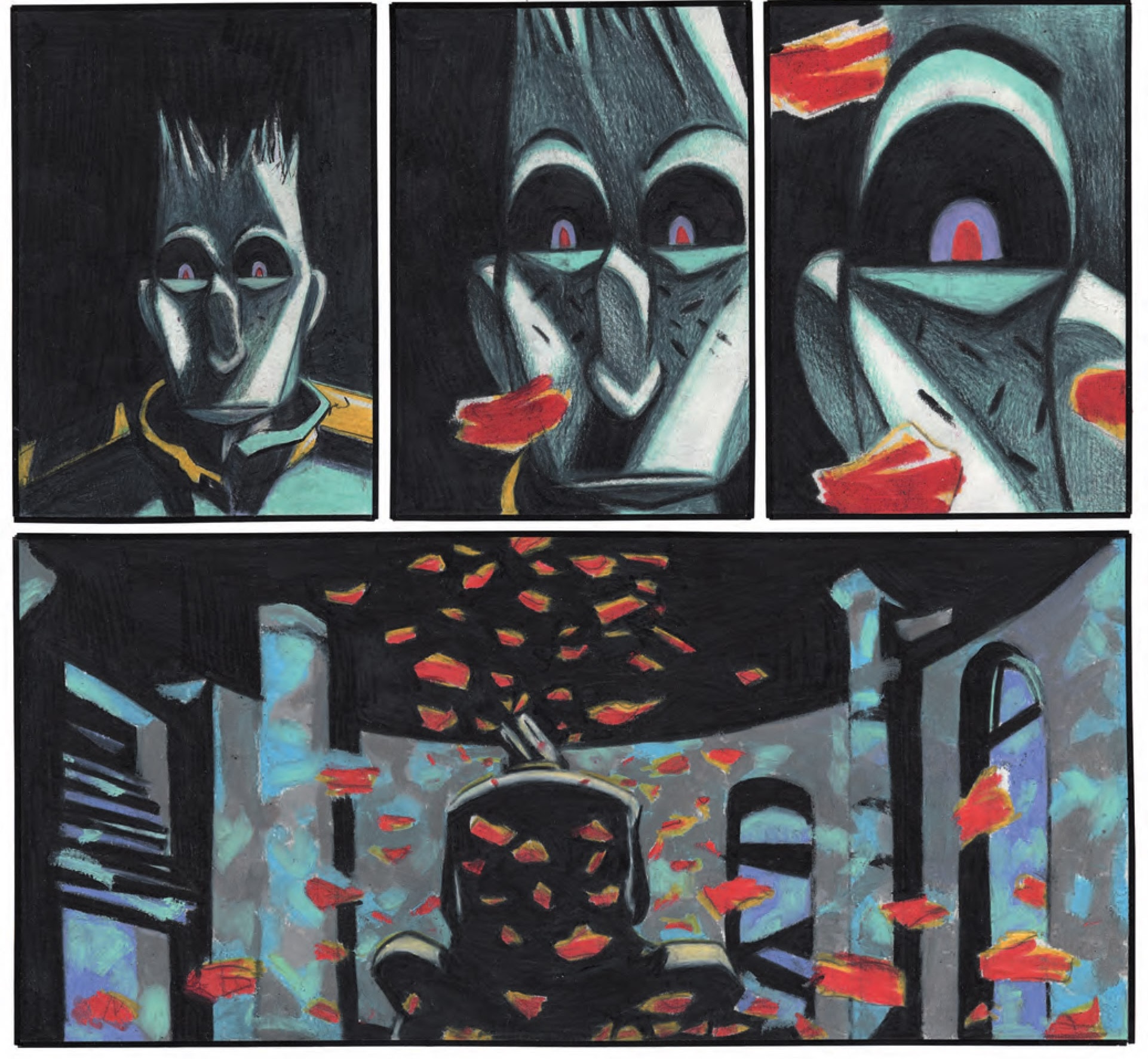 Sequence from Fires.
But I am curious… many artists are mentioned in discussions about Fires, and even when you exhibited at the Pompidou you were placed next to Bacon, right?
Yeah but that was Raven.
Right, Raven. Still, some other of your images have a sense of volume that recalls the way Bacon works with volumes. And I’ve always felt that the movement of color in your work brings to mind Umberto Boccioni. You can also tell me that you never cared about Boccioni, that you can’t stand him and Futurism. (laughs)
On the contrary, I love Futurism. I love Boccioni, and I love Carlo Carrà. I truly love many of them. When I was young, I loved Futurism. For me it was … I don’t know … it was like rock and roll.
Because it was.
It was rock. Futurism was about painting dynamism. Boccioni, in particular. I worked a lot in that direction. And that lesson is inside my work. If you look at Jekyll, there are a couple of pages that are even more Futurist than anything in Fires.
In Jekyll, yes. That sense of movement, the idea of unique forms … almost sculptural. The need to set things in motion and freeze them at the same time. It’s something you often do within the panel, too.
Like Bacon does. Bacon’s images have the same feeling as a frozen movie frame. I don’t know what his relationship with the Futurists was, but in any case the Futurists were extremely important.
And if you think about it, right after Futurism there was a return to the past. That’s when the Metaphysical movement emerged. De Chirico is the exact opposite. And Carrà as well, when his art becomes metaphysical. There is this desire to say: “stop everything, suspend it, introduce silence.”
That’s interesting, but rereading your Jekyll and Hyde there’s a strong metaphysical atmosphere that comes through in many panels. Your works are often about men who are alone or marginalized, and here there’s also this sense of metaphysical loneliness. The backgrounds convey the idea of a city where you are alone, right in the middle of it.
Yes, but there are moments when the city is very dynamic, and there you can see references to Grosz and to Futurism. And then there are other moments when it becomes a mysterious city, full of suggestion. This is where I was mostly influenced by Léon Spilliaert, a great Belgian painter from the '30s and '40s. I discovered his work in Brussels many years ago and I was deeply fascinated by it. Some of his self-portraits strongly recall Doctor Jekyll and Mr. Hyde. They are incredibly powerful.
For me, stories have always been a journey through my passions, or through my discoveries. I remember that with Caboto, all my references were to painting from the period of Caravaggio …
Yeah, that one has much more of a classical vibe.
And so Doctor Jekyll and Mr. Hyde was a journey into Expressionism, starting with Beckmann and his self-portraits, and then moving toward Bacon. Every time it’s a journey. Fires was more or less the same: a personal journey into everything I had learned up to that point and had never really had the courage to use. Because, after all … until then I had only done three stories on my own. One of them was Incidenti (“Incidents”). So I was wrong when I told you I had never done a dramatic story. I actually started with Incidenti.
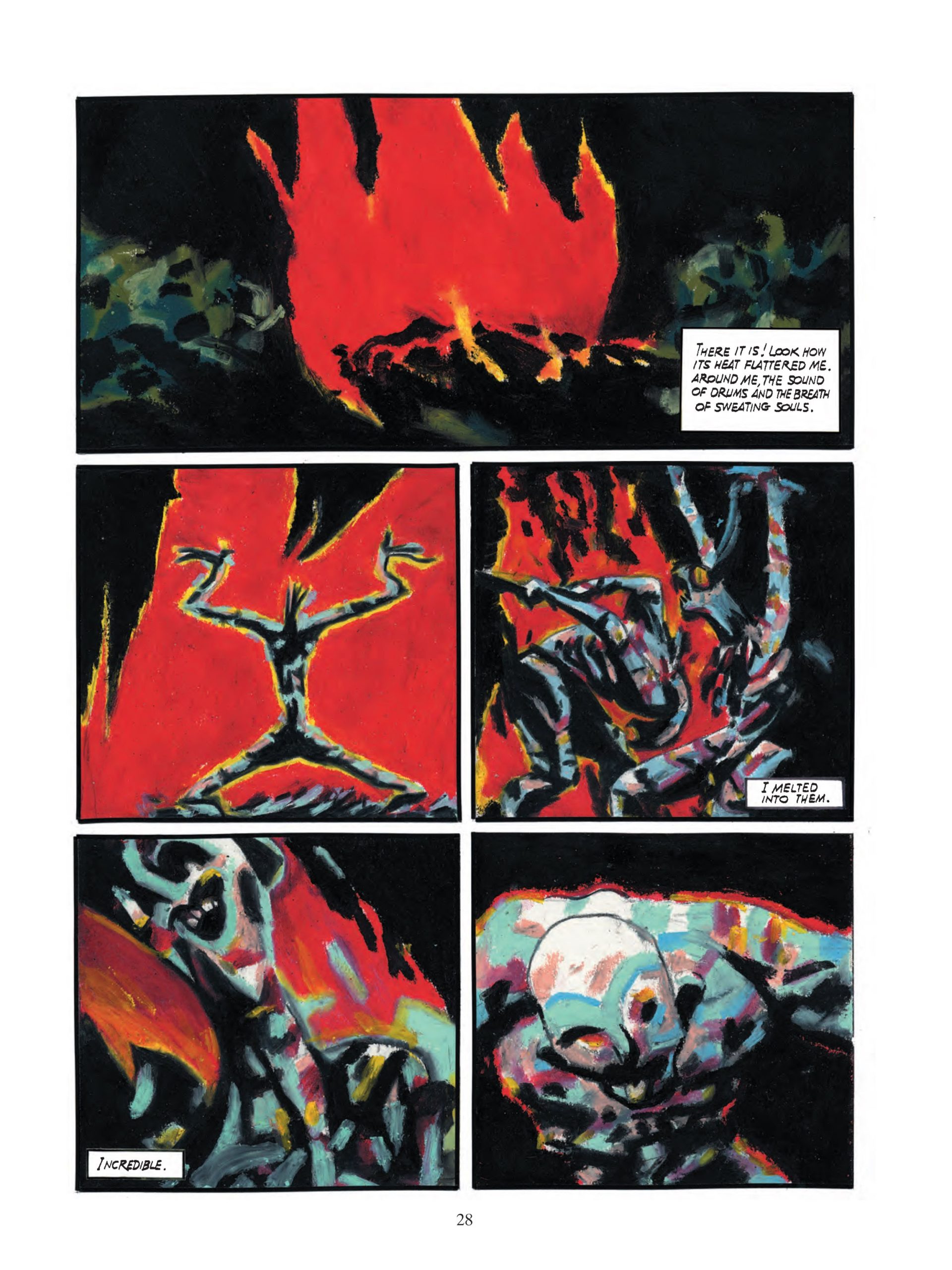 Page from Fires.
Well, Incidenti can be seen as a really traditional story.
My very first personal story, entirely on my own. There are many influences coming from Wenders and so on. But yes, we can say there’s irony in it as well, though it’s dramatic. It’s a dramatic story.
Yes, very cinematic urban drama.
Very much so, because at that time I was working as if comics were … as if I were making a movie. Then something changed. I saw Canned Heat live, with the psychedelic lights and everything else. Music and images have always been very closely connected for me. I hear music and I see images. Frank Zappa’s songs were masterpieces — visionary, incredible symphonies — not to mention early King Crimson and all the other experimental experiences of that time. That’s what I grew up with. All that music had a deep influence on me.
For me, telling a story in comics is a slow process. You learn the language of comics gradually; you understand it little by little. So my love for what remains unsaid gradually emerged too: avoiding the use of text, creating silent images that evoke music, that evoke sounds.
I once read somewhere that you had said Rock Bottom by Wyatt was important for Fires. I wouldn’t think of such a quiet album, with such soft music, if I think of Fires.
Yes, Rock Bottom is an absolute masterpiece. And Robert Wyatt was very influential for me. Not so much for Fires. But for the way it goes deep into feelings, it was especially important for my Linea Fragile (“Fragile Line”), a series of illustrations.
My attempt was to see whether it was possible to put into the stroke of a nib that kind of off-key quality, that kind of falsetto and fragile sweetness that can bring you to tears. Is it possible to do that? To work on the hypersensitivity of the line as if it were Robert Wyatt’s voice ... I was fascinated by that balance between abstraction and narration. I felt that Robert Wyatt opened up the possibility of expressing one’s own weaknesses and fragility, even the possibility of including dissonance within drawing.
You have to understand that an “off-key” drawing is very rare in comics. Even if you look at Herriman’s Krazy Kat, it isn’t off-key. It has an incredibly strong internal structure. You can find something closer to off-key drawing in Copi.
Graphic structure in comics is basically essential. It used to be essential, at least up to a certain point. It was extremely rare to find a drawing that was deliberately badly drawn. Why? Because when someone really has the courage to draw badly, for me it’s not about making things easier. It’s about saying: let’s try to tell fragile things with a fragile line. Let’s try to convey the characters’ sensitivity through this. For me, there had to be coherence in that. Though unfortunately, later on, things drifted a bit, maybe.
And yes, being off-key is extremely difficult. I mean, doing it on purpose.
Yes, Robert Wyatt could do that, in his own way. And there were obviously other artists too.
Apparently where I had read it, it had been reported incorrectly, because if you associate Wyatt’s sensibility with other of your works it explains so many things to me. I mean, it’s really about the single stroke and the white, the emptiness next to it.
I once gave a small lecture here in Paris and played the music that influenced me the most, pairing it with images from my drawings. I remember that last year, when I chose Rock Bottom and started looking for matching images, there was an immediate, perfect fit. For years I’ve tried to create a kind of installation where I would project my images with music behind them, to build this strange world.
Which is somewhere between a dream and a very real kind of pain.
In Fires, music had a completely different role. At that time there was the power of Peter Gabriel.
And Fires is also very percussive.
There is Brian Eno with his ambient music, with On Land, with all those strange, muffled, dark sounds. And there are the percussion elements from the basic soundtrack of Apocalypse Now. It was the percussionist from the Grateful Dead who worked on it, you know? There’s that whole section in Apocalypse Now made of primitive percussion, forest sounds, jungle noises. I was listening to San Jacinto by Peter Gabriel a lot — there’s San Jacinto inside the book. The explosion, the dance around the fire … it’s so powerful. Peter Gabriel’s voice in that period, the darkness, the reds, the rhythm of heat, the inner rhythm. It’s a completely different world. There’s a strong energy inside it.
I apologize if I sometimes tend to exaggerate with connections and references, but I find it fascinating to see what was happening at the same time — what the artist was feeling, what they were experiencing. Because I don’t believe anyone creates alone. Nobody goes into a cave and works in isolation.
Come on, you don’t have to worry about that. I remember the huge controversies around Fires, because at the time it sparked a lot of debate. Either people were completely against it or they loved it.
And I remember that. And look, I didn’t invent anything. There were three or four masters who opened the doors, and I just crossed the threshold. I followed the path opened by Hugo Pratt, opened by Alberto Breccia. I mean, look at Breccia’s Lovecraft — it’s much more radical than Fires.
It never gets old.
Yes, and it’s an abstract comic. And besides, at that time I was a very close friend of the great partisan Renato Calligaro.
Such an amazing artist.
He broke new ground with Poema barocco (“Baroque Poem”). Now I’m not sure if it came out at the same time as Fires.
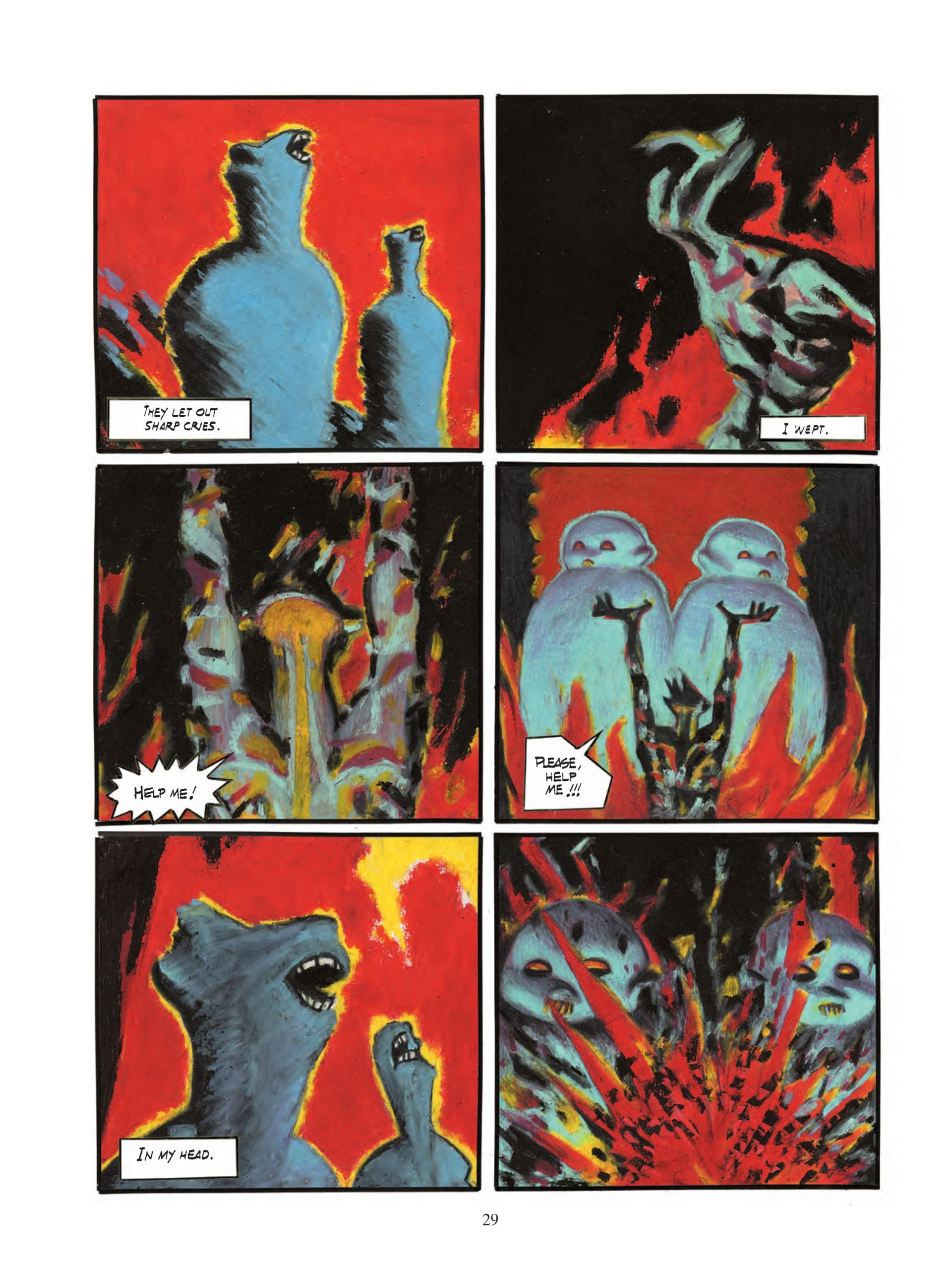 Page from Fires.
Yes, those few pages published in Alter Alter. There was something…
And you should keep in mind that at the time Renato Calligaro was ignored by everyone because he wasn’t considered trendy. He was difficult, he had strong ideas, he insisted on doing things his way. Nobody paid attention to him because he was very political and created poetic, powerful images. He was considered too intellectual. Meanwhile, many other things were happening in comics — transgressive, extreme work. But if you look at Calligaro’s pages today … I’ve shown them to Prudhomme and to French friends who didn’t even know him, and they were amazed. He’s still forty years ahead. And in forty years he’ll still be ahead.
Anyway, I simply followed that path. On my small scale, I tried to carry it forward. I concentrated everything into a single story. And at the same time I wanted to allow for a traditional reading.
But do you think it would be possible to do a book like Fires today, with that same kind of impact?
Comics have taken other directions. After Spiegelman’s Maus, everything moved in a direction that Art developed brilliantly, but has also opened a gap afterward. Many people misunderstood it and thought that they could tell a story, any story, just as long as they added drawings. The story became central. There has been a sort of invasion. Comics went down other paths. And in any case, it wasn’t my aim to invent new tropes for the language of comics.
In Italy, right after Fires was published, many things changed. After our avant-garde period, Sergio Bonelli Editore published Dylan Dog, which at the time felt strange to me. Angelo Stano and I were teaching at the Scuola del Fumetto in Milan, and he was experimenting with characters inspired by Klimt. I thought it was interesting. And then he started working on Dylan Dog. But that way of making comics was a ritual, a restoration. Valvoline, Frigidaire ... it was about disrupting the language. We were blamed when Alterlinus closed, so everything had to return to order. And Bonelli, with Dylan Dog, brought back the focus on structured storytelling. Alfredo Castelli with Martin Mystère, and Sclavi — whom I admired very much, He helped me a lot at the beginning, when he was at Il Corriere dei Ragazzi.
I experimented. There was an explosion in the language. Then, as always happens with avant-gardes, restoration comes. You open doors, and then there’s a step back. Art history has always worked this way: you break the academy, build new structures, then they become the academy, and someone else comes and breaks them again.
With Fires you did something that didn’t really exist at the time. Also conceiving the book as a standalone project wasn’t that usual, as you said. It appeared in a magazine, but in very few installments. Now there’s a market for graphic novels. Back then, in Italy at least, it was a desert — even in the ’90s, until the early 2000s.
For me, L’uomo alla finestra (“The Man by the Window”) was my first true graphic novel. It wasn’t too poetic or too abstract. But it was also the first graphic novel published by Feltrinelli [One of the main Italian publishing houses, mainly not devoted to comics. — Valerio]
Now it’s normal, but at the time everything was serialized. People say Pratt’s La Ballata del Mare Salato was the first graphic novel, but it was a series with a recurring character. The first real graphic novel was Buzzelli’s La rivolta dei racchi, a self-contained story.
But be careful, La Ballata del Mare Salato, when it first came out, it really felt like a self-contained story. You didn’t think it would continue with Corto Maltese later. Corto was just one of the characters. I considered it a novel, something to be read on its own.
So, I’d like to end with a question that is more of a starting point. You’ve told me how you came to make comics. Today people study comics even at the Academy of Fine Arts, while many of your generation studied architecture, as you did. What actually led you to comics? Beyond the fact that you’ve done many other things, I always get the sense that storytelling is essential in your work.
As a child, I mostly didn’t read literature, I looked at images. I looked at pictures in every book, and I bought all the small comic books at the newsstand. I was a collector, almost obsessed. I didn’t actually buy L’Intrepido or similar magazines not only dedicated to comics, because we gambled those; we played cards and used comics instead of money. But I was subscribed to Topolino, Il Vittorioso, Il Corriere dei Piccoli, and Il Messaggero di Sant’Antonio. Those magazines featured the greatest artists of the time, every week.
At the newsstand I’d also buy L’Avventuroso. All the characters were there: Lee Falk’s Mandrake, The Phantom, Batman and the superheroes. We didn’t have Marvel yet. For me, superheroes were Nembo Kid [Italian early name for Superman] or Batman. There was Green Lantern, beautifully drawn. And sometimes there were strange British superheroes who lasted only a few months. I collected all of them.
Then there were many other titles. I kept albums in my wardrobe. I looked at them, studied them, analyzed the drawings. Then I started copying them. I adored Lino Landolfi from Il Vittorioso. He created Procopio, a wonderful character, and above all his comics adaptation of Don Quixote.
Then I began copying art from the first Asterix books. I already knew Uderzo from earlier work published in Il Corriere dei Piccoli. And then Blueberry, the early stories, and Tanguy et Laverdure, and Michel Vaillant. All that French school arrived in Italy through those small Audace booklets. You bought a little book and there was a complete story inside.
And then something important happened: my brother’s girlfriend — he was two or three years older than me, which is a crucial difference at that age — she brought home records from Bob Dylan and The Beatles. She came from a bourgeois family in Como and had the complete early collection of Linus, bound into volumes.
People used to do that back then…
So he borrowed them from her and brought the collection home. And I started reading Linus one issue after another.
A massive dose.
A massive dose indeed. And that’s when I began to discover another way of seeing things. I became fascinated by strips. In fact, I began making strips myself, about a wizard ... a sort of loser wizard.
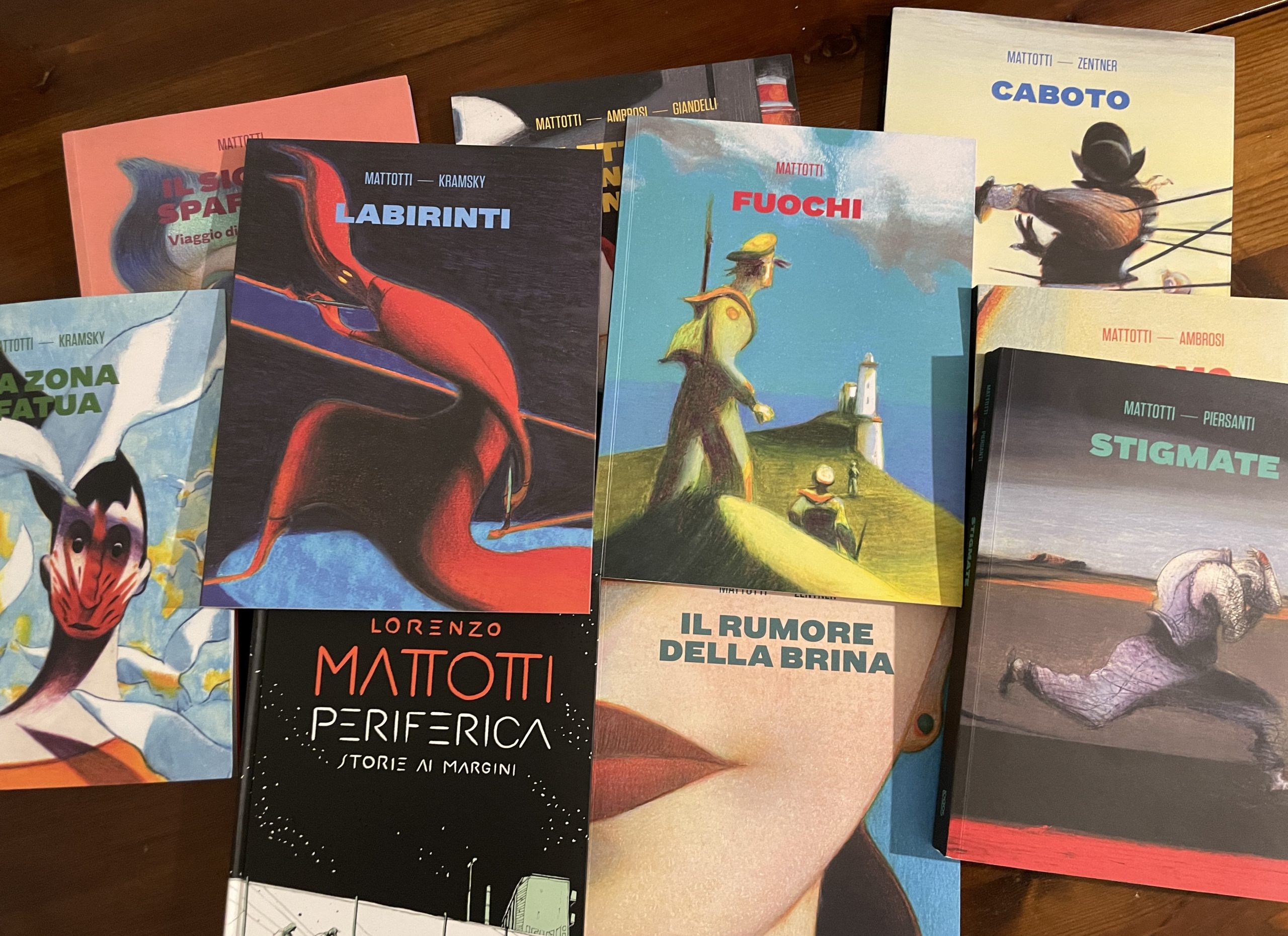 A collection of Mattotti's books. Photo by Valerio Stivé
And then you chose architecture.
I actually wanted to attend the Academy of Fine Arts in Venice, but I didn’t have an art school education.
So you weren’t eligible, basically.
I had never gone to art school. My big frustration was that in Como there was no art institute, and my parents didn’t want me to pursue that path — they were afraid I’d become an artist. They basically kicked me out of the house. I wanted to go to the Academy with my friend Fabrizio — Jerry Kramsky. But when we arrived, they told us: no, you can’t enroll because you come from a scientific high school. You need a preparatory year: drawing from life, art history, and so on. But I didn’t want to take more exams. I was completely disappointed. Still, I wanted to study and stay in Venice.
My luck was meeting Renato Calligaro in Udine and attending the early editions of the Lucca Comics festival, where you could meet artists like Bonvi, who was often a bit drunk, very eccentric type, but he kind to us, and gave us help. He produced the magazine Offside independently, and Kramsky and I showed him some pages, asking if we could do two double-page spreads. The project eventually failed, but he was the first to teach me how to do lettering — drawing two pencil lines and writing between them, and so on. Though his own lettering was barely readable, very underground.
I also met Hugo Pratt, and with Calligaro I visited the Qipos agency, where I saw Breccia’s original art, the South American school, Enrique Breccia painting in oils. I met Altan, who had just returned from Brazil, Muñoz and Sampayo. Later I met them again in Lucca and we became friends. With Sampayo I made a story that Linus rejected. I was constantly rejected for four years.
You are proving that beyond talent, everyone needs a lot of determination.
Yes, I hit my head against the wall so many times. I could have quit. But at a certain point I thought, "If I don’t draw, what do I do?" It was all I had.







 English (US) ·