
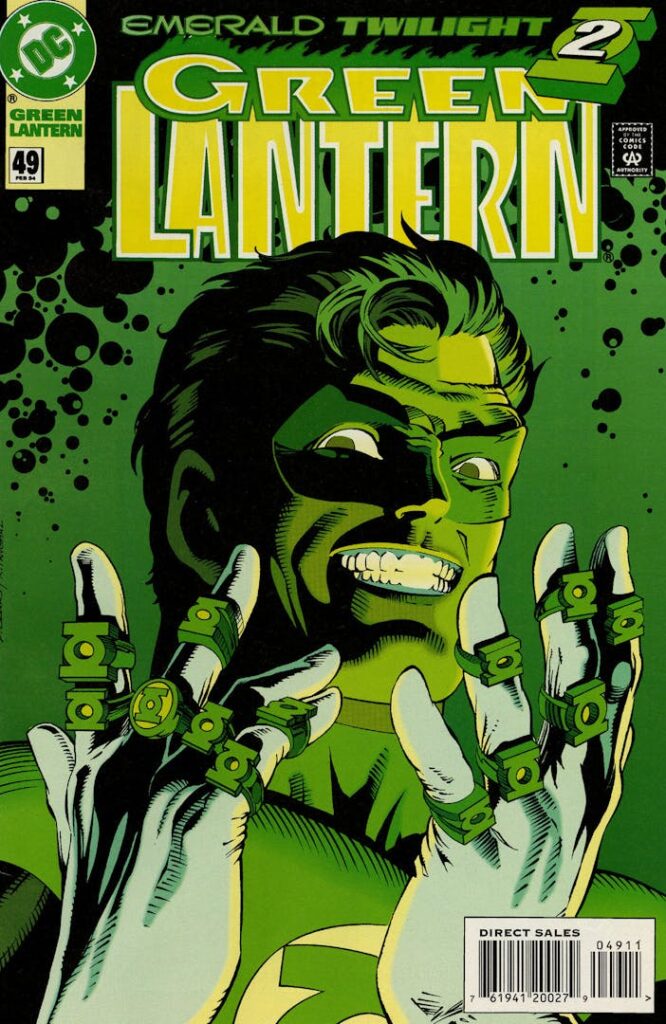
Green Lantern #49 is officially our Comic Book Cover of the Day, providing a pensive and visceral intensity that forever altered the vibrant hierarchy of the DC Multiverse. Published in early 1994, this issue serves as the penultimate chapter of the “Emerald Twilight” saga—a story that dismantled thirty years of Silver Age heroism to make way for a grittier, unpredictable era. For fans who want to see the foundations of Hal Jordan’s descent into madness, this cover is a definitive portal into a spectacle of absolute power.
The creative engine and authority behind this industry-shaking milestone includes:
- The Architect: Ron Marz (Silver Surfer, Witchblade)
- The Artist: Bill Willingham (Fables)
- The Cover Master: Darryl Banks (Green Lantern)
- The Publisher: DC Comics
The history of Green Lantern #49 is rooted in the pensive aftermath of the “Death of Superman” event. Following the total destruction of Coast City by Mongul and the Cyborg Superman, Hal Jordan suffered a complete psychological breakdown. Consequently, the transition from a hero of the vanguard to a grief-stricken renegade created a spectacular vacuum in the Corps’ security hierarchy. As we track new comics legacies today, this issue remains a pensive reminder of how high-stakes editorial decisions can redefine a brand’s authority.
The Rampage to Oa in Green Lantern #49
What readers should prepare for in Green Lantern #49 is a narrative that finds its heart in the professional vacuum of the Green Lantern Corps. Enraged by the Guardians’ refusal to let him use his ring to resurrect Coast City, Hal Jordan abandons his oath and begins a pensive march toward the center of the universe. Along the way, he systematically defeats his fellow Lanterns—including Boodikka and Jack T. Chance—taking their power rings for himself. This intelligence-heavy approach to tactical combat shows a Hal Jordan who is more dangerous than any villain he ever fought.
The pacing of the issue allows for a deep dive into the psychological toll of Hal’s betrayal. We see him discarding the foundations of his identity with every ring he adds to his hand. Transitioning from the quiet, spiritual realization of his failure to the high-intensity confrontation with the remaining Corps members, the script maintains a hierarchy of suspense that is “completely off the charts.” As critics have noted, the event succeeded because it didn’t just break the character; it “broke the bad idea” of a hero who could never fail.
The Visual Authority of Darryl Banks and the 90s Aesthetic
Visually, Green Lantern #49 is a spectacular achievement for Darryl Banks. The main cover—featuring a pensive and terrifying Hal Jordan glowing with the emerald energy of multiple rings—has become one of the most significant images of the 90s. Rendering a hero who is literally being consumed by his own extraordinary power required a level of artistic authority that Banks delivered with visceral flair. For fans who track comic book covers for their storytelling clues, this art perfectly sets the tone for the “unwrapped” and raw reality of Hal’s fall.
Furthermore, the volume utilizes the unique strengths of the “Emerald Twilight” arc to explore how power can corrupt even the purest intention. The interaction between Hal and the Guardians provides a rhythmic tension that carries the reader through the 32-page journey. As the “corpse of the Corps” begins to pile up, the reader is treated to a study on resilience and the cost of maintaining one’s agency in the face of cosmic catastrophe. Whether you are following the tactical movements of the emerald rays or simply soaking in the spectacular 90s logo work by Kez Wilson, this issue is a mandatory addition to your collection.
The legacy of this issue is absolute. It led directly to the birth of Parallax in issue #50 and the introduction of Kyle Rayner, the “Torch-Bearer.” It is a mathematical certainty that without the volatility of this 1994 era, the modern Green Lantern mythos would look significantly different. Transitioning from a state of controlled mission to one of total chaos, the issue stands as a masterclass in superhero deconstruction.
In conclusion, Green Lantern #49 is an essential pillar of DC history. From its debut as a pensive character study to its status as a cornerstone of the Ron Marz era, it reflects the power of an original voice that can reshape an entire universe. Whether the “Green Scar” is haunting the mind of Kyle Rayner or leading a charge for the Sinestro Corps, his darkest hour began right here. Don’t miss this portal into the “Emerald Twilight” when you revisit the classics this week!
📢 Join the Conversation
Was breaking Hal Jordan a necessary move for the Green Lantern franchise, or was it a “bad idea” that went too far? Which of Hal’s emerald ring constructions in this issue was your favorite? Join the conversation on X and tag us @comicbookaddt to share your thoughts on the fall of the legend!
Follow our community for more updates:








 English (US) ·