
Brian Nicholson | March 4, 2026
A mea culpa is in order. A few years ago I reviewed the previous book in the Hobtown Mystery Stories series; positively, but in retrospect not effusively enough. The Cursed Hermit was the second book in the series. It is a fair expectation on the part of the authors that most readers would have read the first installment, The Case Of The Missing Men, before undertaking the follow-ups. I had not. If you watched broadcast television in the pre-streaming era, you are familiar with the sensation of coming in after a story has begun and getting what you can out of it. This is also how serial comics worked, prior to trade paperbacks. It is my inclination to believe you can tell whether or not something is worthwhile even if you enter into it late. Still, it is not surprising that, as stories deepen with the more knowledge of the characters therein, subsequent volumes are better if read with knowledge of what preceded them. When I endorse this third book, The Secret Of The Saucer, I am recommending reading the prior volumes to get caught up beforehand in the same breath.
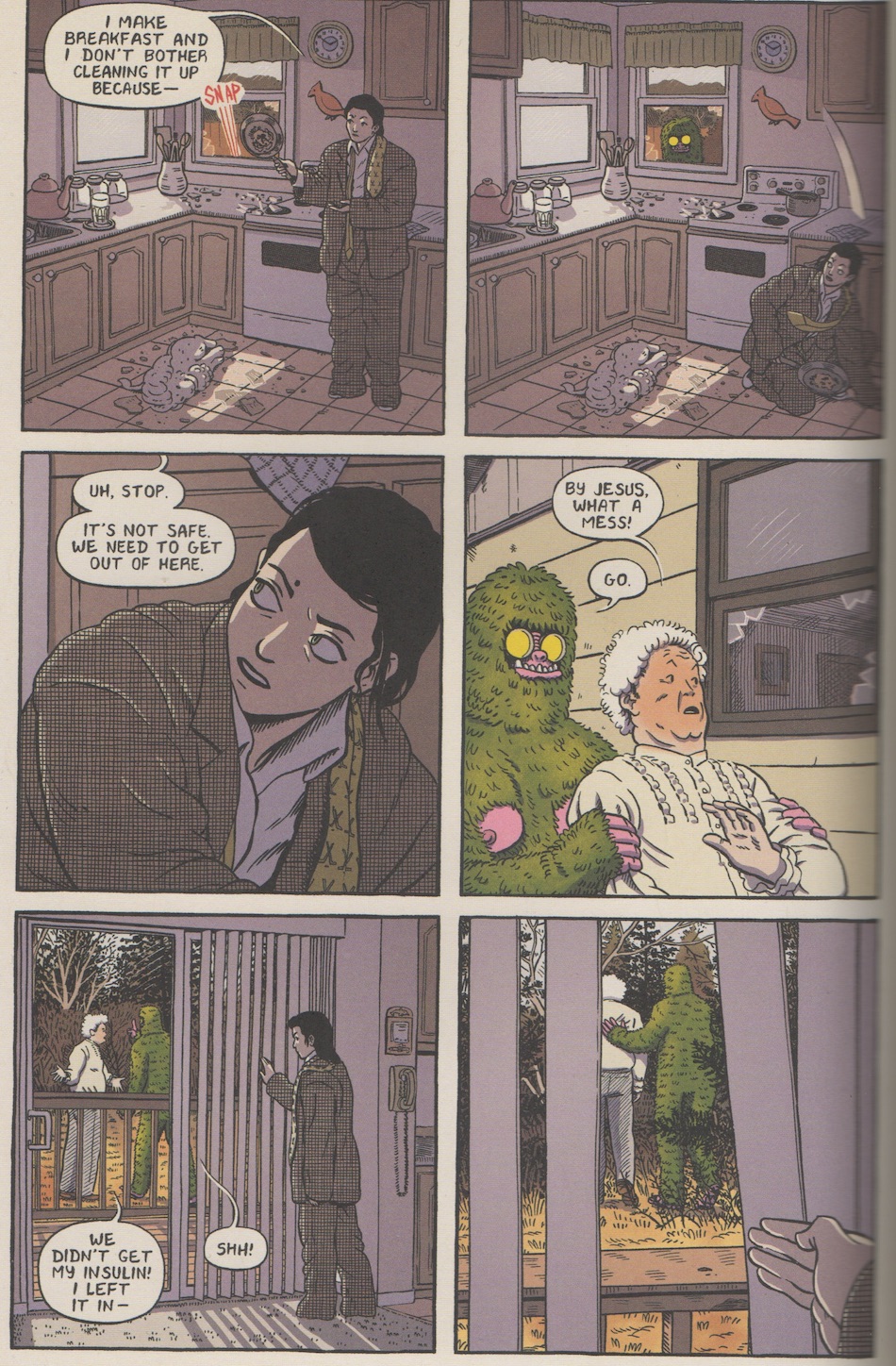
Previously, I described Alexander Forbes’ art as clip-art-like, which is easily understood as a diss, suggestive of a cut-and-paste reuse of panels which is not at all what he does, or could even attempt, given the rigor of Kris Bertin’s scripts. Rather, the density of the scripts necessitates varying degrees of detail across disparate elements. The act of bringing these aspects into solid compositions often suggests a feeling of being collaged together in Forbes’ hands, with the facial expressions in The Cursed Hermit one of the more simplified elements in any particular panel, because the faces need to be recognizable amongst the strangeness meant to read as incomprehensible upon initial encounter. Reduced in size for print, the pages feel that much more schematic and assembled than free-flowing and gestural.
Since 2019’s release of The Cursed Hermit, among all the other things that happened in the world, you might have missed that the Hobtown series has been picked up by Oni Press from the smaller Conundrum, and have added color to their subsequent reprints. I have those first books in black and white, and think that’s an ideal presentation for the work, but the layer of color provided by Jason Fischer-Kouhi certainly lends the underlying line art a greater degree of cohesion, even if I hate the addition of superfluous shadows on so many things that I wish were just colored flat. The series is also printed larger now, closer to standard comics size than the paperback book presentation of Conundrum, which emphasized the idea of the books as being a take on the children’s adventure format of Nancy Drew or The Hardy Boys. It is partially due to this presentational choice that led to me reading volume two in isolation — my reading of Hardy Boys Mysteries as a kid was always catch as catch can. The new presentation of the covers, in skewing away from homage, emphasizes the world of Hobtown as its own thing, and clarifies you should start the series with the volume with a big number one on the cover.
Volume three invites reappraisals, commencing with “The End” appearing right after the title page, as the book runs its chapters in the reverse of the story’s chronology, to echo a disorientation of time and language that occurs in-story as a result of an alien encounter. I will not be retracting my comparison of the series to David Lynch’s best-known work; this reversible structure posits “What if Memento was an episode of Twin Peaks?” and gets readers that much closer to Homer Simpson’s reaction of “Brilliant! I have absolutely no idea what’s going on.” The book gains some clarity when read from back-to-front, but this should only be done after an initial reading of the book in the form it is presented. There is something immensely pleasurable about reading the book sequenced one way and then another, although this would not be the case were the book not dense and multilayered but also a lot of fun in the first place. Twin Peaks is absolutely the obvious comparison, but to use a reference point the authors are possibly unfamiliar with, the goofiness of the teenage characters feels less like Lynch than it does the films of Nobuhiko Obayashi, he of Hausu and the feature film adaptation of The Drifting Classroom. The weird chronology here could be compared to his 1983 The Girl Who Leapt Through Time, the confrontation with forces outside the scope of the knowable familiar to fans of 1981’s School In The Crosshairs.
Read in one order, the story ends on an unsettling moment. Read in another, it merely begins on one. Either way you read it, the opening and the closing of the book reassert a status quo to affirm the core of the book is the friendships between characters. There is an earnestness to this series in the sense of affection these characters feel for each other which provides a degree of coziness to contrast the otherworldly strangeness of the dangers presented, and keeps it grounded in something human. Some horror feels like a series of provocations in the name of harshness that lead to me finding it tedious. Hobtown feels scarier than more austere horror might, because it is continually inviting the reader in, and while we get enough of an explanation to understand the basics of what’s going on, things are never so over-explained as to remove mystery. Any crazy-board diagram of the goings-on will have multiple arrows pointing to a series of question marks.
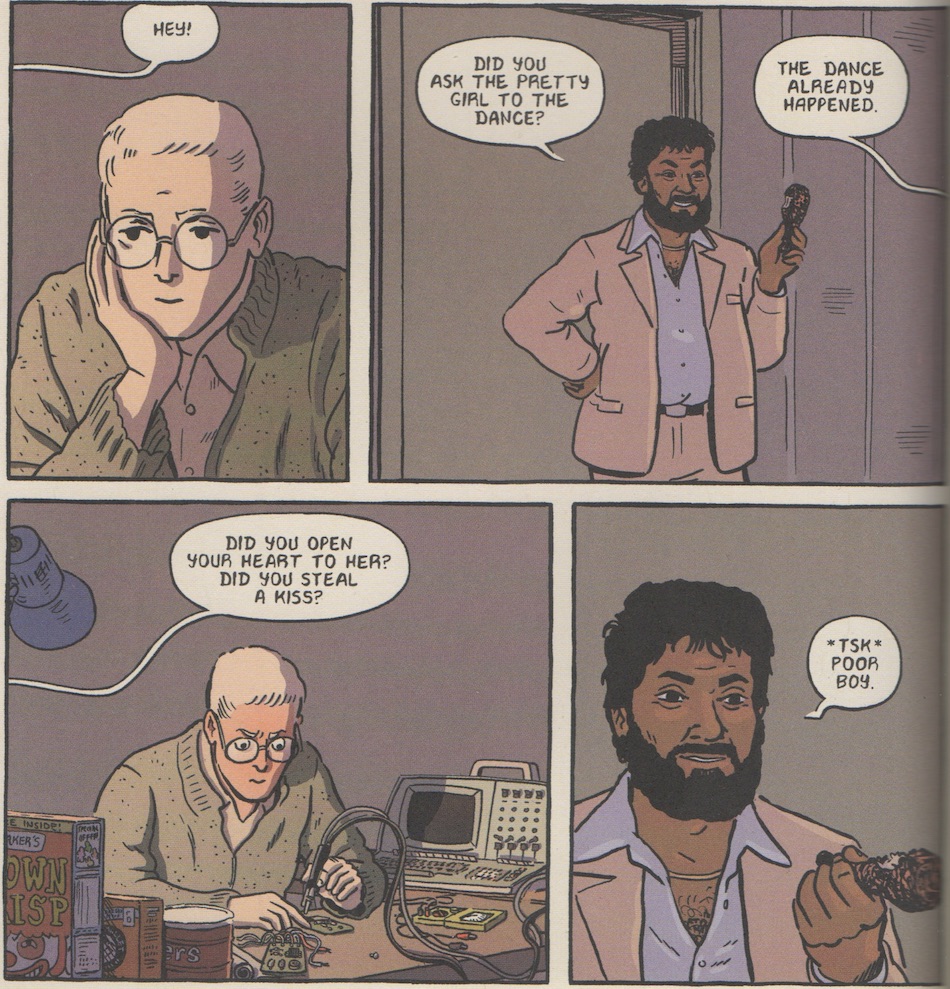
Things are not schematic in Hobtown. This is part of what makes the earnestness of the characters so emotionally involving. Many stories with young protagonists present romantic relationships between characters as being of such importance that a fantasy of romance seeps into the groundwater of the worldview presented, suggesting a sense of fate and cosmic importance to who young characters want to smooch, simplifying how many variables enter into a healthy human lifespan. The gestures towards romance in the Hobtown series are fumbling and tentative, exploratory attempts at finding out what works for the characters and their feelings. This is suited to their youth, but it is also in keeping with the nature of existing in the fog of the unknowable they occupy as investigators of mysteries.
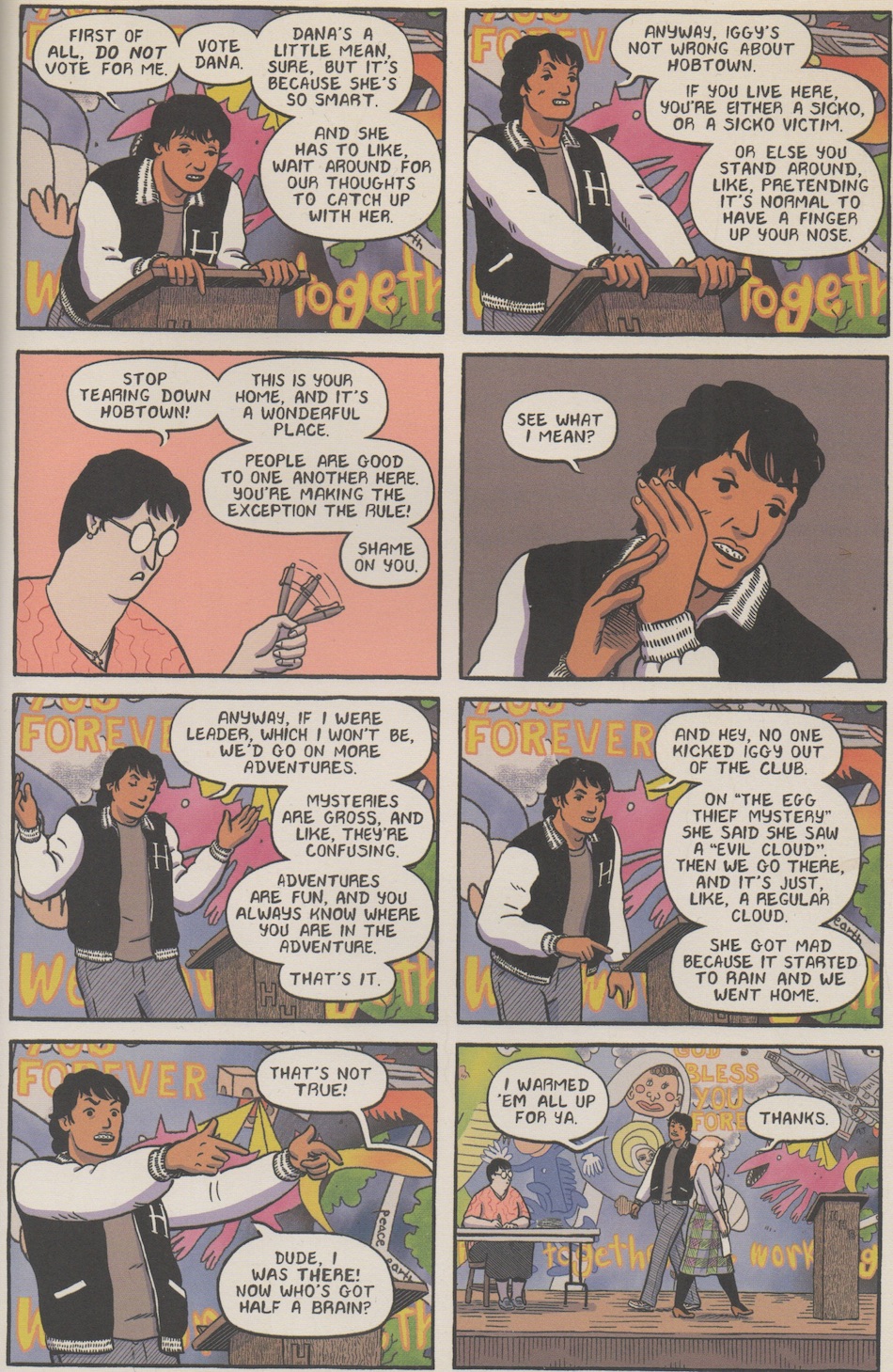
In her skepticism about aliens, main character Dana Nance is not quite our Dana Scully. Hobtown’s Nova Scotia setting is on the opposite side of the country than The X-Files' Vancouver shooting location. As the title suggests, there is a flying saucer in volume three, and while its secret is revealed by the end of the book, larger questions of alien existence are unanswered. One of Dana’s rivals is Iggy — rival for club leadership, as well as potential romance — who enthusiastically cites Fox Mulder as a role model, a concise way of grounding the story in a particular mid-nineties time period. Dana clarifies that UFO means “unidentified flying object,” and that things flying through the air that can’t be identified are, by definition, UFOs, and that using such terminology doesn’t necessarily attribute alien origin to them. Introduced in volume one smoking a pipe, the sort of affectation a teenager or her author might choose to indicate she’s a wise-beyond-her-years Sherlock Holmes figure, Dana in volume three acts more like a normal teenager, sharing cigarettes to bond with her friends.
Rereading THB recently reminded me of my ideal for comics storytelling and how many contemporary comics, in prioritizing visual clarity, come up with pages that lack both visual interest and considerable story development. So many modern comics only dare themselves a quarter of the word count of Mort Weisinger’s 210-words-per-page-max limit, while likewise believing they need four times the panels to convey a single idea visually, resulting in reading experiences with plots too thin for my liking. Comics like THB and Hobtown keep it moving because they’ve got a lot of story to tell, and they work at a pace where as many character details are included as possible among a great number of plot points, with a few of the latter needing to be inferred. In privileging uncertainty of narrative details, what can be known — the personalities of characters — pops that much brighter. Character moments truly sing in this series. Denny, shirtless and dripping sweat practicing basketball by himself, is seen brandishing something pulled from a back-of-pants pocket, which is clarified a page later to be a two-pack of snack cakes, selected as a breakfast option. This is the sort of thing that makes a character that could be reduced to “dumb jock” likable and charming. He’s not trying to maximize his protein absorption!
We need these things, especially on that initial front-to-back read, as we try to understand what’s going on, so that the reading experience does not become merely a puzzle to solve. There is enough pure sensation to follow while you’re puzzling over meaning, not searching for clues, but finding moments that stick with you. There are a great many of these: Dana spaced out from an alien encounter, talking to the air in a fast-food restaurant, dropping her tray right in front of the garbage can. Two kids being confronted with the possibility of their death, held hostage for no reason they can even fathom. The shotgun blast which from a reader’s perspective serves as a deliverance of justice, but in-story is just retribution between enemies equally stupid.
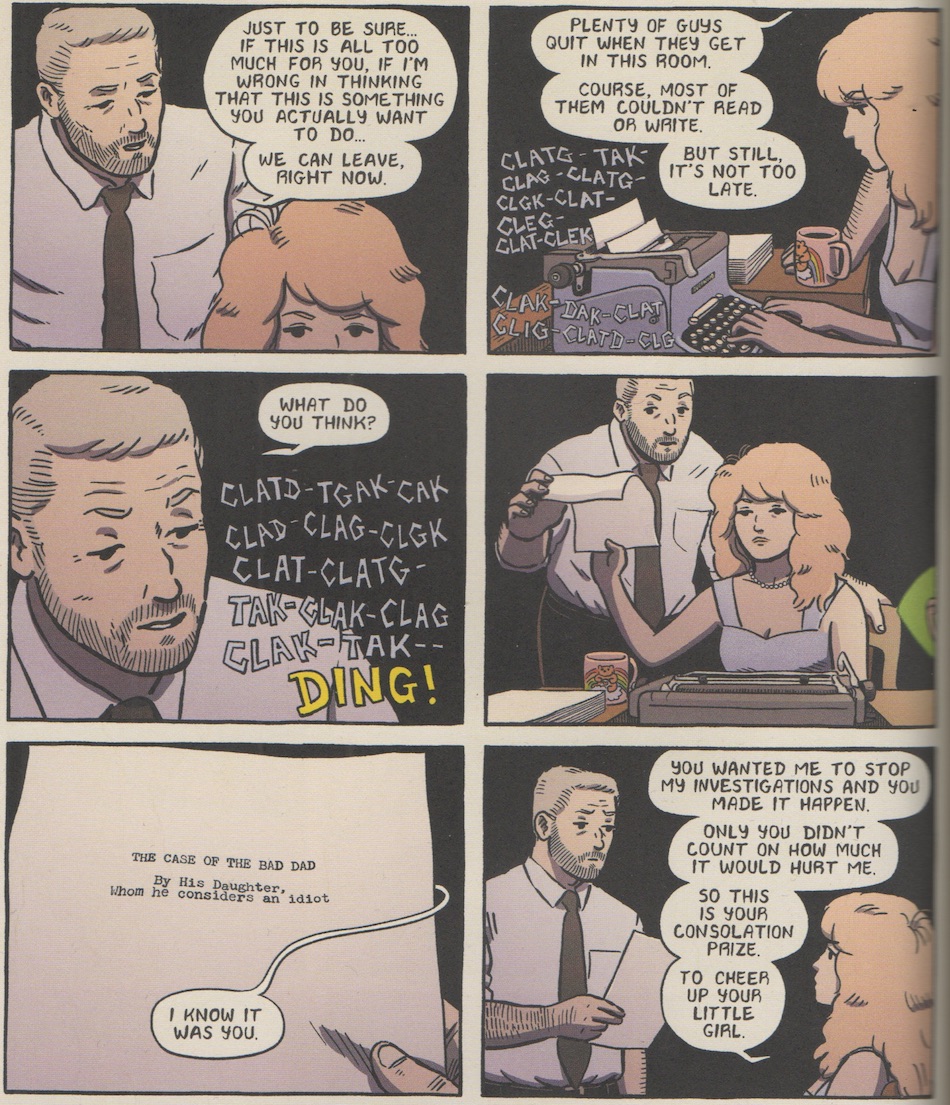
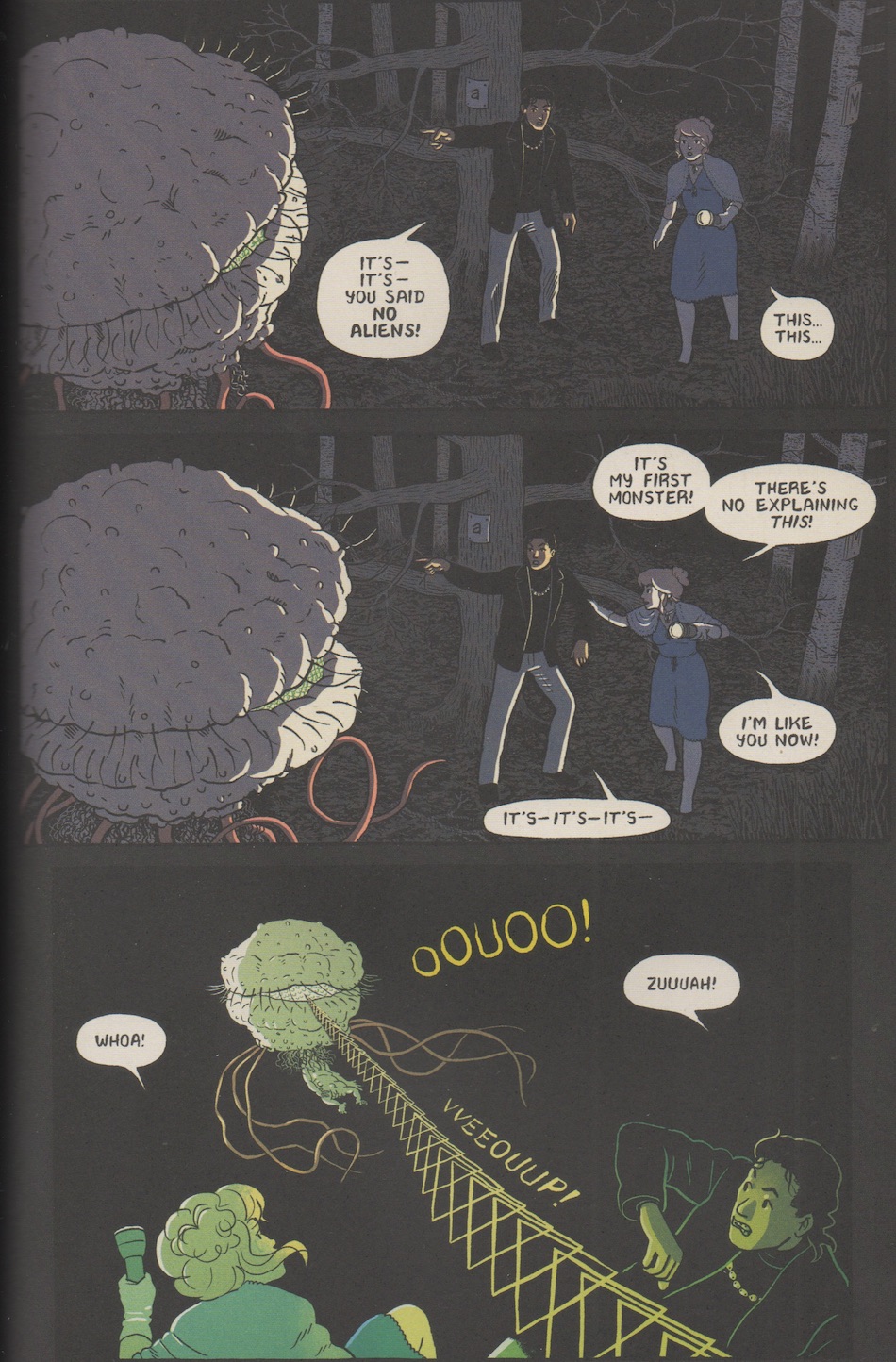
What gets sorted out, after you’ve read the whole thing, is that the mysteries in Hobtown are conspiratorial, which means they are also those of friendships and affinity groups: secret societies, detective clubs, private jokes. Our heroes are the version of this we see in a positive light; their opposite numbers are investigated. We see people moving through these spaces: Two people role-playing their way through a UFO encounter support group in hopes of gaining information, allowing the script to offer a sudden unexpected moment, a monologue explaining the impact of horror on those who live through it. The series does not shy away from capital-h Horror — true face-to-face encounters that you can only scream in reaction to, because it's so outside your own understanding of the world. When such an experience does not result in death, life goes on; and the horror then becomes more insidious when one has to coexist alongside such things, and so inoculate oneself to it, befriend it in a spirit of conspiracy. The world grows in its shape from this sense that anything can have a black shadow hidden behind it, and this, which Forbes’ approach to the art continually suggests, is one of the reasons the series gets bigger and deeper the more of it you read. That the structure of The Secret Of The Saucer effectively doubles its own size, twice as large on the inside than it appears on the outside, only underlines the richness of the meal of the book, the stickiness it gains as you chew it over, the heft of the gunk accumulating in your throat.








 English (US) ·