
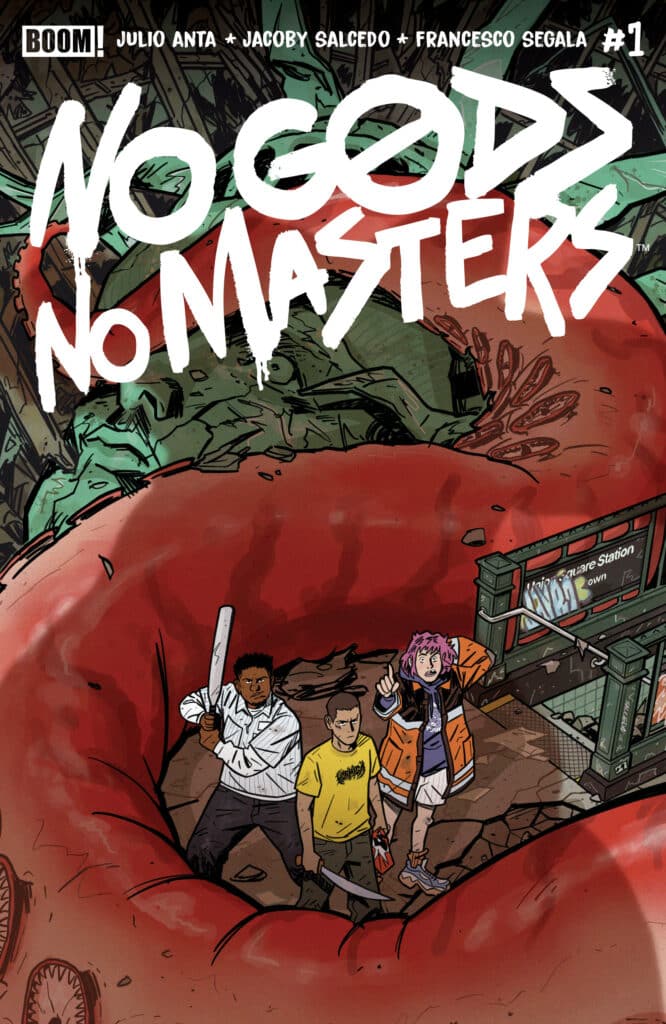
No Gods, No Masters #1 does exactly what a strong debut issue should do: it grabs readers with a massive high-concept hook, then makes sure the people running from the monster matter more than the monster itself.
From writer Julio Anta, artist Jacoby Salcedo, and colorist Francesco Segala, this new BOOM! Studios debut takes the familiar kaiju disaster setup and shifts the emotional center away from military response, city-smashing spectacle, or monster mythology. Instead, the issue focuses on three New York City teenagers caught in the middle of an impossible catastrophe.
That is the move that makes this first issue work.
The premise is immediate: afternoon detention is interrupted when a kaiju erupts into New York City. Three students with very different lives are forced together as the city begins falling apart around them. At the center is Felipe, a Venezuelan teen still adjusting to life in New York. When the disaster hits Manhattan, Felipe’s first concern is not the monster, the news, or the larger apocalypse. It is his mom, who may be trapped underground in a damaged subway station.
That emotional priority gives No Gods, No Masters #1 a real pulse.
Readers looking for more BOOM! Studios coverage can check out our BOOM! Studios section, while fans tracking the series announcement can also visit the League of Comic Geeks news post for additional release context.
A Kaiju Story That Starts With Kids, Not the Creature
The smartest thing about No Gods, No Masters #1 is that it does not begin by asking readers to care about the monster. It asks readers to care about Felipe.
The issue opens with chaos already underway, then pulls back to show the emotional and social pressure that existed before the skyline cracked open. Felipe is not just “the kid in the yellow shirt.” He is a young person carrying economic pressure, family responsibility, migration trauma, school conflict, and the constant feeling that one bad day can undo everything.
That is heavy material, but the issue does not turn into a lecture. Anta lets the details build naturally through conversation and conflict. Felipe’s seized e-bike is not just a plot detail. It represents work, money, independence, and his ability to help his mother. When that bike is taken from him, the loss feels personal because the book makes clear how much he sacrificed to get it.
This is where the issue separates itself from standard monster-apocalypse storytelling. A kaiju can level buildings, but Felipe’s life was already fragile before the creature arrived. That makes the disaster feel less like a random spectacle and more like another impossible weight placed on people already being crushed by systems bigger than themselves.
Felipe Is the Emotional Anchor
Felipe is easily the strongest part of this debut.
He is angry, guarded, exhausted, and scared, but the writing never reduces him to one emotion. He lashes out. He shuts down. He tries to explain himself. He feels embarrassed by how much he needs to keep going. He is under pressure at school, under pressure at home, and under pressure from a city that does not seem built to care whether he survives it.
That makes his response to the kaiju attack incredibly believable. When the monster hits, Felipe does not suddenly become a fearless action hero. He becomes a kid with one urgent thought: find his mother.
That motivation gives the issue forward momentum. The city may be collapsing, but the story’s real engine is intimate. Felipe’s mom sells candy on the subway, and when her location shows up near 14th Street, everything changes. The disaster stops being abstract. It becomes a rescue mission.
That kind of human-scale storytelling is what makes kaiju fiction powerful when it works. Giant monsters are terrifying because they make people feel small. No Gods, No Masters #1 understands that the best way to sell that terror is to keep the camera close to the people on the ground.
Malik and Jeanie Add the Right Friction
The supporting cast also works because the issue gives the teen trio immediate personality conflict.
Malik is not introduced as a generic classmate. He has his own pressures, including baseball, family expectations, and a scholarship opportunity. His world is different from Felipe’s, but the issue finds common ground through frustration, responsibility, and the feeling of being trapped by adult systems.
Their early conflict could have been written as simple bully-victim tension, but the story quickly complicates it. Malik is not a cartoon antagonist. Felipe is not simply innocent. Both boys are carrying stress into the same room, and neither one fully understands the other at first. That makes their eventual shift toward mutual respect feel earned.
Jeanie adds another strong dynamic. She comes into the detention space with sharp edges, a dry attitude, and enough emotional intelligence to see that the boys are being ridiculous before they do. Her situation with foster parents gives her a personal stake in survival too, even before the larger disaster begins.
Together, Felipe, Malik, and Jeanie feel like a strong YA survival trio because they are not instantly best friends. They are awkward, defensive, funny, scared, and forced into proximity at the worst possible time. That is much more interesting than a group that magically clicks from page one.
Jacoby Salcedo Makes the Chaos Feel Personal
Jacoby Salcedo’s art is a major reason this issue lands.
The visual storytelling is energetic without becoming messy. The school scenes feel grounded, full of small body-language details that reveal how uncomfortable everyone is before the monster even appears. Felipe’s posture, Malik’s frustration, Jeanie’s expressions, and the cramped feeling of the office and classroom spaces all help sell the emotional tension.
Then the kaiju action hits, and the book snaps into a different gear.
The monster designs are unsettling in a way that feels deliberately strange. These are not clean, iconic superhero-style creatures. They are jagged, grotesque, and hard to fully process at first glance. That works because the characters themselves do not understand what they are seeing. The creature is not presented like a cool collectible figure. It is presented like something wrong has entered the world.
The page where the book reveals the ruined cityscape under the huge title treatment is especially effective. It gives the story scale without losing its grimy, street-level energy. New York does not look like a clean disaster-movie postcard. It looks damaged, smoky, cracked, and dangerous.
That is exactly the right visual tone.
Francesco Segala’s Colors Keep the Book Moving
Francesco Segala’s colors give the issue a strong emotional rhythm.
The school scenes use grounded tones that make the environment feel familiar and lived-in. Then, when danger erupts, the palette sharpens. Reds, oranges, sickly greens, and dusty urban colors help create a sense of impact and panic.
The flashback material involving Felipe’s journey is especially strong because the colors shift the emotional temperature. Those sequences feel more fragile and haunted, separating Felipe’s past from the immediate present without making it feel disconnected. The book is constantly moving between personal trauma and public catastrophe, and the colors help keep those layers readable.
When the monster chaos arrives, the colors amplify the violence without making the page unreadable. That balance matters. A kaiju comic needs scale, but a survival comic needs clarity. This issue has both.
The Story Has Teeth
What makes No Gods, No Masters #1 stand out is that it has something to say.
This is not just “kids run from a monster.” The issue is clearly interested in migration, policing, poverty, labor exploitation, school discipline, foster care, public infrastructure, and how disasters expose the cracks already present in society.
That may sound like a lot, but the issue does not dump those themes onto the reader all at once. They emerge through character details. Felipe’s delivery work matters. His e-bike matters. His mom’s job on the subway matters. Malik’s scholarship matters. Jeanie’s foster situation matters. The school staff trying to manage these kids matters. The news coverage of New York’s attack matters because it links the kaiju disaster to an earlier catastrophe in Venezuela and the migration that followed.
That connection gives the title its bite.
The phrase No Gods, No Masters feels bigger than a slogan here. It points toward a world where young people are forced to survive institutions, monsters, and adults who either cannot help or will not help fast enough. The kaiju may be the loudest threat, but the book keeps reminding readers that power comes in many forms.
Some forms wear uniforms. Some sit behind desks. Some appear on TV. Some rise out of the river.
A Strong First Issue With a Killer Final Push
As a debut, this issue is well-structured. It introduces the cast, establishes the social stakes, detonates the disaster, and ends by pushing the trio into motion.
The final section turns the book into a true survival story. With subway passengers trapped, bodies buried, the power grid damaged, and the city in panic, Felipe’s race to find his mother becomes the emotional spine of the next chapter. By the end, the kids are not waiting for rescue. They are moving toward danger because the person Felipe loves most may be underneath it.
That is a strong hook.
It also makes the issue feel urgent without needing to overexplain the larger mythology. We do not need to know everything about the monsters yet. We just need to know that another one has appeared, New York is not ready, and these kids are now caught inside a disaster that adults barely understand.
Final Verdict
No Gods, No Masters #1 is an excellent debut because it understands that kaiju stories are strongest when the destruction means something. Julio Anta gives the issue emotional weight, Jacoby Salcedo delivers grounded character work and explosive monster chaos, and Francesco Segala’s colors help the book move between school drama, street-level survival, and apocalyptic terror.
This is not just a monster book. It is a story about young people trying to survive systems that already made life hard before the monster showed up.
The result is tense, emotional, socially sharp, and genuinely exciting. If this first issue is any indication, No Gods, No Masters could become one of BOOM! Studios’ most interesting new genre launches.
Review Score: 9/10
Book Details
Title: No Gods, No Masters #1
Publisher: BOOM! Studios
Writer: Julio Anta
Artist: Jacoby Salcedo
Colorist: Francesco Segala
Issue: #1
Genre: Kaiju, Survival, Teen Drama, Science Fiction
Format: Single Issue Comic
Main Characters Introduced: Felipe, Malik, Jeanie
Premise: Three New York City teenagers are forced together when a kaiju attack turns detention into a fight for survival.
Why You Should Pick This Up
Pick up No Gods, No Masters #1 if you want:
A kaiju comic with real emotional stakes
A survival story centered on teenagers instead of soldiers
A New York disaster story with social bite
A debut issue that balances character drama and monster chaos
A new BOOM! Studios series with strong long-term potential
Join the Conversation
Stay connected with Comic Book Addicts for more comic reviews, previews, release news, creator updates, and collector-focused coverage.
Website: https://comicbookaddicts.com/
New Comics: https://comicbookaddicts.com/new-comics/
Instagram: https://www.instagram.com/comicbookaddicts/
Facebook: https://www.facebook.com/TheComicBookAddicts/
Tumblr: https://www.tumblr.com/blog/thecomicbookaddicts
Pinterest: https://www.pinterest.com/comicbookaddt







![UDON San Diego Comic-Con 2026 Exclusives [UPDATE July 16]](https://sdccblog.com/wp-content/uploads/2026/07/SDCC_2026_IncentiveCards.webp)


 English (US) ·