
Robert Newsome | April 30, 2026
Developing an understanding of professional wrestling is, I believe, essential to understanding the modern world. Whether or not you’re a fan of the sport — whether or not you even care about it — it has become one of the major keys to unlocking the weirdnesses and intricacies of 21st century America. It’s a bold assertion, I know, and I would probably say the same thing about baseball or basketball had I been raised since infancy as a baseball or a basketball fan, but I wasn’t. American society is overflowing with sports metaphors. For better or for worse, they’re a significant part of how we relate to and communicate with the world around us. I’m not sure how much I actually care about professional wrestling these days, but that doesn’t really matter. It’s a lens through which I see my world. There are other lenses, but this is one of the largest. I can’t do anything about it. My past made it that way, and the past is difficult to escape.
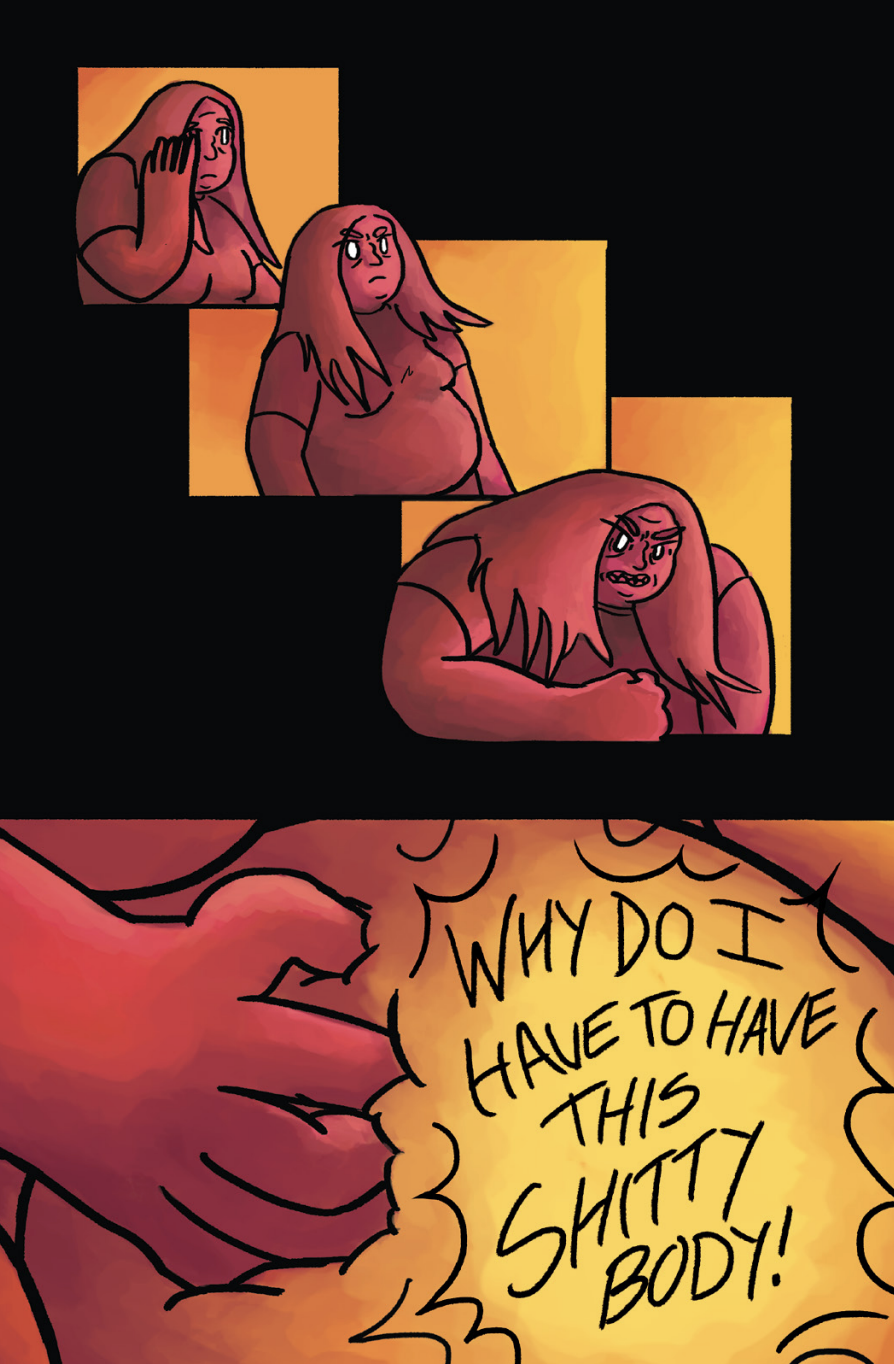
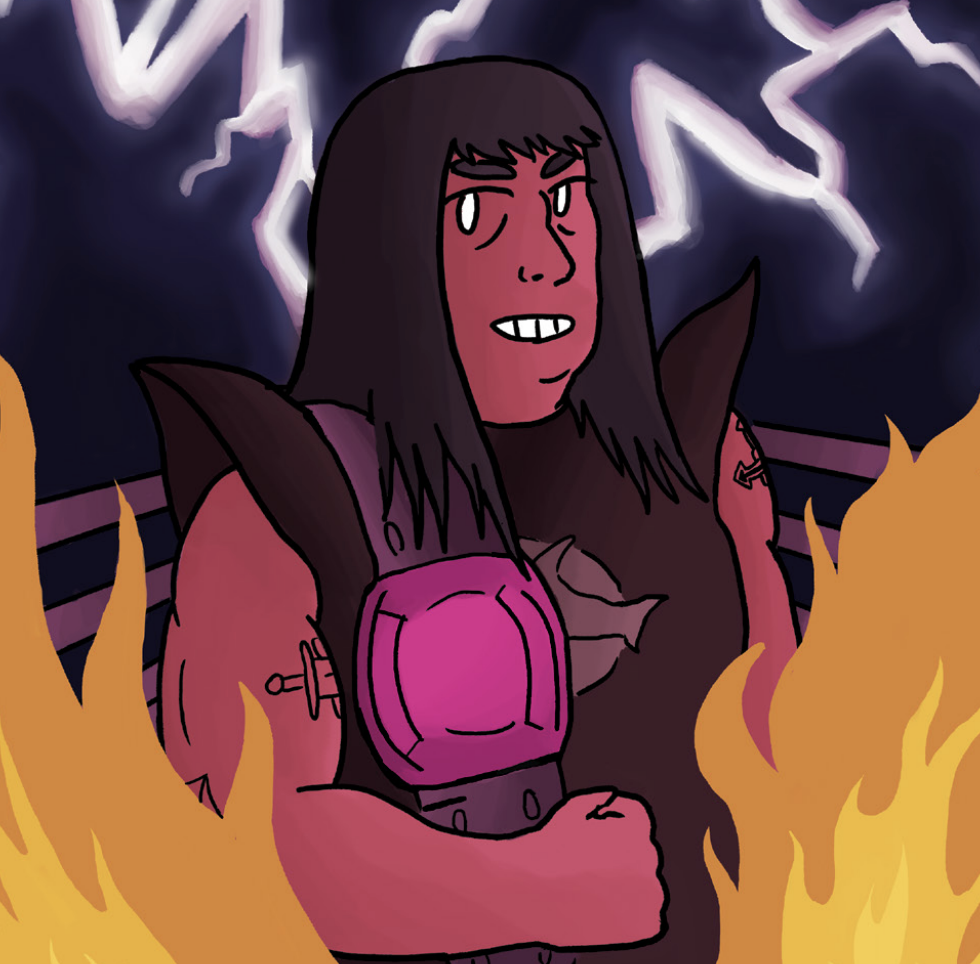 The past, and its impact on (and interference with) the present is a major theme in Bread Tarleton’s Soften the Blow. The book focuses on Audrey, a former professional wrestler who has left the business behind and is searching for a way forward while being haunted (and, at times, hunted) by her past, a condition that manifests through negative and intrusive thoughts and outbursts of rage. In the present, Audrey is alone, unfocused, out of wrestling and living in a small town trying to make sense of her life. Audrey’s past, like everyone's, is wrapped up in her present, and Audrey, a trans woman, is plagued with a negative self-image and intense body dysmorphia. Wrestling is a body-based business and its focus on the body comes from both the fans and the people running the show. It’s a real pressure cooker for anyone with pre-existing difficulties about their corporeal form, and Tarleton’s art creatively and deftly places this pressure and anxiety on the page.
Generally cartoony — at times reminiscent of slightly more polished early Hutch Owen-era Tom Hart — and pleasantly rough around the edges, Tarleton’s art shines in its depiction of internal struggles. It can be difficult to place things that can’t actually be seen on a comics page, but in Soften the Blow, Tarleton deftly depicts the past’s lurking trauma, dysmorphia’s gnawing agony, and, in an incredibly emotionally affecting ending, the transcendence of joy and acceptance. Generally, I prefer comics with gutters and grids, but Tarleton uses the layout of Soften the Blow’s pages as another tool to communicate the intangible. A shark (representing “Megalodon,” Audrey’s former in-ring persona) plows its way through a field, Audrey’s body undergoes physically impossible contortions, even the mundane act of a haircut is given an entire page, the time-lapse of the cut giving weight and heft to Audrey’s emotional state.
In Audrey, Tarleton has created a character that feels fully realized. Her past as a professional wrestler is shown, but not fully. Instead, Tarleton allows the reader to fill in the empty spaces, showing fallout from an in-ring incident (and other less explicit factors) that led to Audrey’s exit from the business, but not focusing on that period of her life. Instead, Audrey has to deal with Megalodon as a presence in her current life, occasionally looking in the mirror to see the dead eyes of a shark staring back at her, sometimes finding herself in danger of being consumed by the razor tooth-lined jaws of her past self. Additionally, Audrey is haunted by another version of herself, one who chastises her for not following the rules of maintaining Audrey’s physical being, who lashes out at her for any perceived lapse in an unobtainable ideal state of existence.
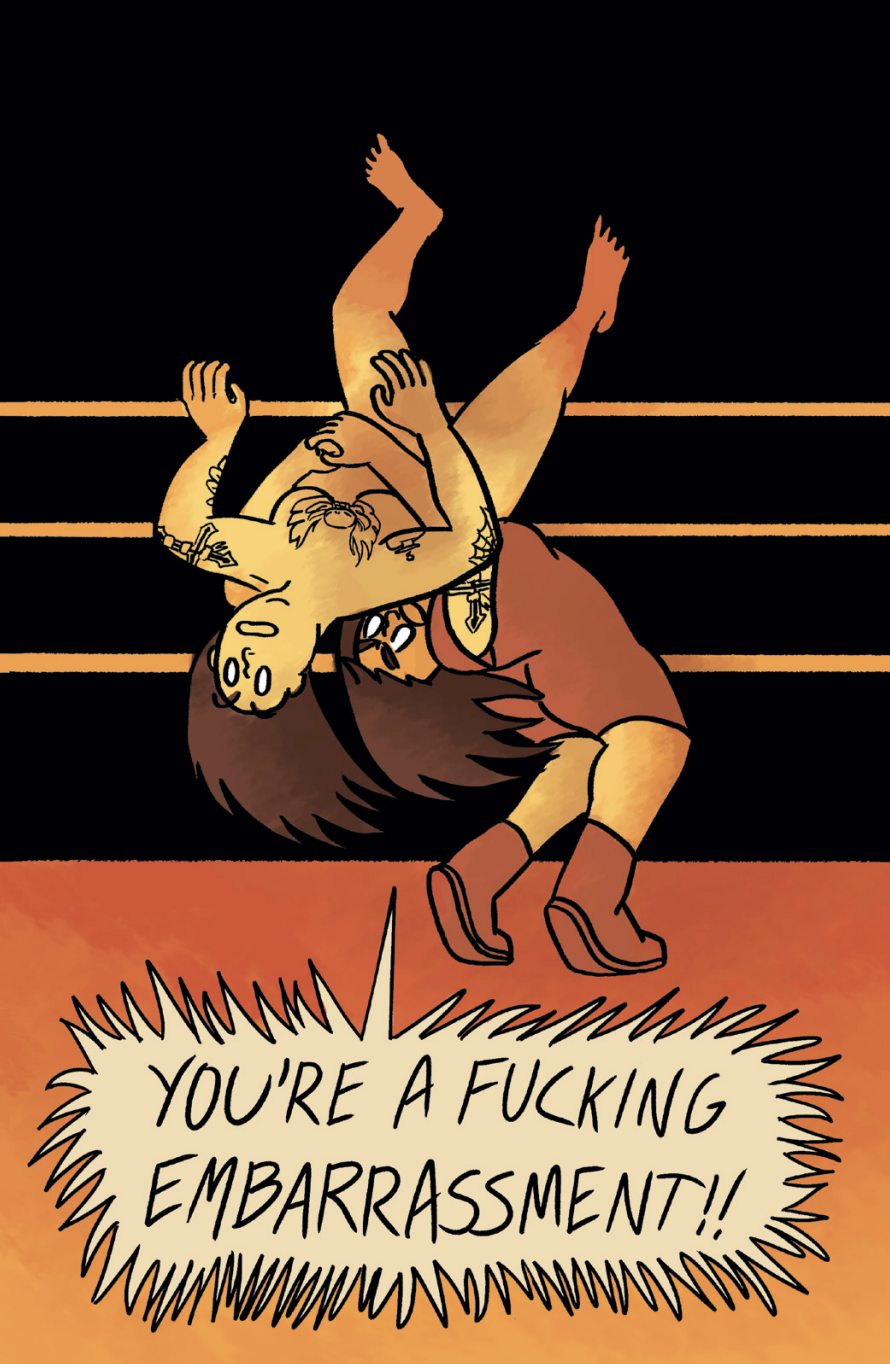
This separation of the self is one that is at the heart of understanding Audrey, and why it’s important to the story that Audrey is a wrestler. Professional wrestling relies on an augmented and heightened reality. The people you see in the ring aren’t themselves. Wrestlers separate themselves from their characters, though the thickness and strength of this separating boundary varies for each performer. Think, for example, of what is likely the most well known popular example of this phenomenon, the 2013 Bollea v. Gawker Media trial. In this trial, a key distinction was made between the person of Terry Bollea and the character of Hulk Hogan, even though both were the same person. We all know that Michael B. Jordan isn’t a set of vampire fighting twins, or that Scarlett Johansson isn’t a superhero spy, even though we’ve seen them presented as those things. The line between a wrestler and their in ring character, though, is hazier and more malleable. I can say, for example, that I have absolutely met Ric Flair, but I don’t think I’ll ever get to meet Richard Morgan Fliehr.
We don’t spend too much time with Megalodon, but we do get to know Audrey, and she’s a likable person, someone you want to see happy and whose setbacks and self-sabotaging behaviors are genuinely disappointing. Audrey’s existence as a trans woman deepens the layers of self-idealization, self-deprecation, and identity in Soften the Blow and opens a larger conversation in terms of how her transness relates to her presentation of herself to the world around her and to herself. The reader watches as Audrey wrestles (if you’ll excuse the use of that verb here) with the concepts of identity and authenticity creating the aforementioned rules for herself and then punishing herself for any perceived failure. We also see Audrey’s struggles with alcohol use and abuse and how that struggle is woven into the traumas of Audrey’s past and their manifestation in Audrey’s present.
Despite the heavy and potentially grim nature of the issues at the core of Soften the Blow, Audrey’s story is ultimately one of hope and of joy. Fans of wrestling know this arc well. There’s a wrestler. You love them. They offer something, whatever it is, that you can identify with. Maybe you can see a little of yourself in them. Maybe you just like their moves. Whatever it is, they’re “yours.” Sooner or later, they’re probably going to get locked into a pattern of loss. They lose their belt, maybe they lose their hair, maybe they lose their mask. They just can’t seem to get a break. They take loss after loss, some humiliating, some close calls, maybe even some as the result of nefarious actions on the part of their opponent. The deck, it seems, is stacked against them.
But the fans never leave them. Little by little, light starts to creep into the darkness. Small victories accumulate. “Your” wrestler, eyes fixed firmly on a goal — it doesn’t matter what it is; a championship, redemption, respect — starts to climb out of the pit they dug for themselves (even though you know they didn’t do all the digging alone). The victories mount. Sure, there are setbacks along the way, but the trajectory is upward. Finally, the big victory comes and for those who have watched the journey, it’s triumphant, overwhelming, a welcome catharsis. Sure, there might be setbacks or struggles in the future, but maybe it’s worth it for that one bright moment of joy. This is the structure of the journey that Tarleton gives Audrey and it’s one well worth taking, one that leaves me with hope that we’ll see Audrey again in or out of the ring.






 English (US) ·