
Zack Davisson | April 30, 2026
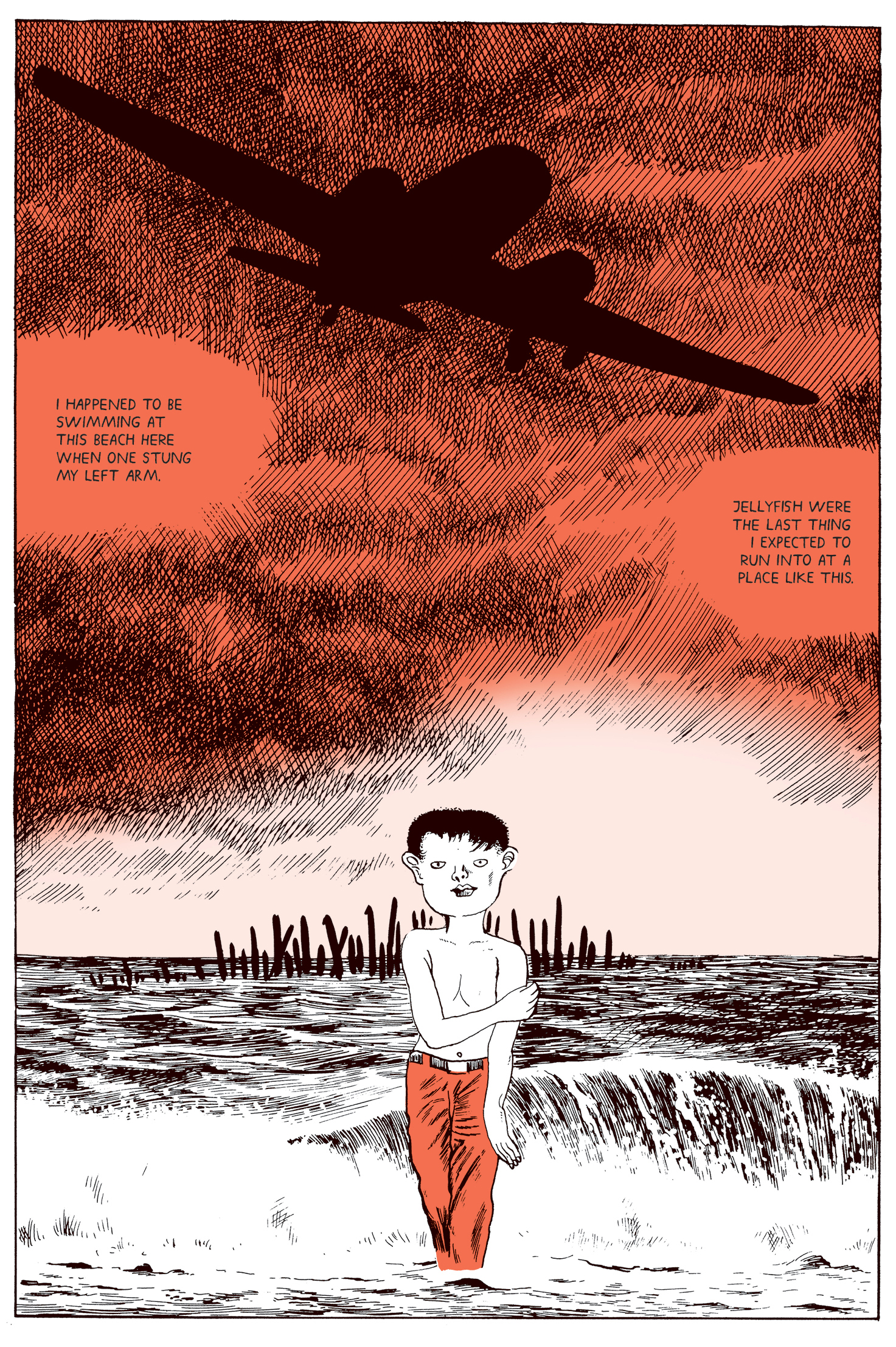 Opening page from "Nejishiki," as collected in the eponymous volume by Drawn and Quarterly. All English translations here are by Ryan Holmberg unless otherwise specified.
I had a conversation the other day about “manga style.” They insisted that there was an identifiable, imitable art style from Japan that could be replicated for other audiences. I said Japan’s legacy of artists did not have a uniform style. As Exhibit A, I offered the work of Yoshiharu Tsuge.
A young boy steps from the ocean, holding his arm. A military plane soars over his head. Remnants of fortifications stand silently in the background. A jellyfish has pierced the boy’s arm, severing an artery. Wandering through town, the boy seeks a doctor, but the bizarre town and its folk offer no solace. There are dozens of optometrists but no surgeons. Boarding a train driven by a man in a cat mask, the boy finds a gynecologist. After sleeping with her, the gynecologist installs a screw valve on his severed artery. Saved, the boy sails off in a motorboat.
Not exactly Shonen Jump, is it? Not exactly One Piece. Welcome to the world of Yoshiharu Tsuge. A unique and uncompromising artist, Tsuge offered nothing to the world other than who he was. There were no compromises in his art. He had a unique vision and dedication to his craft. Sometimes to his detriment. Yoshiharu Tsuge took the world of manga and twisted it in the same way as his most famous work, Nejishiki (Screw Style).
Early Life
Yoshiharu Tsuge was born on Oct. 30, 1937, in their family boathouse on the Nakagawa River in Tateishi, Katsushika Ward, Tokyo. Born into relative luxury, he was the second son of Ichiro, the head chef working at the luxury Chiyoya Ryokan in Izu Oshima, the largest of the Izu islands off the coast of Tokyo. Chiyoya was the most prestigious inn in Motomachi. They served the imperial family and government officials as well as prominent artists who always stayed there when they visited the island. One day his mother Masu suddenly went into labor, and Ichiro had to deliver his son before the midwife could arrive. Masu stopped breathing, and unsure what to do Ichiro gave her artificial respiration and jiggled her legs until she recovered.
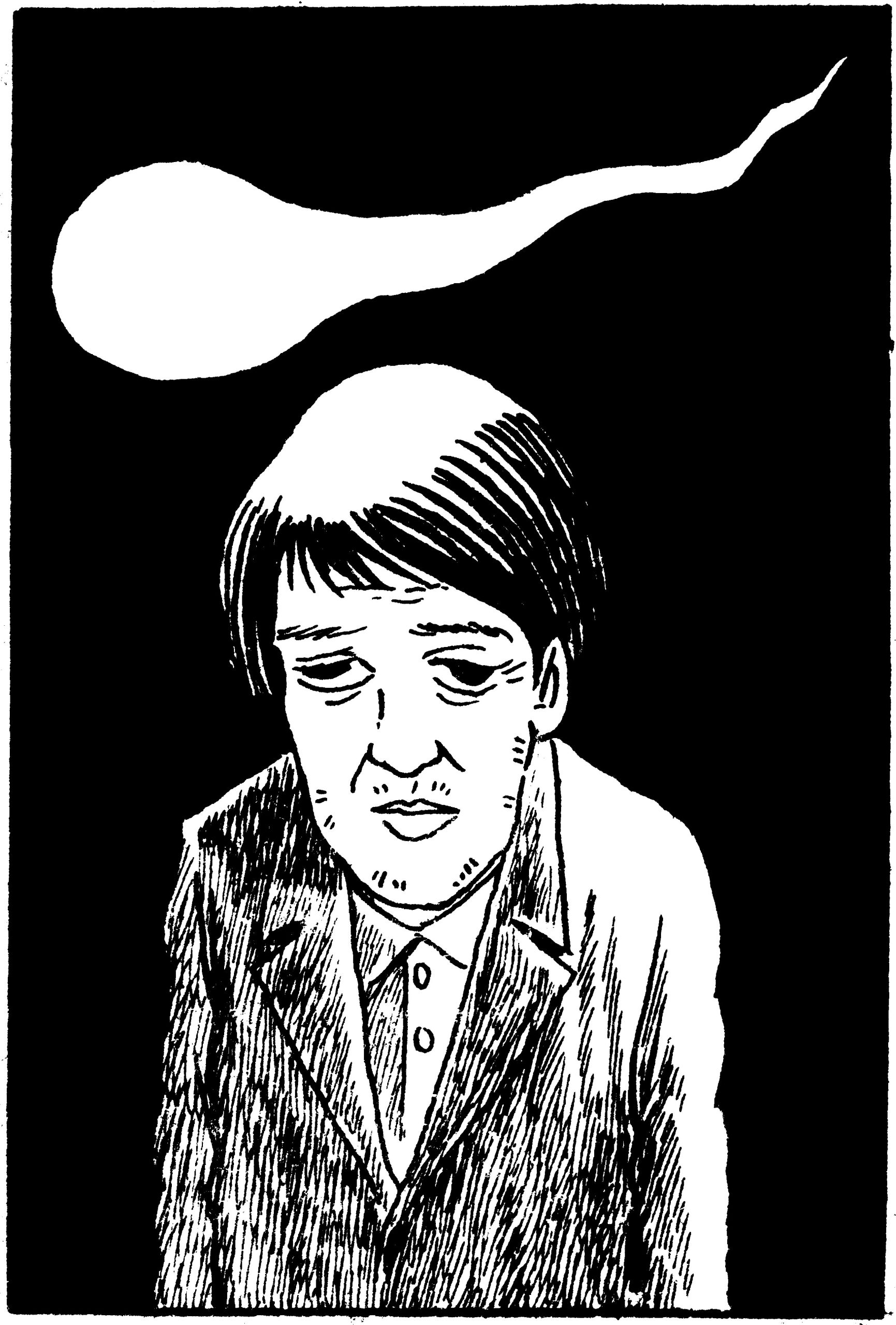 A Tsuge self-portrait.
Tsuge was delivered into a world of chaos. The aftershocks of the Great Depression continued to reverberate across the globe. Desperate for resources and wanting to see itself as a great world power, Japan used a minor skirmish on the Marco Polo Bridge in China as an excuse to launch a full-scale invasion. Battling Chiang Kai-Shek’s United Army, Japan marched relentlessly towards the capital of China, Nanjing. The atrocities that happened there would horrify the world for generations.
Tsuge knew a few years of peace before his world collapsed around him. He was five years old when his father died of Addison’s disease in 1942, leaving his mother to care for him and his two brothers. (One of his brothers, Tsuge Tadao, would also become an acclaimed manga artist.) This followed a drastic decline in circumstances. They went from a comfortable life to struggling as Masu took a job in a munitions factory. The family of four moved into a single room in company housing. Tsuge was six years old when the man who would become his employer, Shigeru Mizuki, was drafted and sent to fight in what would later be called World War II. He was eight when the war ended in 1945 and Japan surrendered.
Like most wartime children, Tsuge didn’t have much in terms of education. His timid and awkward personality made adapting to groups difficult. Air raids frequently closed school and Tsuge found himself praying for more of them, wishing for air raids every day. He once saw an antiaircraft gun shoot down a B-29, splitting it in two. It was, however, in elementary school that he first developed a love of drawing. Making art was a solitary activity where he could escape into his own world.
After the war, choices were driven by necessity. His mother remarried and had two daughters. Tsuge disliked his stepfather and lived in fear of his abusive treatment. As their family grew, Tsuge and his brothers ran a small store at the black market in front of Kaisei-Tateishi Station in Katsushika to contribute to the family finances. A nine-year old Tsuge would also accompany his mother into the forests to gather wood to sell. As soon as he graduated elementary school in 1950, he took a job in an electroplating factory. He was thirteen years old.
Post-war Japan affected Tsuge deeply. This world of rubble and dust would serve as the background for his art. Most of his work was set in the eight-year period spanning Japan’s defeat in the war in 1946 to 1954.
Suffering from anthropophobia (fear of people) and erythrophobia (fear of blushing) since early childhood, Tsuge felt ill at ease even within his own family circle. Dreading returning home to the now family of eight, he would spend long hours at the electroplating factory, working from dawn to dusk.
Desperate to escape his family, at fifteen he unsuccessfully tried to stowaway on a ship. He was discovered by the crew and spent the night at a police station. The following year, in 1952, Tsuge tried again, sneaking onto a steamship bound for New York. He had only a day’s worth of bread rolls and a bottle of juice. The crew discovered him off the coast of Nojimazaki and was transferred to a Japanese Coast Gard patrol boat that took him home. His dreams of escape defeated, he took a live-in job at a Chinese noodle shop, but that was a failure too. Eventually Tsuge slunk back to his trade as an electroplater.
Finally at age seventeen, Tsuge realized there was only one career that would allow him the freedom of isolation. There was one career where he wouldn’t need to talk to anyone and could sit alone in a room all day.
Yoshiharu Tsuge decided to become a manga artist.
Tsuge and Tezuka
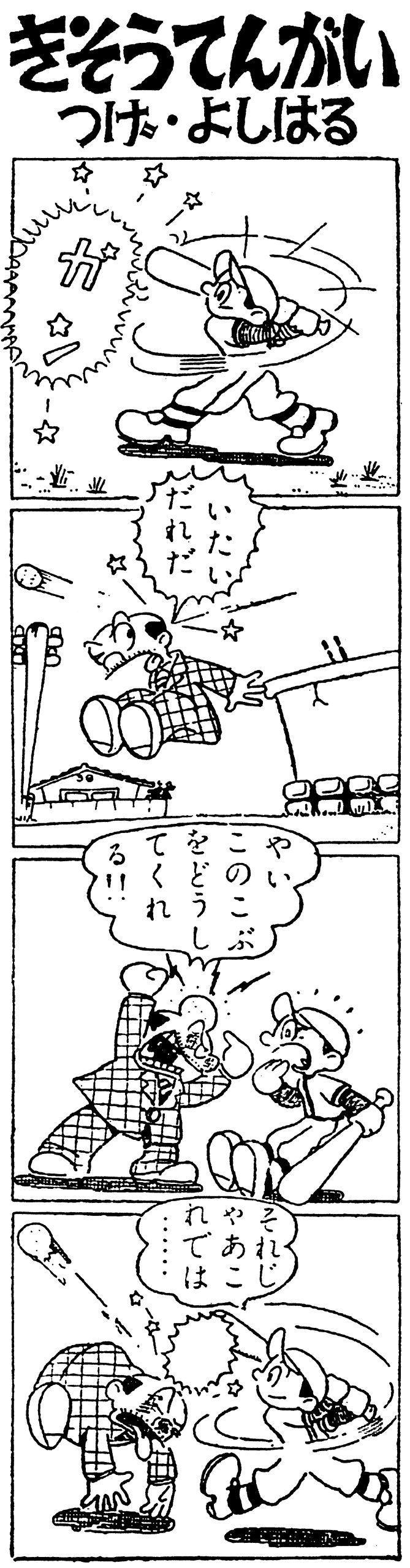 "An Incredible Story," one of Tsuge's first strips, 1954.
Manga had exploded with the revolution that accompanied Osamu Tezuka’s New Treasure Island published in 1947. Tezuka took his drive and brilliance to Tokyo where he defined what comics would look like for Japan. Publishing in magazines like Manga Shonen and Shonen Magazine, Tezuka created some of his most influential works, such as Kimba the White Lion (1950) and Ambassador Atom (1951). It was in Manga Shonen that he developed the instructional column called Manga Classroom (1952–54). Here, he taught the fundamentals of being a cartoonist and encouraged readers to create their own comics. Tezuka wanted readers to not just enjoy reading manga, but to see it as a learnable craft they could master. This column would be art school for many future artists, including Yoshiharu Tsuge.
Tsuge had become obsessed with the manga of Osamu Tezuka in fourth grade. He would rush to the bookstore whenever a new volume came out. Because of their poverty, Tsuge’s mother could rarely afford to buy them for her son. Desperate not to miss an installment, Tsuge sold his own toys to buy Tezuka’s comics. More often he waited for his step-grandfather, a thief by trade who would come by every few months. His step-grandfather loved Tsuge and always had spare money to buy him manga. His tastes expanded to include Fukujiro Yokoi, Ichisaburo Sawai, and Kiyoshi Ohno, as well as adventure novels by Yoichiro Nanyo.
Tsuge even once went to visit Tezuka, and the famed manga apartments of Tokiwa-so, where many of Japan’s most prominent manga artists lived. Tezuka taught him about the business side of manga, about how much they were paid, and what the work was like. This strengthened Tsuge’s resolve to become a professional.
Tsuge’s first published manga was in October 1954. Hanin wa Dare Da!! (Who did it?) and Kiso Tengai appeared in the pages of Tsukai Book, a children’s magazine published by Hobunsha. These were short one- and four-panel gag scripts he used to make his portfolio. Much to his mother’s dismay, Tsuge quit his job at the electroplating factory and began shopping his work to publishers. He spent about a week before he was accepted by his tenth publisher. Tsuge made his official professional debut in May 1955 with the highly Tezuka-influenced Hakumen Yasha (White-faced Yasha), a fairy tale story of a young boy who takes the name Hakumen Yasha to fight against the corrupt local lord.
He was now a professional manga artist.
While this was happening, in Osaka another revolution was brewing. Far from the clean art and slick pages of the Tokyo manga magazines, artists were churning out work for the kashihon rental manga industry.
At the time, the average magazine cost 220-224 yen. While not expensive, this was still beyond the means of many poor children and struggling college students. Kashihon offered a cheaper alternative. Customers rented manga for a fee of about 20 yen for three days. Kashihon manga were printed in small, hardbound editions that could endure being passed through many hands. They could be collected editions of weekly comics like modern day manga, but just as often were original stories commissioned specifically for kashihon markets. Although much kashihon manga was produced in the Kansai region, it was distributed to rental chains across Japan.
Kashihon comics were cruder, more violent, and vulgar than those printed in magazines. Considered second class, rates were cheap, and artists struggled to survive. However, kashihon had fewer commercial limitations and more room for experimentation. It was in the world of kashihon that Tsuge would emerge from the shadow of Tezuka and grow into his own.
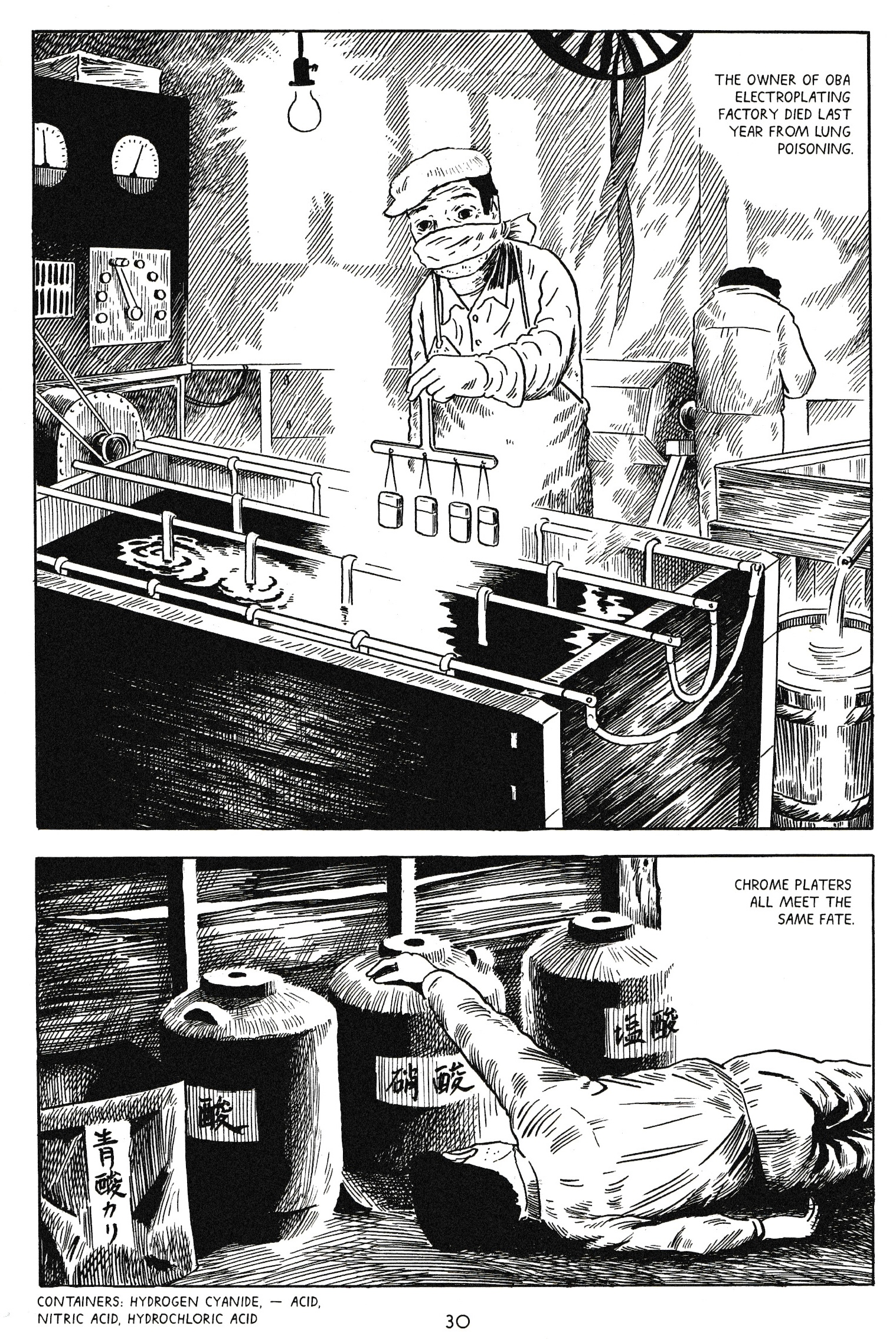 Page from "Ebo Electroplating Factory," collected in the eponymous volume.
Tsuge began drawing rental manga regularly around 1955, immediately following his professional debut. He published several Tezuka-influenced works with the publisher Wakagi Shobo, such as Ai no Kurabe and Senshi no Kanata. Most of these were semi-historical adventure stories. Senshi no Kanata told of a plucky young boy joining the Imperial army to rise in status in the chaos of the late Edo period. Like many manga artists, Tsuge also drew shojo girls’ comics. Ai no Kurabe depicts a girl who becomes entangled in a strange fate while searching for her deceased father. Drawing shojo was not as prestigious as making shonen boys’ comics, so the barrier of entry was lower. It was common for novice artists to get hired to do shojo comics in recognizable, sellable styles. The pay was not great, but it was enough to scrape buy if you produced enough pages.
Rental manga shops began to spread across Japan. Signs for Neo Shobo, the Osaka-based rental manga chain, began appearing across Tokyo as well. They were popular for more than just manga; in a time before the explosion of coffee shops and ice cream stores, rental manga shops were an easy place to get a job for young women. This ensured they became a popular hangout joint for young boys as well. Tsuge admitted that he would hang out at these shops, hoping to be casually noticed by the pretty staff who would be impressed that the actual artist was there. But they never did. The girls had no interest in their product and considered it to be mere children’s toys.
As coffee shops grew, the girls drifted to waitressing as a more glamorous job. Manga artists like Tsuge started hanging out in coffee shops instead. Tsuge said this was why so many manga artists were married to waitresses.
While his crippling shyness and erythrophobia meant he had no luck with the ladies, he did begin to gather around himself a group of artist friends. Moto Abiko, one half of the team Fujiko Fujio that created the popular character Doraemon, formed the collective group Shinmanga-to or New Manga Party. Tsuge attended meetings and became close friends with Shinji Nagashima, Masaharu Endo, and Fujio Akatsuka. Tsuge would frequently stay at Akatuka’s apartment in Tokiwa-so and was even featured as a character in Akatsuka’s comic Yoshiharu-kun.
In 1956, Tsuge produced some of his last Tezuka-influenced comics, the trick-based mysteries Ikiteita Yurei (The living ghost) and Tsumi to Batsu (Crime and punishment). His next work in 1957, Yotsu no Hanzai (Four Crimes) was a departure.
Yotsu no Hanzai was an anthology of four separate tales —"Aspiring Villain," "Tales of Peeping," "Unchi-kun’s Bizarre Crimes," and "The Head.” Heavily influenced by Japanese mystery writer Edogawa Rampo, the narrative unfolds through a framing device in which various guests staying at a hot spring take turns recounting strange tales. Along with solving the mysteries, the characters vent some of Tsuge’s frustrations with his work. In "Tales of Peeping," a debate unfolds between the protagonist Tsuji (a stand-in for Tsuge) and Endo (representing Masaharu Endo) about the needs of art versus the needs of entertainment. Tsuji states “My manga is not the typical garbage you see in every children’s magazine — it’s art!” He then shouts, “We need literate manga!”
Yotsu no Hanzai was interesting enough that other manga artists took notice. Tsuge was always proud knowing that Sanpei Shirato, legendary artist of Kamui, kept a copy in his library.
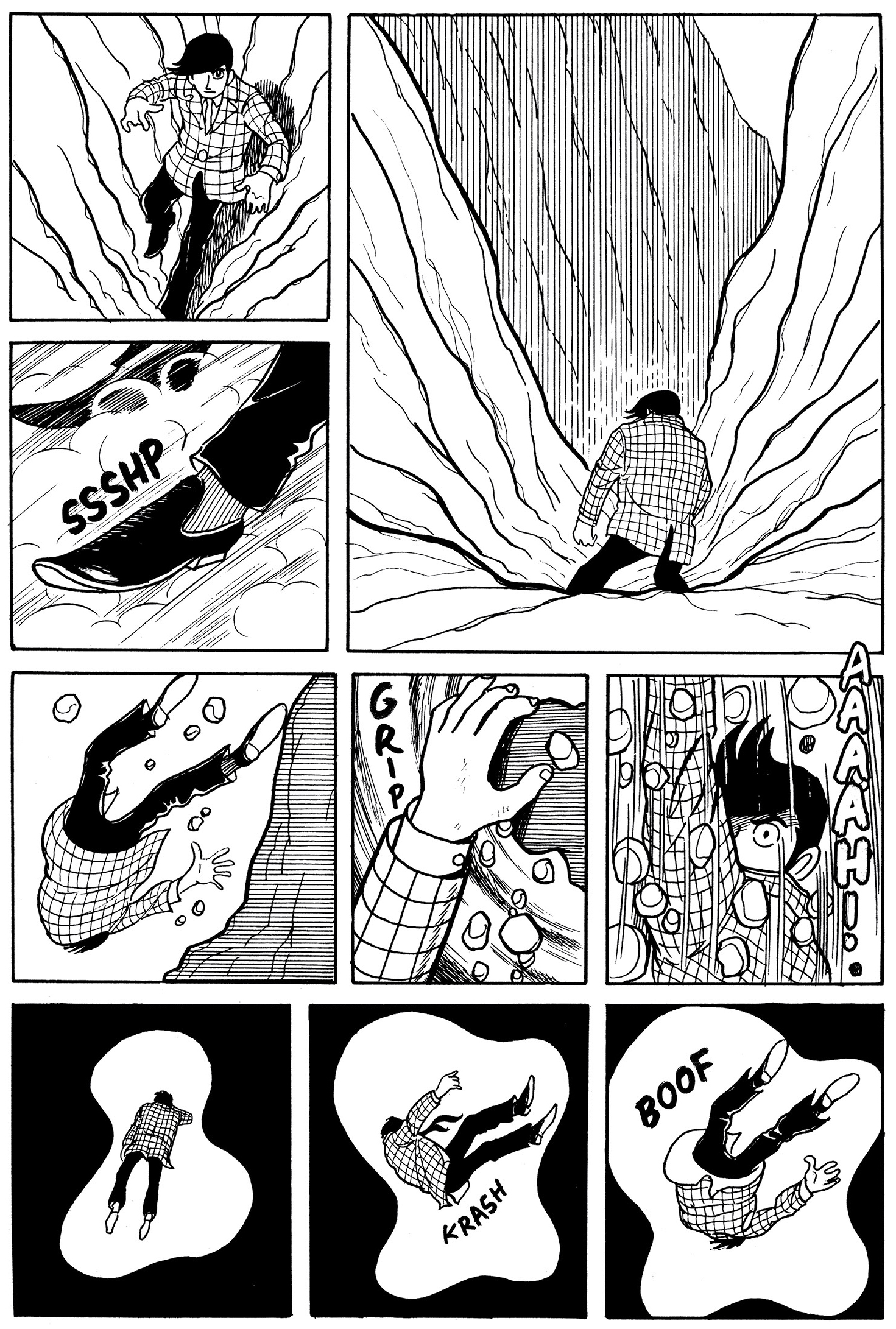 From "Handcuffs," a 1959 story redrawn in 1963, collected in The Swamp.
Tsuge and Tatsumi
On Aug. 31, 2024, an anonymous poster asked on Yahoo! Answers asked, “The manga of Yoshiharu Tsuge and Yoshihiro Tatsumi share a striking resemblance; I wonder, which of them came first?”
Tsuge and Tatsumi’s names are often brought up together. To answer the anonymous question, Tatsumi came first. Tsuge encountered Tatsumi’s work in the pages of Kage (Shadow), a magazine dedicated to thriller stories. Tsuge was drawn to Tatsumi and Masahiko Matsumoto’s work. There was a grittiness to it unseen in other magazines. The two met for the first time in 1958, although they did not share a particularly close relationship. Artistically, however, they followed a sort of parallel evolution.
By 1957, manga had matured enough as an art form that artists were interested in moving it beyond children’s stories. It had been a decade since Tezuka’s New Treasure Island revolutionized Japan’s comic book industry. Since then, most worked in a Tezuka-style, churning out volumes of stories for children. However, as seen in Tsuge’s "Tales of Peeping," some of the artists themselves were finding this less than satisfying. But the pay was subsistence level at best. They were all struggling. And like many artists, they decided if they weren’t going to get paid well, they might as well make something they were actually proud of.
Yoshihiro Tatsumi coined the phrase “gekiga,” or “dramatic pictures,” to define this new style of manga. This was similar to American comics pushing the term “graphic novel” over “comic book,” as a way for readers and critics to take them seriously. Tatsumi had also been mentored by Tezuka and worked in that style early on. But he was unsatisfied. Tatsumi’s 1957 work Yurei Taxi was the first to be labeled gekiga when it was published. Gekiga artists drew inspiration from film and literature instead of Tezuka. Artists developed not only new story styles but an entirely new aesthetic and language of visual storytelling, Moving away from Tezuka’s rounded forms, they used sharp angles and gritty lines, with hatching for shading. They aimed to do to Japanese comics what director Akira Kurosawa was doing to Japanese film.
In 1959, Yoshihiro formed the Gekiga Kobo, or Gekiga Studio, and issued a Gekiga Manifesto that was sent to various publishers and newspapers. The manifesto explained this new approach, saying their work would move manga away from youthful escapism and into social realism. The group would only last a year; egos broke it apart. But the impact on comics would last for years.
Never much of a joiner, Tsuge was not part of Gekiga Kobo. While other artists looked to film, Tsuge became engrossed in psychological fiction. He read the works of Jun’ichiro Tanizaki, Edgar Allan Poe, Edogawa Ranpo, and Osamu Dazai. While Tatsumi was pushing the art form of manga outward, into the real world where people lived, Tsuge was slowing dragging it inwards.
Tatsumi and Tsuge are often described as the most important figures in the development of gekiga. By the 1960s, the gekiga style had completely taken over Japanese comics. It became so ubiquitous that the word itself ceased to have meaning. The subculture had become the culture.
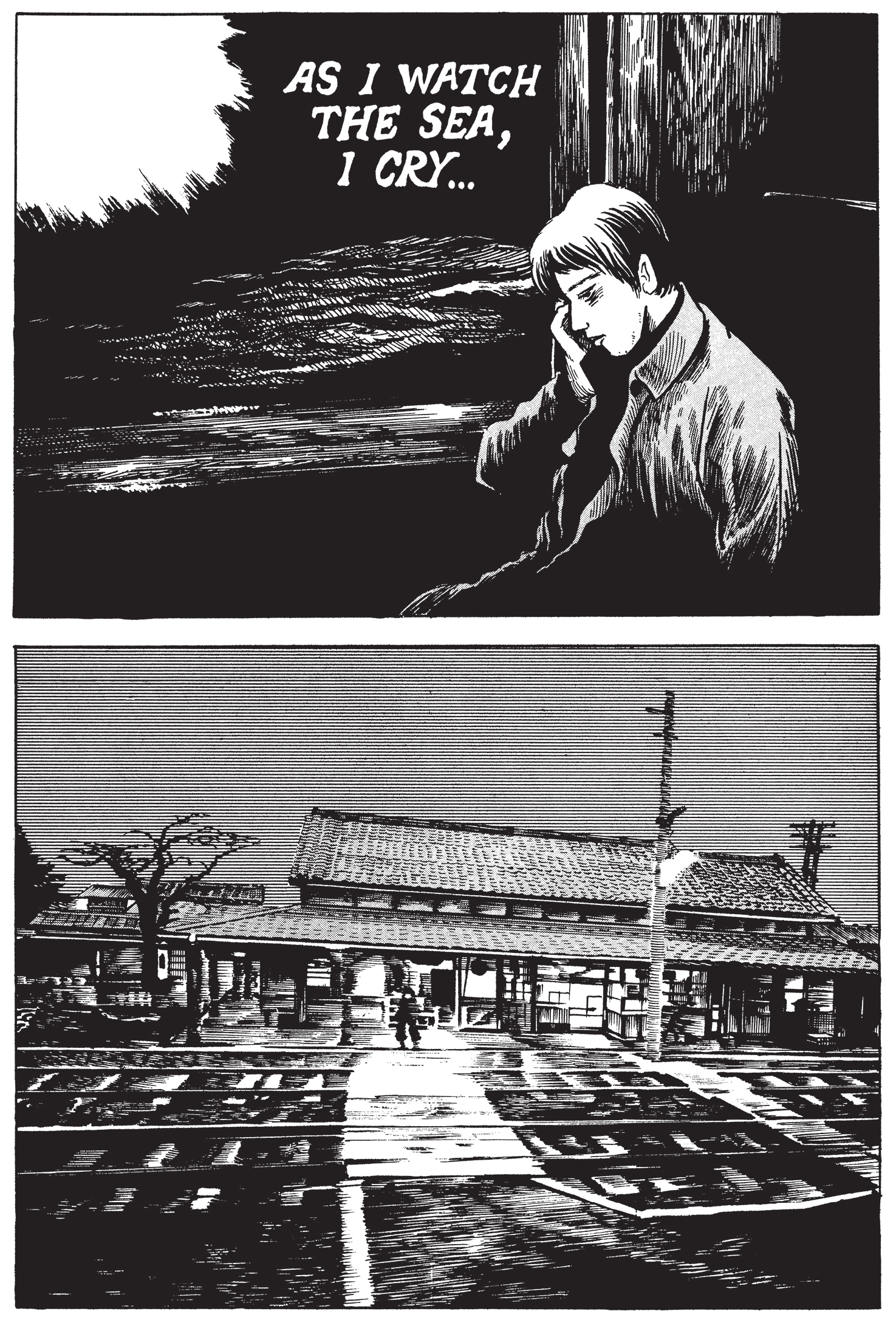 From "Master of the Willow Inn," as collected in Nejishiki.
The End of Tsuge’s Manga Career
Over the following years, Tsuge produced a variate of rental manga works such as Nanatsu no Hakaba (Seven Graves; 1957), Obake Entotsu (Ghost Chimney; 1958), and Fushigi na Tegami (Mysterious Letter; 1959). Ostensibly detective stories, Tsuge was much more interested in psychological mysteries rather than crime committed for financial gain. Explorations of the inherent cruelty of human nature permeated his work.
Tsuge’s work from this time introduced elements that would make up the internal landscape of his work. Tall chimneys bellowing out black smoke — the kind that could be seen across Japan used to incinerate garbage — became symbols of anxiety. The passing of letters became a central motif. Around the time he was drawing Bakumatsu Funden (Funden of the bakumatsu; 1958), Tsuge's artistic style underwent a sudden and dramatic shift toward the somber.
Bakumatsu Funden tells the story of a warrior bearing a secret letter he is to deliver. He winds up at a tenement full of a motley crew of pickpockets and ronin. They serve as the narrative guide for the story, showing the turbulent upheavals as Japan transformed from the feudal Edo period to the mechanized Meiji period.
Tsuge had moved into a boarding house in Kinishicho. He described it as a veritable human dumping ground. The house had about forty residents, each crammed into closet-sized rooms. Tsuge shared close quarters with prostitutes and scam artists. His immersion in the lives of these people on the fringes of society began to cast a dark shadow over his artistic style. Tsuge would later reflect that with the creation of Bakumatsu Funden he sensed that something fundamental had shifted within himself.
Tsuge’s dark turn proved to be too dark for readers. His stories were increasingly unpopular. As the 1950s gave way to the '60s, the mood of Japan shifted. The country was ready to put the gloom of World War II behind them and metamorphosis into a new nation. Rapid economic growth was accompanied by political turmoil. And in terms of comics, readers wanted only one thing — ninjas.
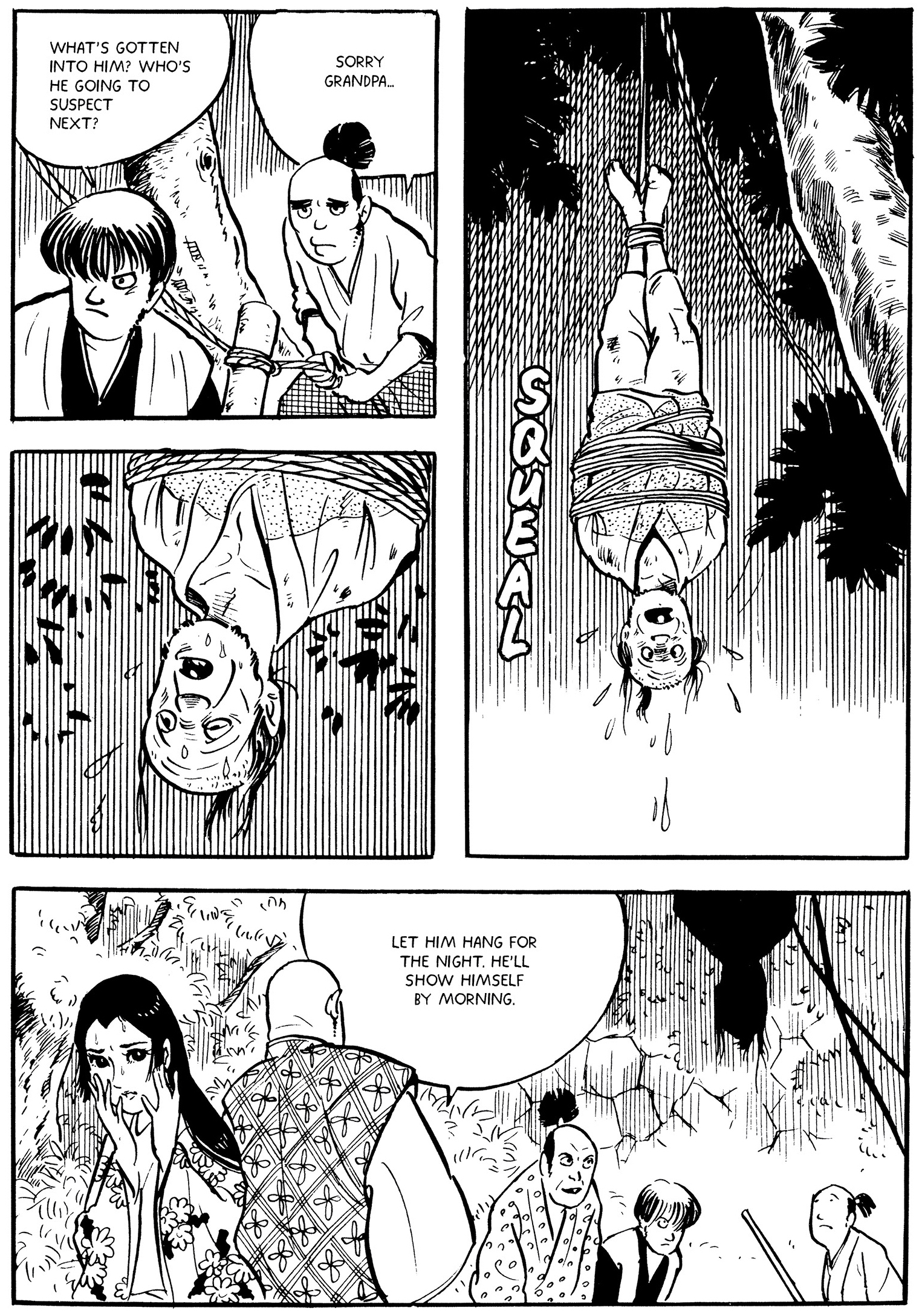 From "The Ninjess," originally drawn in 1961, later redrawn in 1966, collected in The Swamp.
In 1957, Toshiro Mifune headlined the Yagyu Secret Scrolls series. In 1959, artist Sanpei Shirato began his long-running series Ninja Bugeicho (Ninja Martial Arts Handbook), published by San’yosha Publishing. The head of San’yosha, Katsuichi Nagai, was launching a new ninja-themed magazine and asked Tsuge to contribute. He produced six stories in the Musashi Hiwa (Secret Stories of Musashi) series. More ninjas would follow. He worked on Moro ha (Blind Blade), Kimen-seki (Stone of the Demon Gate), and Ninja Hicho (Secret Ninja Chronicles), all more or less in a style Tsuge adopted to mimic Shirato.
Around this time, Tsuge met Kokeshi. She was a door-to-door salesperson with Pola Cosmetics. Getting over his shyness, Tsuge moved in with Kokeshi in her apartment. While working on manga he would occasionally accompany her on her rounds, lugging her heavy trunk full of cosmetics.
Things were good, but it would not last.
Tsuge said when he handed in the manuscript for Kimen-seki, Sanpei Shirato was there to take it. Shirato read the entire thing in absolute silence. Tsuge's work with San’yosha ended in 1961, with his final story Ochimusha (Fallen Warrior).
Things went downhill from there. His relationship with Kokeshi ended when he found out she was cheating on him. Tsuge was evicted from the apartment and forced to return to the hated Kinishicho boarding house. He sunk so low as to sell his own blood for money —something suspected of many manga artists at the time but only Tsuge owned up to it. As he watched artists who started after him such as Shigeru Mizuki rise to the heights of fame and success, he was forced to realize that there was no audience for his art. His tightly crafted, short stories plumbing the human psyche were not what anyone wanted to read.
In 1962, taking a massive dose of the sedative Bovarin, Yoshiharu Tsuge attempted to take his own life. However, as with most of the things in his life the time, it ended in failure.
Tsuge and Mizuki
In 1965, two things happened that changed his life. He began publishing stories in the new avant-garde manga magazine Garo. And he began working for Shigeru Mizuki.
After a year and a half away, Tsuge tried drawing manga again. In 1963, he published Yato no Toide (Bandit Forest) from Top-sha. Yet he found the producing entertainment instead of art excruciating. Yoshihiro Tatsumi urged him to try other genres, such as science fiction or slice of life. He had no interest in social issues; he was always looking inward.
The way Mizuki tells it in his autobiographical Showa: A History of Japan, he met Tsuge on a train platform one day, to a gathering of manga artists. Tsuge told Mizuki he was thinking of quitting manga. Aghast, Mizuki told him what a waste of his talent that would be. Later, at the urgings of Katsuichi Nagai, he offered Tsuge a job.
Shigeru Mizuki was one of Japan’s most famous comic artists. His folklore series Kitaro is a classic in the same stratosphere as Tezuka’s Astro Boy, and equally influential. After coming home from World War II after his arm had been blown off in an Allied bombing run, he got his start as an artist working in the proto manga kamishibai paper theatre. He moved to working in rental manga a few years after Tsuge got his start. According to Manga: A New History, Mizuki was one of the few cartoonists to enter manga with an original art style, instead of imitating Tezuka. This set him apart. Mizuki’s rental manga series Hakaba Kitaro later became Gegege no Kitaro, where it achieved phenomenal success, being one of the earliest manga series adapted for animation and creating an empire of toys, films, games, and everything imaginable. By 1966, his fame had gotten the better of him, and he was no longer able to keep up by himself. He founded MizukiPro and hired a stable of artists to help him as assistants. Several of these assistants went on to find their own success, such as Ryoichi Ikegami with his series Crying Freeman.
From the beginning, Tsuge and Mizuki worked more as peers than as master/apprentice. Mizuki was fully aware of Tsuge’s skills, not only as draftsman but as a creator. Whereas other assistants were assigned specific tasks, such as drawing the intricate backgrounds that were the hallmark of Mizuki’s comics, Mizuki asked Tsuge for ideas. With the constant pressure and demand for new stories, sometimes Mizuki would come up blank. In those cases, no matter what time it was, Mizuki would contact Tsuge asking for an idea. Tsuge said he never needed to give more than an initial thought; once Mizuki had the seed he could bring the story to resolution.
There is much of a “he said / he said” about the working relationship between Tsuge and Mizuki. Tsuge said as an established artist he had nothing new to learn from Mizuki. However, looking at the work from the time sees Tsuge adopting Mizuki’s art style, mimicking it in the same way he had earlier with Tezuka and Shirato. Tsuge’s most iconic work Nejishiki (Screw Style) has all the hallmarks of a Mizuki comic. The photo reference backgrounds in particular are Mizuki’s signature.
They worked together for only a short year and a half. Whatever the reality, their pairing has become the stuff of manga legends.
What is known for a fact is that Mizuki created a safe harbor for Tsuge. Mizuki paid Tsuge an unheard-of high wage. He provided financial stability at a time when Tsuge needed it most. And that stability allowed Tsuge to create art that would permanently carve his name in manga.
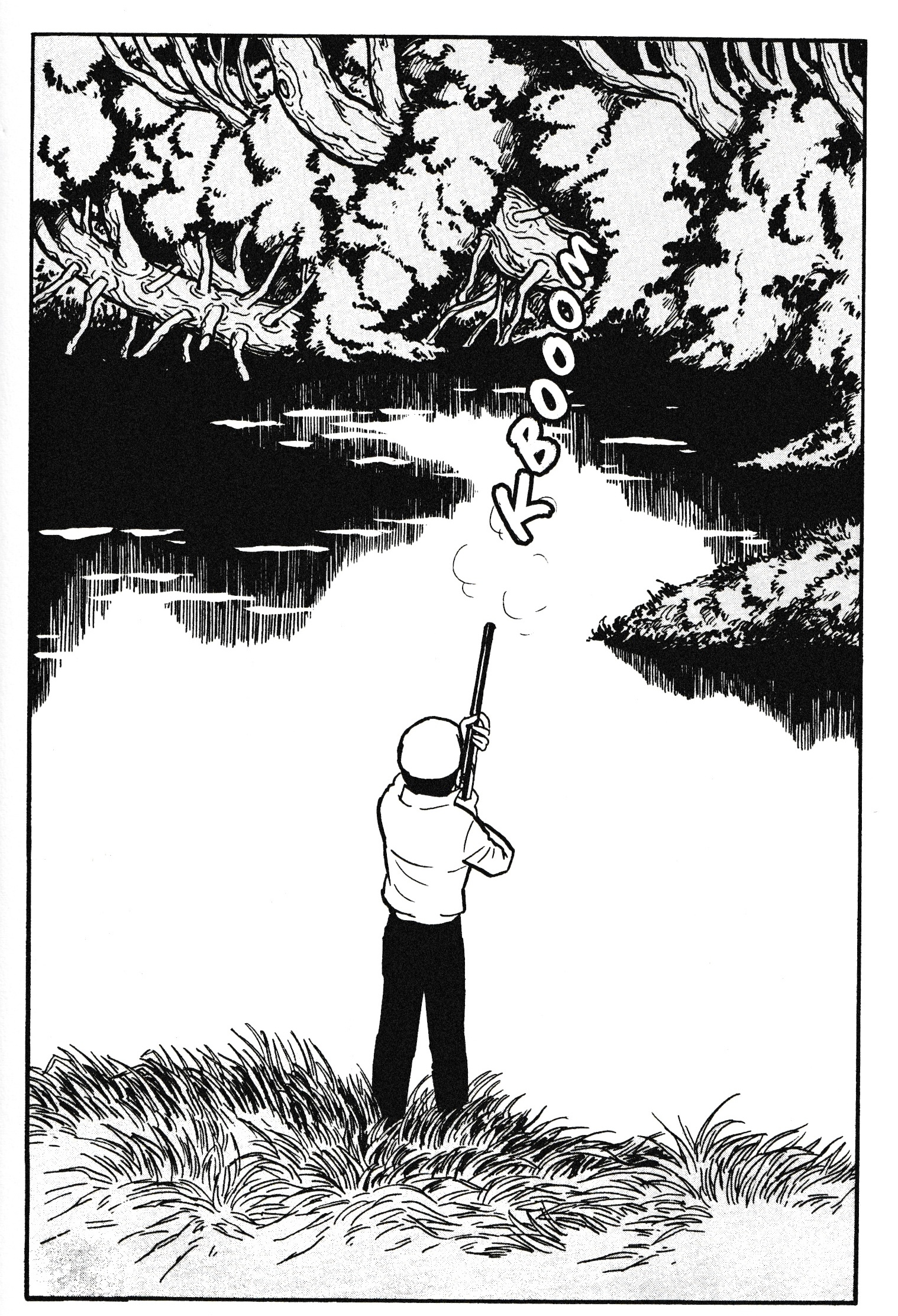 Image from "The Swamp," as collected in the eponymous volume.
Garo
In 1965, a page in Garo magazine said “Yoshiharu Tsuge — please get in touch!” It had been placed there by editor Katsuichi Nagai who knew exactly the talent needed for the new avant-garde manga magazine. There were boundaries to be pushed, and Tsuge would push them.
Garo had been founded in 1964 by Nagai, the same editor who had previously hired Tsuge to make ninja comics. Nagai intended to use it as a platform for politically engaged and artistically experimental comics. He had gotten the idea by the success of Sanpei Shirato, which showed there was a hunger for social themes threaded within manga stories. Shirato’s series Kamui Den started with the inaugural issue. As an editor and publisher, Nagai’s approach was unique. He paid a fee and gave the artists pages. What they did with the pages was entirely up to them.
Tsuge was entirely unaware of the existence of Garo. But his curiosity was piqued. In 1966, he published his first comic in Garo, the short story "Numa" ("The Swamp"). A surreal fairy tale about a hunter who encounters a mysterious woman in the woods, the story was inspired a trip he took with Sanpei Shirato to Suebiro Ryokan in Otaki, Chiba. Tsuge met a young woman working at an inn who spoke with a heavy accent. From that he dreamed up the story.
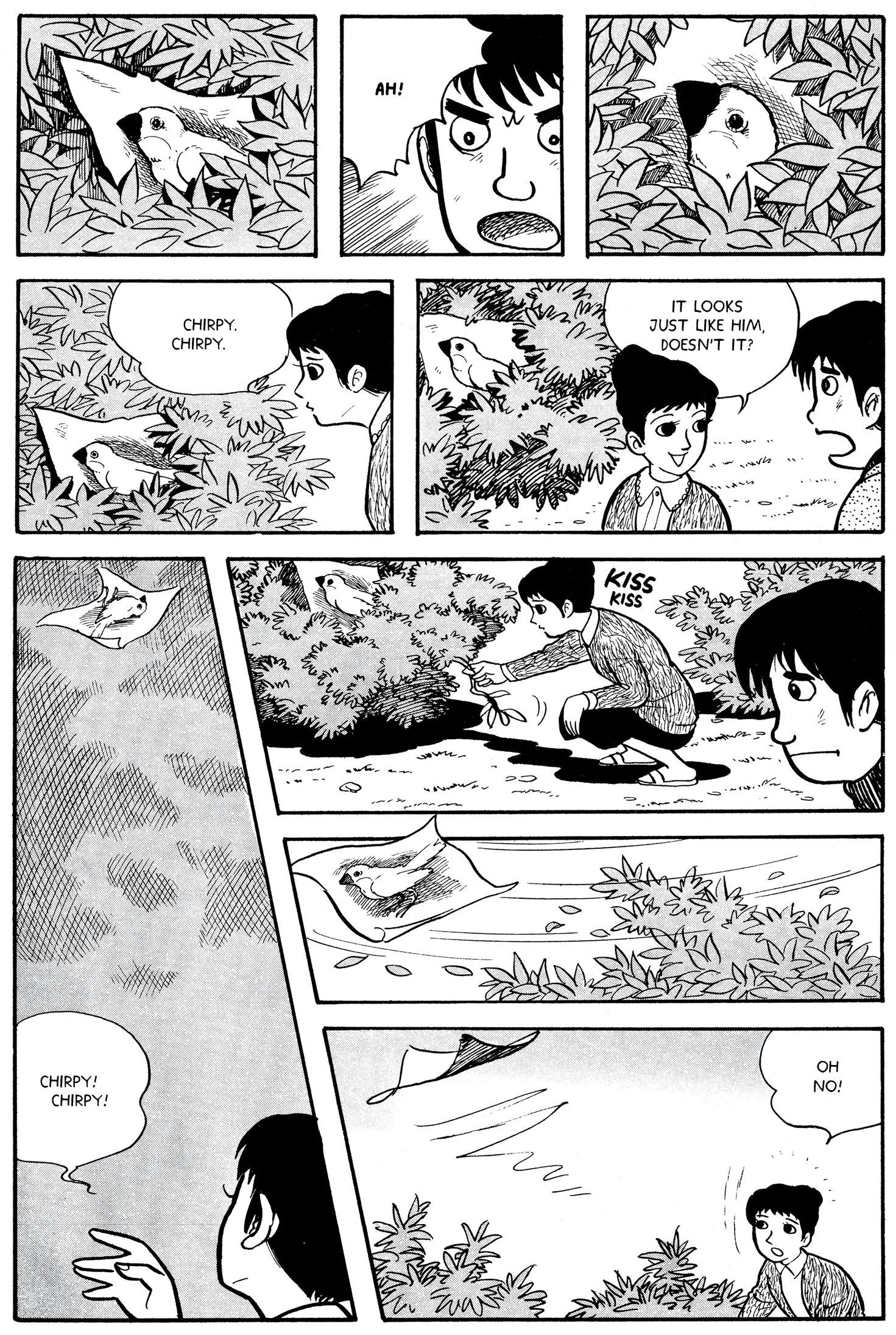 From "Chirpy," as collected in D&Q's The Swamp.
Energized by the freedom of making art without need of entertainment, he next created "Chiko" ("Chirpy"). Considered one of his masterpieces of the period, he drew from his own lived experience. Tsuge tells a story of when he was living with his girlfriend Kokeshi. Tsuge accidentally killed her pet sparrow by putting it in a cigarette case. Terrified at watching its bright red beak slowly turn white, Tsuge buried the bird in a neighbor’s garden then lied to Kokeshi when she came home, saying the bird had escaped. Tsuge said the story happened in exactly that way with the exception of the burial; in real life he simply tossed the dead bird into some tall grass.
"Chirpy" established the genre of what would be called I-manga, or autobiographical fiction. Japan had a literary genre of I-novels, which embellished the truth in favor of a good story. Tsuge claimed to be entirely unaware of this. He said he gave it no deep thought. He simply found it interesting to draw an event that had actually happened to him.
"Numa" and "Chiko" were created immediately after each other yet stand in stark contrast. The surreal "Numa" gave way to the very real "Chiko." However, neither made much of an impression on readers. And the impressions they did leave were negative. The works were too gloomy — complaints he had heard before during his rental manga years.
Disappointed, Tsuge intended to quit drawing his own manga and devote himself full time to being Mizuki’s assistant. The only other story he did was "Hatsutakegaru" ("Mushroom Hunting"), a fill-in after Mizuki’s promised sixteen-page story only reached eight pages. Borrowing another Mizuki assistant, Yoshikazu Kitagawa, to do the backgrounds, this story is done in the classic Mizuki Style.
Over the next year Tsuge worked and travelled. He had developed tendonitis in his hand and needed to take frequent breaks from the demands of MizukiPro. Traveling inspired him. He sketched and journaled. Manga, however, was not done with Tsuge. In 1967, the first collection of his works, Uwasa no Bushi (The Phony Warrior) was published.
Editor Shinzo Takano joined the staff of Garo with one mission — to return Yoshiharu Tsuge to the world of comics. Takano began regularly visiting MizukiPro, needling Tsuge about drawing new manga. Dreading the fact that he had read the last Tsuge original work, Takano joined with friends and colleagues to found a critical coterie magazine called Manga Shugi in 1967. The inaugural issue featured a Yoshiharu Tsuge retrospective, with contributing essays discussing his oeuvre.
Takano heard from another assistant at MizukiPro that Tsuge was delighted by the magazine. A month or two later, Tsuge unexpectedly appeared at the Garo offices and handed over a new manga manuscript. Takano recalled it was simply rolled up and secured with rubber bands, then stuffed in his pocket. This manuscript became the comic "Tsuya" ("The Wake").
Tsuge began producing autobiographical and travelogue strips for Garo. Sparked by sudden inspiration, he became incredibly prolific. His artistic style became notably more precise and meticulous. The works rolled out of him. His travelogues in particular became popular. Purchasing a professional-grade camera, he documented the landscapes he encountered. All while still working as an assistant at MizukiPro.
And then came "Nejishiki."
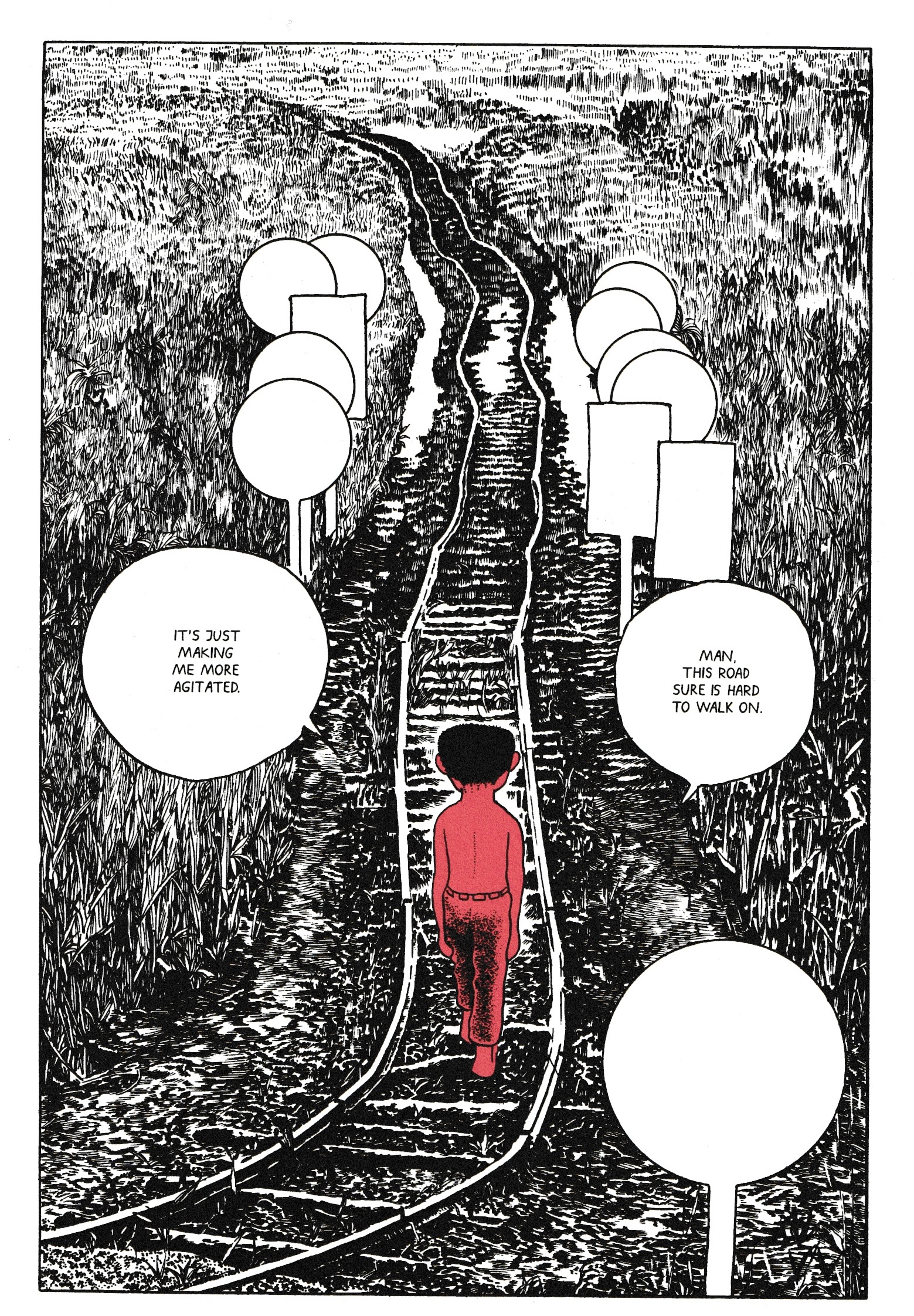 Scene from "Nejishiki."
Published in 1968, "Nejishiki," with its surreal atmosphere was a departure from his normally realistic stories. Tsuge said it came from a dream he had while sleeping on the roof of a ramen shop. A bizarre, discursive excursion with little plot, it exudes atmosphere and nihilism. A short story of twenty-two pages, it is unlike anything else seen on the comic page at the time. None of the characters are named. Only the boy exhibits movement, with the rest static as if paper cutouts. No one knows where the boy comes from, or where he goes. The art is grotesque. It feels like a dream because that is exactly what it is.
There are words and words and words written about "Nejishiki." It seems unnecessary to recap them all here. It would be like writing a piece on Alan Moore and trying to cram in decades of critical thought and review of Watchmen. I can say that it changed manga forever. That single story continues to inspire readers and artists. Anyone who is serious about manga has read "Nejishiki."
Whatever your interpretations are of "Nejishiki," Tsuge would probably say you are wrong. When asked about all of the studies and papers and articles written about the story, he dismissed them all with a laugh, saying none of them were even remotely accurate.
"Nejishiki" achieved a place as an influential work of art. It established Tsuge as a cult figure. "Nejishiki" was adapted as both a video game in 1989 and a film in 1998, directed by equally avant-garde director Teruo Ishii (Jigoku). In 2017, Tsuge was honored by the Japan Cartoonists Association, and in 2020 he won a special award honoring his contributions to comics at the Angoulême International Comics Festival.
"Nejishiki" brought him financial success, respect, and stability. All of which Tsuge said were detrimental to his art. The “Tsuge Boom” that followed "Nejishiki" brought a sudden influx of money, which Tsuge said made him lazy. With no need to drive him, he simply stopped producing.
Tsuge often said success was the greatest curse of art. He was critical of both Tezuka and Mizuki, whose early work was groundbreaking but then became stuck in a specific style once that became a money maker. Their audiences would no longer allow them to deviate from that style. Their success was their jail. Tsuge was now branded as the “artistic manga artist.” According to Tsuge, this categorization restricted the venues available to him where he could publish his work.
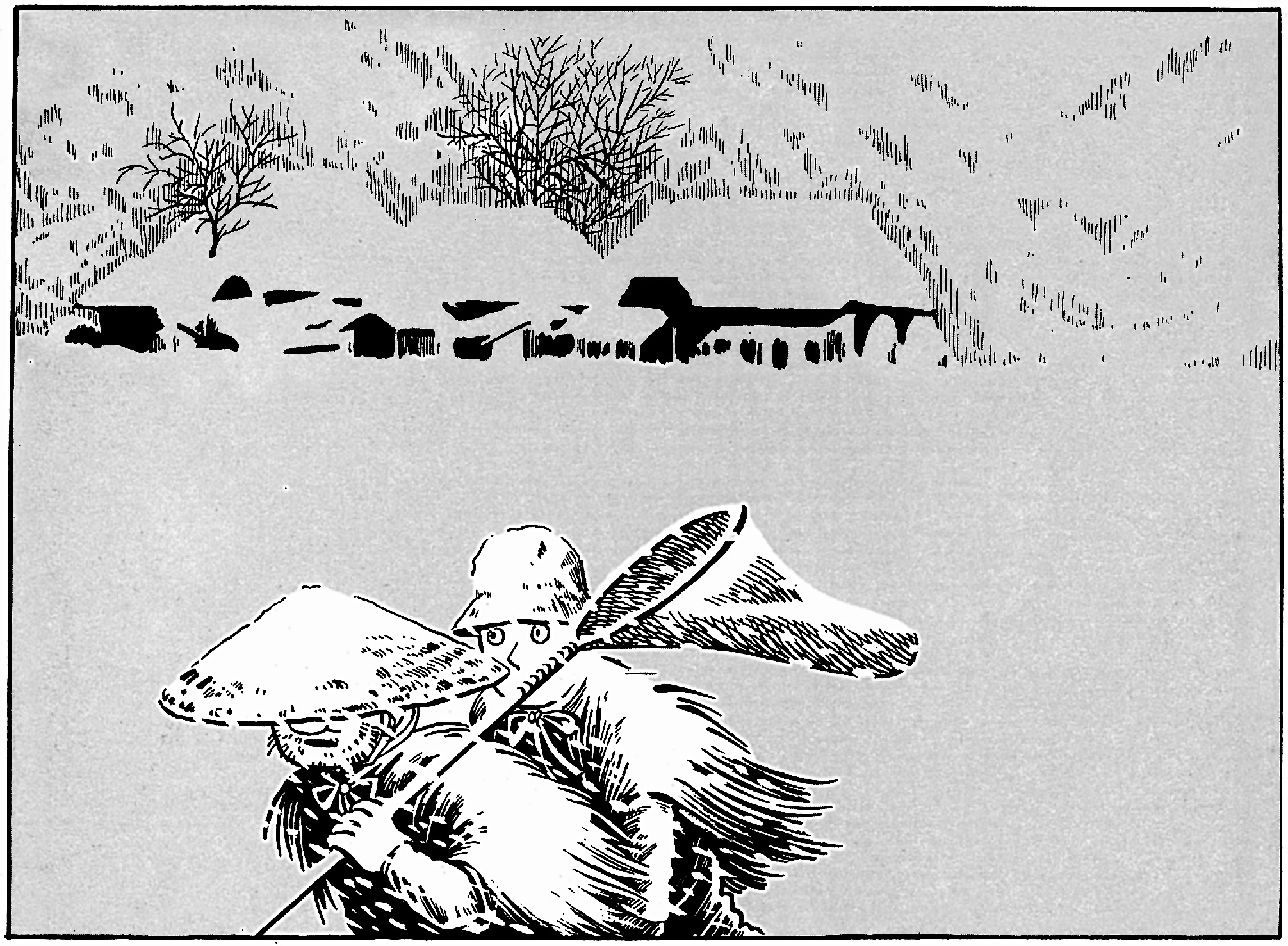 Panel from "Mister Ben of the Honyara Cave," collected in Red Flowers.
A Man Without Talent
In 1969, Tsuge met actress Maki Fujiwara. In 1970, he moved to Chofu City and began living with her. Later they got married and had children. Tsuge described himself as the least prolific artists in all of Japan, working just enough to secure money to live on. His output dwindled. From 1971 to 1972, he published nothing new. He continued to travel. He just stopped writing about it.
Tsuge continued to turn the camera inward. He moved away from the style that had established him in Garo. His comics became increasingly autobiographical and erotic. Instead of somber landscapes he became attracted to open skies. Tsuge began keeping a dream diary, meticulously recording his dreams. His 1972 "Yume no Sanpo" ("A Dream Stroll") was an attempt to translate his actual dreams into manga. He began to intentionally create distorted perspectives, showing up in works such as "He Rolled Me Up Like a Grilled Squid."
In 1985, Tsuge began a series called Muno no Hito (The Man Without Talent) featuring a once well-known manga artist whose work has declined. Taking pride in his reputation as the “artistic manga artist,” he refused paid work he thinks is beneath him. This leaves him to a state of dire poverty, and he begins exploring other occupations. He tries his hand at dealing in antiques and used cameras but fails at every business attempt. He finally sits on the shores of the Tama River, gathering interesting stones and trying to make a living selling them. Berated by his wife to give it up and get a real job, the artist refuse, enamored of the stones he has gathered.
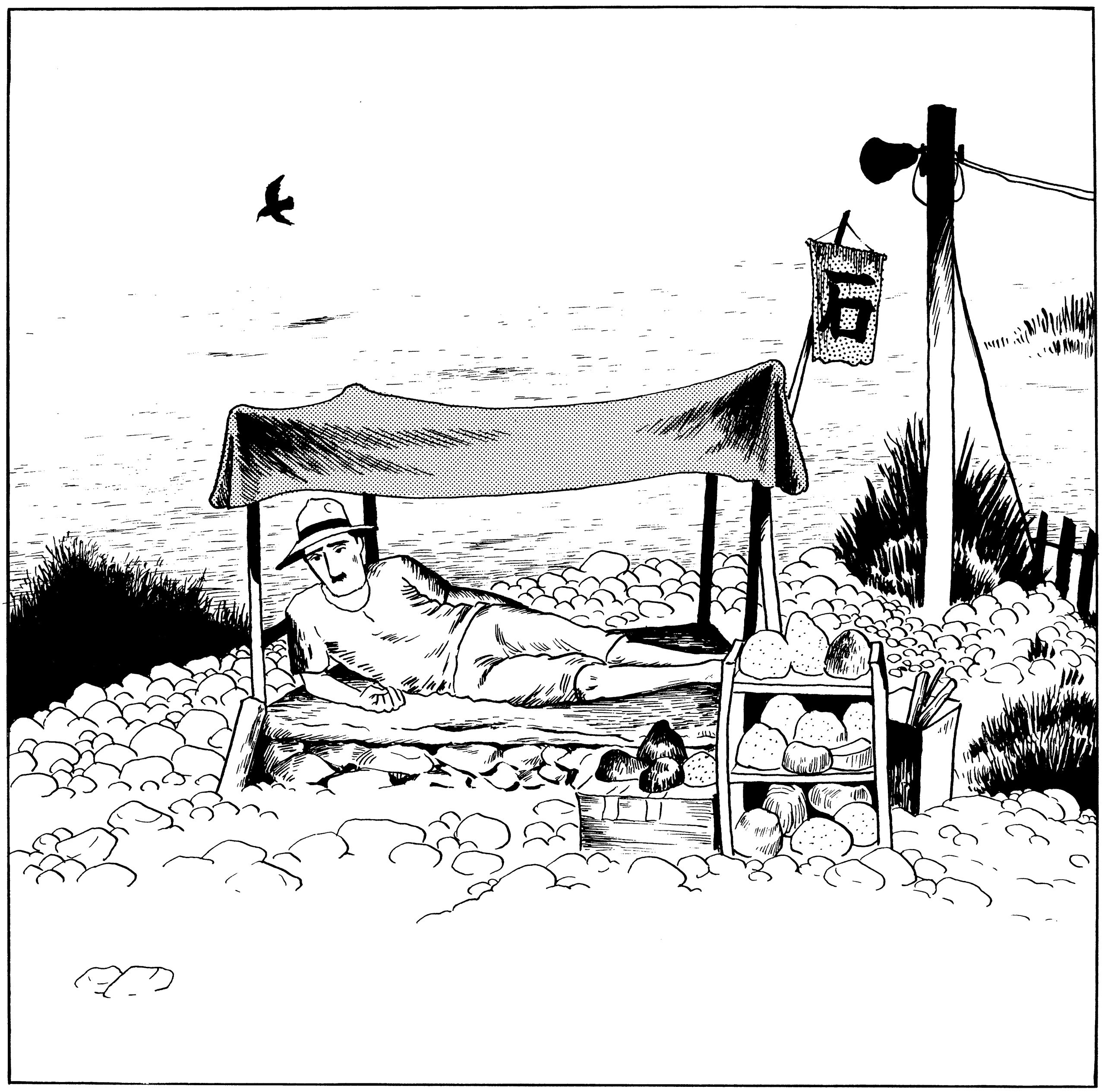 Image from The Man Without Talent.
Tsuge published his last work in 1987, a short manga story, the appropriately called "Ribetsu" ("Parting"). It told the story of a man who attempts suicide after a break-up, echoing Tsuge’s own attempt to take his own life that led to his career blossoming.
He removed himself with his wife and children into a private life. Tsuge refused offers of publicity, including turning down lucrative offers to appear on television. He simply wished to disappear. And that is what he did. The doors that Tsuge opened, however, did not close behind him. Other manga artists followed in his footsteps.
If you want to know Yoshiharu Tsuge, read his comics. It is all there. Almost everything I have written about here became a comic at some time. His childhood home appeared in "Umibe no Jokei" ("Seaside Scenery"). His stowaway attempt found its way into "Umi e" ("To the Sea"). His time working in the electroplating plant is chronicled in the 1973 "Oba Denkimekki Kogyosho" ("Oba Electroplating Factory"). His wife Maki published her own comic, My Picture Diary, sharing one year of their life together. This won the Eisner Award in 2024 for Best US Edition of International Material – Asia.
It is a luxury now that more of Tsuge’s work is now available in English than at any time before. Tsuge was often asked why, at a time when so much manga was finding such readership overseas, his was left untranslated. Some of this was Tsuge himself. He said that he was trying to escape attention, to stay out of the spotlight. He wanted to live "ite inai," meaning a life unengaged with society. Sometimes manga artists need a champion, and Tsuge found one in Ryan Holmberg.
Working with multiple publishers, Holmberg has tirelessly raised awareness of Tsuge, not only in translating his work but writing exhaustive essays about his life. Holmberg is equally a champion for Tsuge’s brother Tadao and has brought many of his works into English as well. For explorations of their work and meaning, no one has written more or better on the Tsuge brothers than Holmberg.
For one who lived such an interesting life, Yoshiharu Tsuge died a mundane death, of aspiration pneumonia in Tokyo on March 3. He was eighty-eight years old. On his death, hundreds of articles were written about him worldwide. The man who once said he wished to be invisible was anything but.
The End
Tsuge told the story of an encounter with Shigeru Mizuki. Walking across a crowded shopping strip, Tsuge unexpectedly ran into Mizuki. Mizuki called out to him, saying, “This is boring, isn’t it?” Tsuge shouted back, “Yeah, it sure is.” Mizuki nodded his head in agreement and wandered off. The moment stuck with Tsuge — someone who had lived such an interesting life and found as much success as Shigeru Mizuki still found life to be boring.
That was the last conversation they ever had.







 English (US) ·