
Patrick Rosenkranz | May 12, 2026
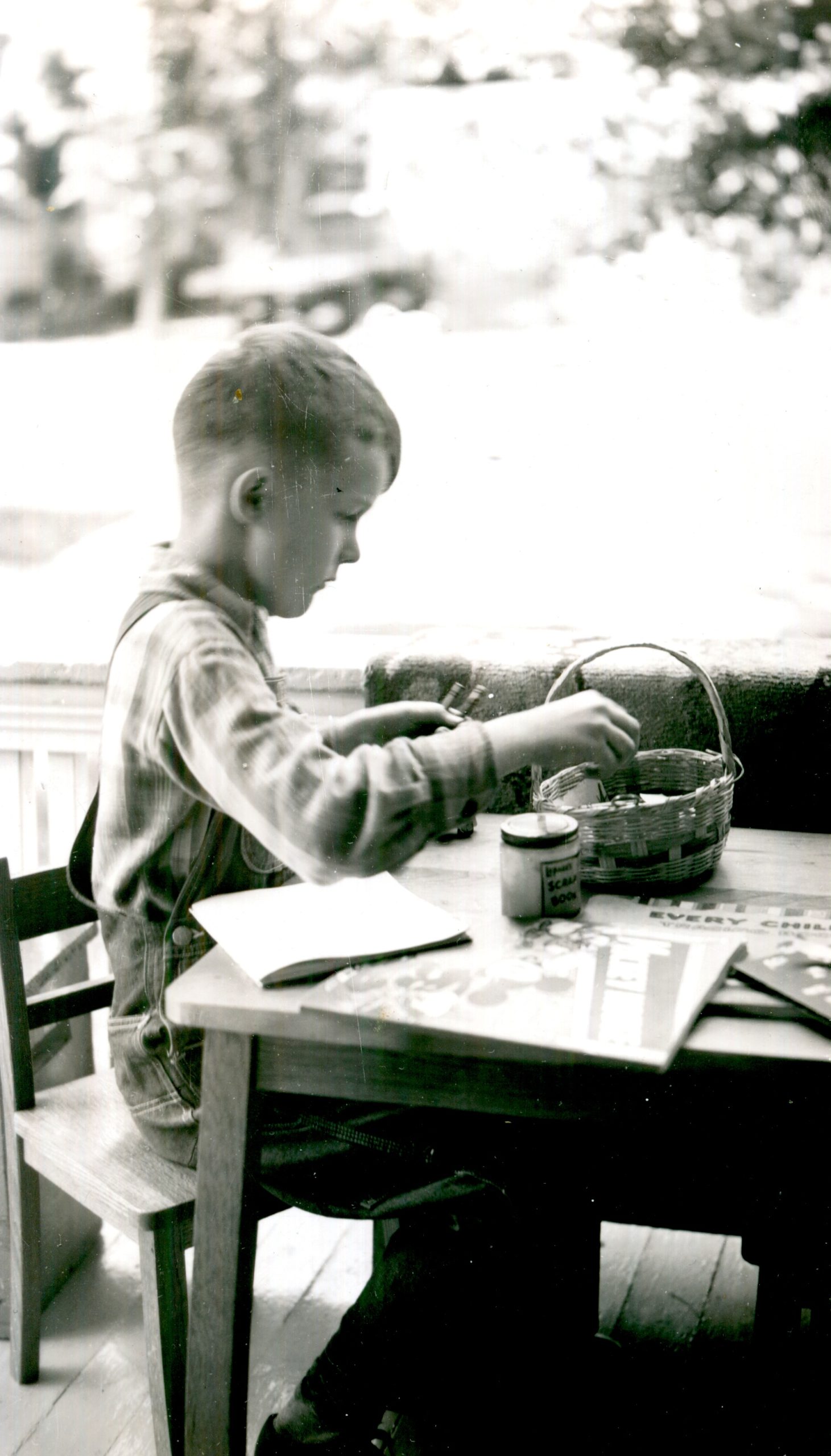 A young S.Clay Wilson at his parents' home in Lincoln, Nebraska, circa 1952.
In today’s modern world handwritten letters are a rarity. There are still occasional birthday wishes and Christmas cards that contain a short note and a signature, but long letters that take time to write have been replaced by electronic messages that fly through the ethernet. Even signatures for documents can be done digitally. The cartoonist S. Clay Wilson was old school all his life and valued sending and receiving personal correspondence. Even as a young boy he preferred hand-drawn holiday cards over Hallmarks.
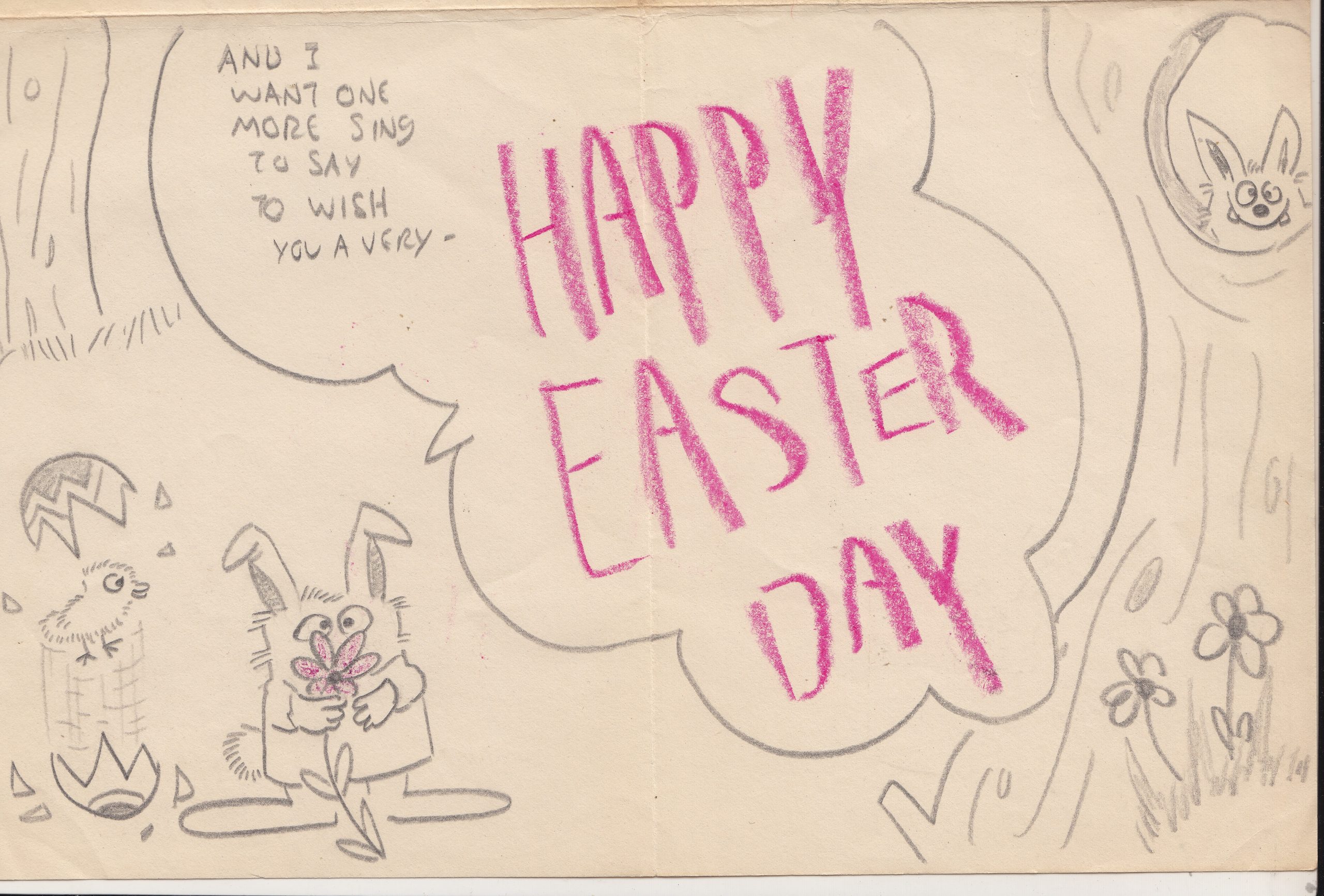
He lavishly decorated his letters to his friends. That ritual ended shortly after his traumatic brain injury in 2009, when he could no longer draw or put a sentence together. Here are some examples from beginning to end that celebrate his lifelong diligence for his own enjoyment.
Wilson never learned to use a computer and often expressed disdain for electronic communication. However, Lorraine Chamberlain moved in with a Mac and an email account in 2000, so he could always count on her to be his go-between with the 21st century. Imagine how much less interesting his correspondence would be if he had chosen Yahoo or AOL for delivery, even with all the jpegs and emoticons that are available today. Fortunately for his friends, Wilson was an old-fashioned man, who must have been taught good manners by his parents at an early age about thank you notes.
***
S. Clay Wilson’s morning ritual used to begin with a cup of tea, a puff of kief, and the day’s correspondence. All through his adult years, he would sit down at the drawing table each morning, surrounded with pens and ink, felt-tip markers, watercolors, cut up magazines, stickers, and a suitcase full of rubber stamps to respond to his friends and fans who took the effort to write him a card or letter. He loved to send and receive mail.
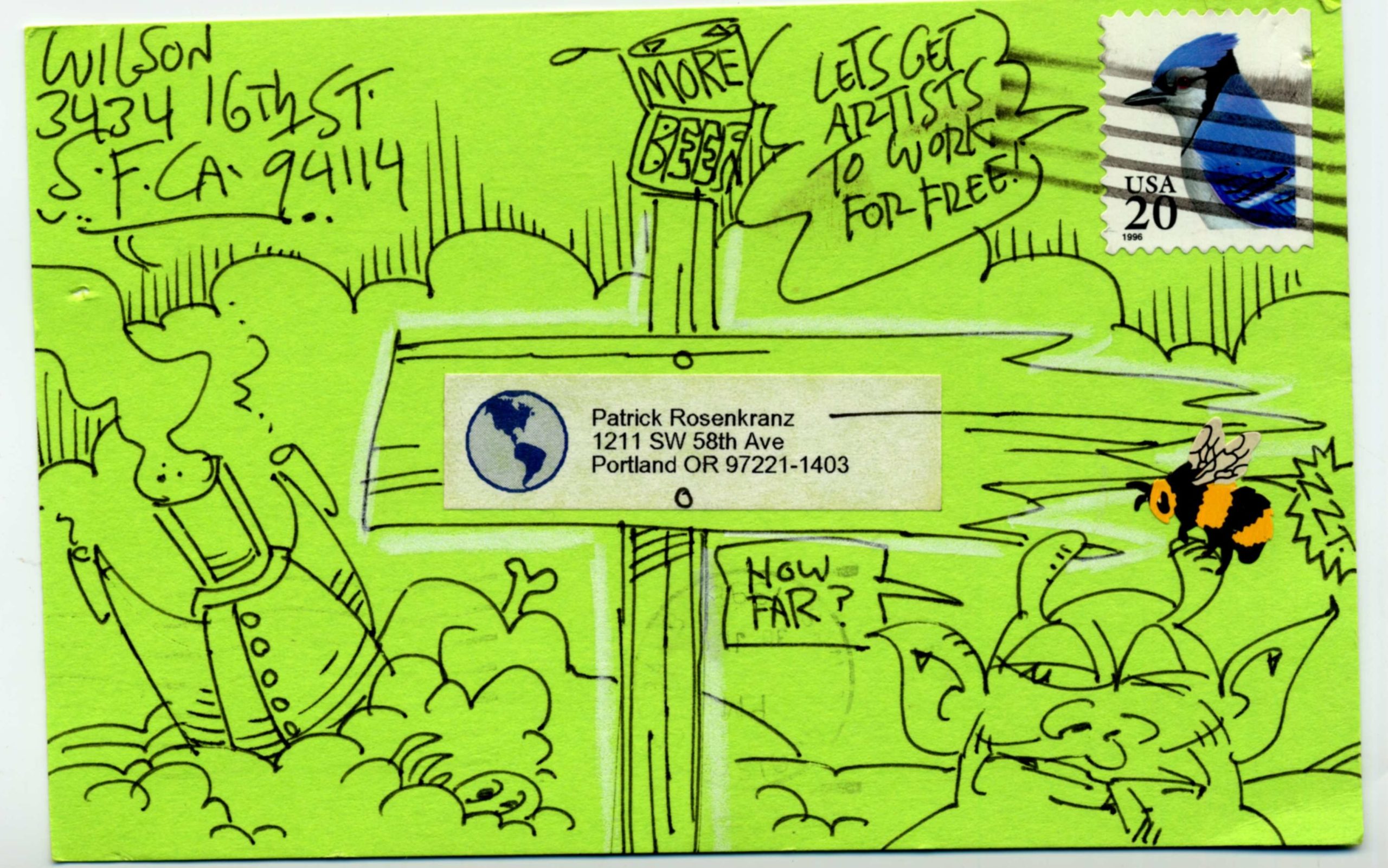
Postcards, stationery, and envelopes often got the “Full Wilson” treatment before they were mailed off, decorated with collages and drawings, adorned with speech balloons, or stamped with devils, hearts, pinup girls, beer mugs, sharks, rocket ships, horses, UFOs, Polliwogs, beer cans, dancing dogs, nudie cuties, femme fatales, alligators, Jolly Rogers, frogmen, pickles, matches, razor blades, flying wheels, rising suns, motorcycle riders, and many other stamps that he collected over the years. When friends sent him mail that featured rubber stamps he didn’t have, he would offer to trade something for them. Playboy and Hustler magazines also provided suitably lurid clippings for his photo collages. He pushed his envelopes but he had to remain on the slippery side of propriety if he wanted the postal service to deliver his mail. His packages to overseas friends often received more than usual attention from customs authorities.
“These wonderful envelopes would arrive with these really bizarre stickers and drawings on the outsides of them. They were just amazing to get,” said Brenda Fyall, who helped host Wilson in the Scottish Highlands when he visited there during his Europint 1984 Tour. “Of course, the customs and excise had been through them every single time, which was rather funny.”
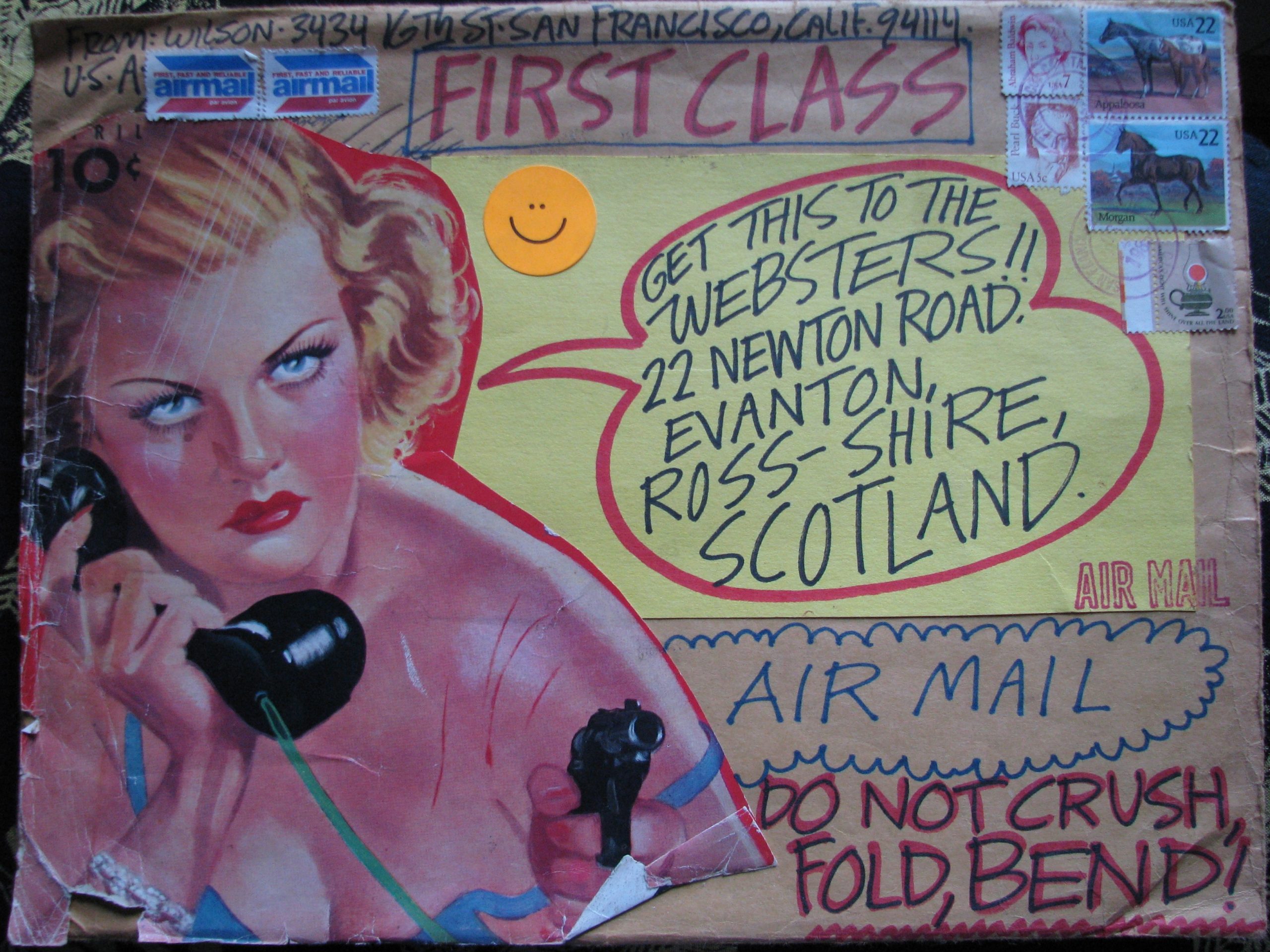
Since his correspondence was private, he logically expected that only the recipients would ever read them, but many of his friends kept them and shared their caches of letters. After Wilson could no longer speak fluently for himself, his writings helped me to understand another side of him apart from the bluff and blunt public persona he most often portrayed. He had a lot of open-hearted affection for the people who were close to him, and he sometimes confessed to boneheaded blunders in his love life or regrets for drunken antics that in retrospect might have been avoided. This correspondence also helped me trace his movements and put dates to the milestones in his career. In The Mythology of S. Clay Wilson, I reprint or transcribe many of them to allow the reader into hitherto unseen aspects of this iconoclastic artist.
***
David Fowler was one of Wilson’s earliest regular correspondents. They met at the University of Nebraska around 1960. During the summer following graduation, Wilson was drafted into the Army. After he was dismissed from a boot camp for medics, he reported for active duty in the National Guard. He wrote Fowler some illustrated accounts of his experiences. “The ugly pain is that I have to go to National Guard camp from the 10th of August to the 24th. A bad scene,” he wrote. In another letter he added “I’m writing this letter to you with a government pen on a cold grey evening while sitting at a scarred desk in a stark desolate message center office dimly lit by naked bulbs with helicopters buzzing overhead. One nightmare Jackson. … I really can’t think of anything to write about. Describing this situation here to you would only depress me further. See you later alligator.”
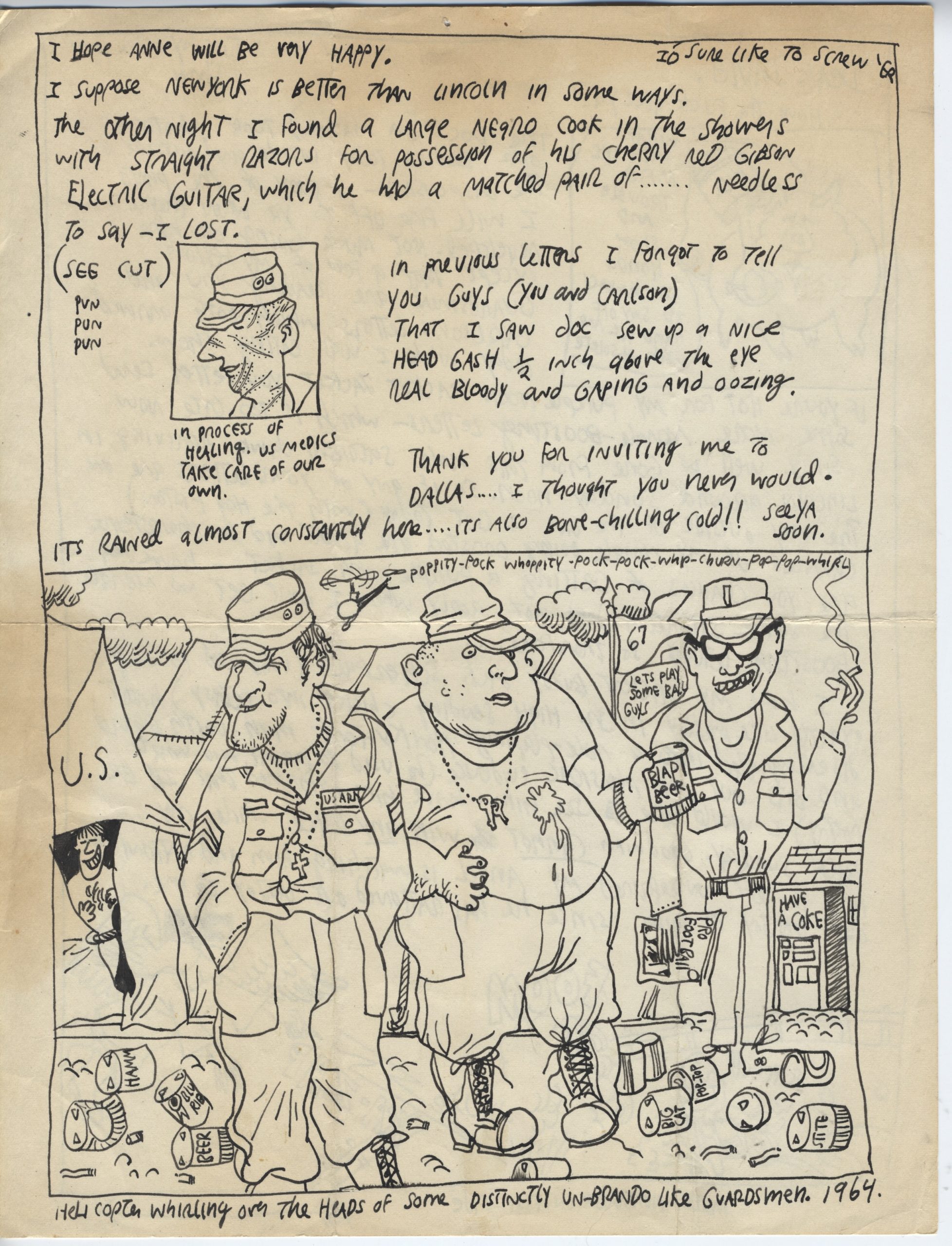
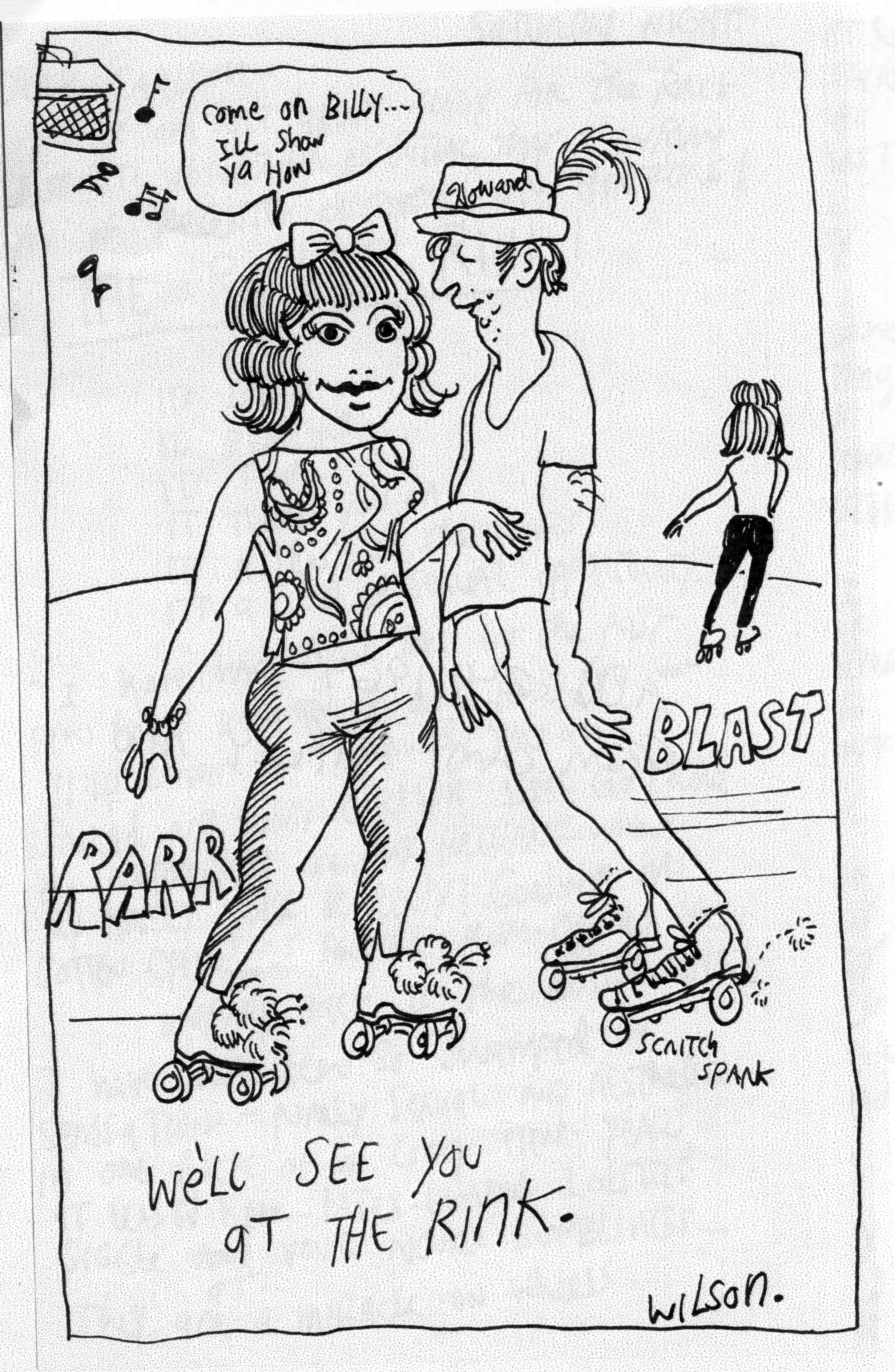
Camp life brightened up a little by the time he wrote about a new passion to his friend Bill Carlson. “I am just about ready for the rack but it’s absolutely essential that I inform you of recently discovered new horizons! The Roller Rink!” Calling the Little Falls, Minnesota Roller Rink a “feast of the senses” and “a field of sexual opportunity” he swore his friend to secrecy, saying they will replicate his discovery together at the local rink when he returns home.
The “Capri-clad teenage girls” on wheels stoked his imagination for another six pages. “A constant swirling cloud of young be-bops. Beautiful little girls beyond description with lithe little bodies blasting around on skates, which with the slightest imagination will cause an instant Levi-ripping erection! I’m watching them all blasting around in this hypnotic vortex all to the loud chants of The Beatles and "It’s fun, fun, fun till her daddy takes her T-Bird away." Too much. Too much. I’m turned on DELUXE. I’m spending every cent I own on this activity from now on! I have never in my entire life been this turned on outside of the actual act of screwing itself. You will dig it. The perfect blend of sex and violence, which is not vicarious. It’s cleansing like taking a shit or crying or something.”
John Gary Brown was another college chum who later roomed with him in an old stone house near the UK campus in Lawrence, Kansas. When Wilson lit out for San Francisco in 1968, he sent back regular reports to his pals about his adventures in the Bay Area. “Wilson was good writer,” said Brown. “We stayed in touch and visited each other as often as we could. He was a great pen pal, and I have saved all his beautiful correspondence in scrapbooks that follow the misadventures of the subculture and the 9mass culture alike.”
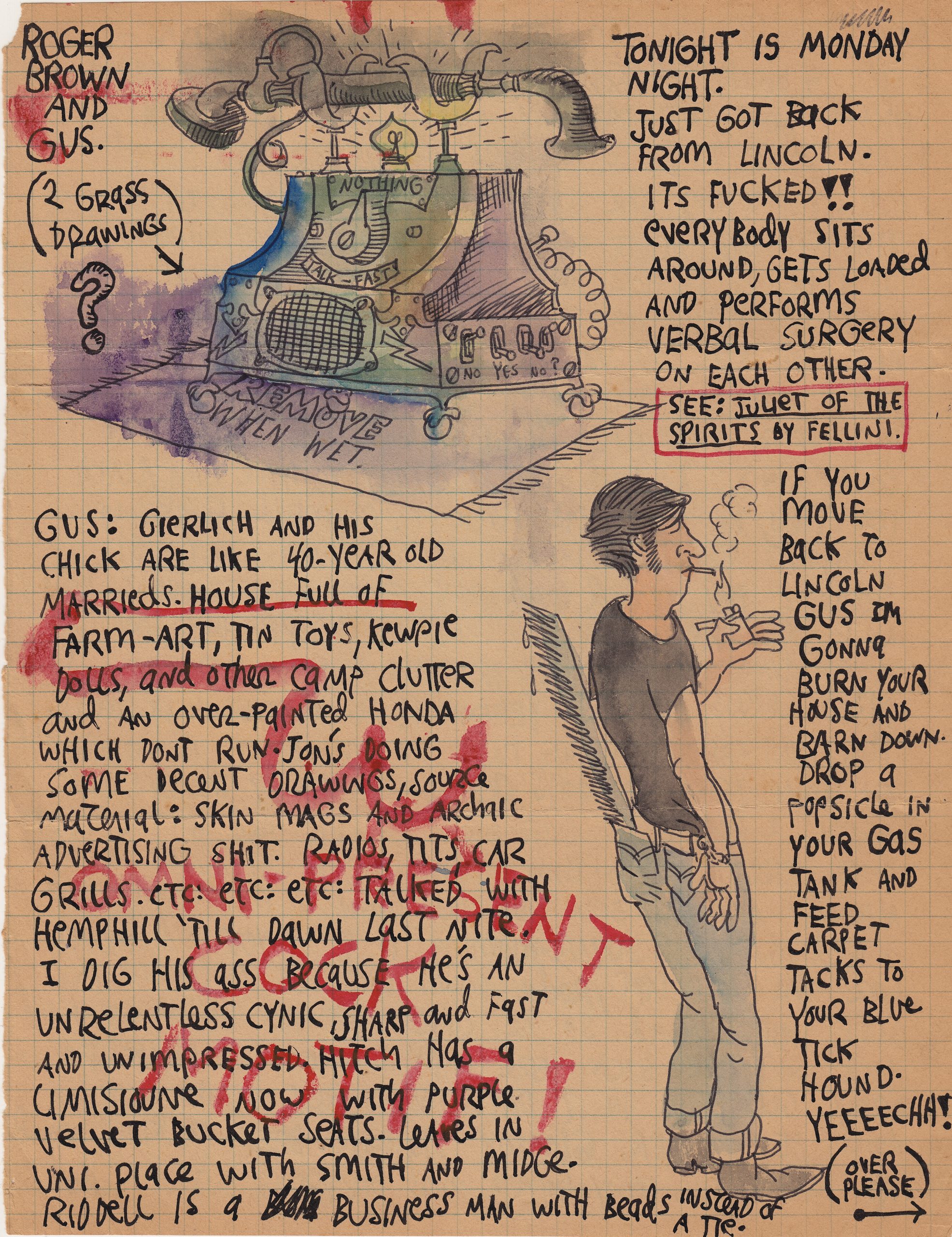
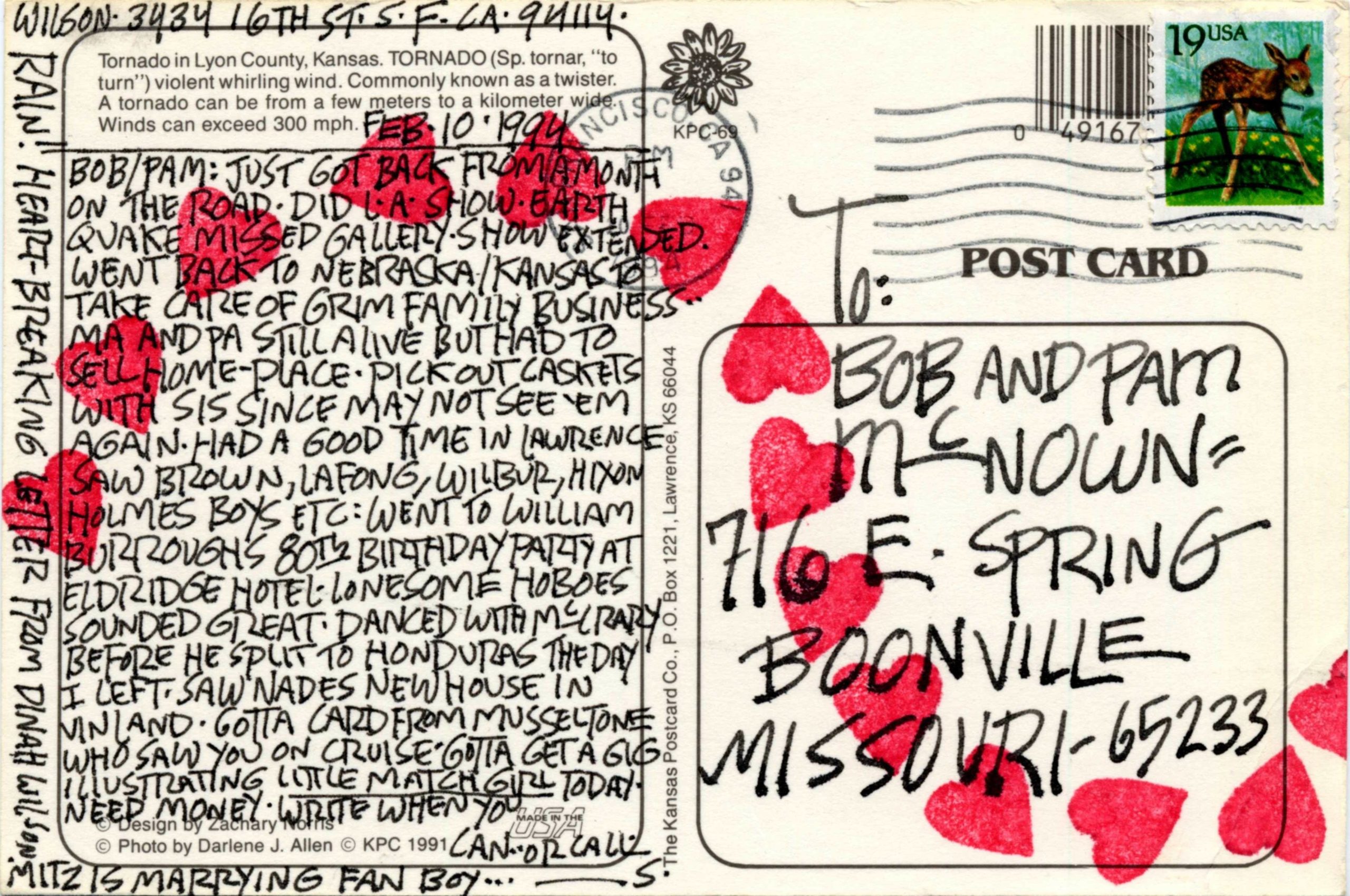
Wilson had friends everywhere and worked at keeping in touch with them, despite long distances or infrequent get-togethers. He enjoyed having an audience to his exploits and the feedback they gave him. He liked to exchange points of view about art and the human condition. He kept everyone informed about his latest comic book or gallery exhibit or interview or magazine illustration. He sent out hand drawn price lists of his original art on a regular basis. If a gallery show didn’t sell out it prompted a new price list of the leftovers at bargain prices. He was a self-promoter par éxcellence. When someone received a card or letter from Wilson, they got more than just an acknowledgement.
Robert McNown, who knew Wilson when he worked as a figure study model at art school in Lawrence, endeavored to match Wilson’s postal output and outrageousness. “If I put a postcard in the mail on Tuesday and didn’t have one back by Friday, I thought he’d died,” said McNown. “He was that good at responding and it lit my fire as well. It was this ongoing odd communication thing. We would banter back and forth.” McNown also saved Wilson’s cards and letters and preserved them in three-ring binder plastic sleeves.
Underground cartoonist Joe Schenkman introduced himself to Wilson at a Rip Off Press party in San Francisco in 1970 and they quickly became good buddies. Wilson and Schenkman began what would become forty years of correspondence. “A letter to him wasn’t just a letter,” said Schenkman. “He never typed and they were complete art experiences, inside and out. S. Clay was an intense letter writer, and both of us liked to flip out the post office and each other with as outrageous envelopes as we could get away with. Writing letters with Wilson was also the unspoken contract where you never got a letter until you responded. His response time? Super-fast. Correspondence, and as wild and crazy and full of eyeball kicks as it was — a letter for a letter — is very old-fashioned. And in some ways, so was Wilson. Often he began with homemade envelopes made from magazine pages, then pasted a homemade label on top of that, with Wild Style lettering. We were both big fans of the graffiti movement. Repeating rubber stamps ... babes, skulls and crossbones, etc. These letters show another side of Wilson as an artist. More one-on-one, art for the people, art with a little ‘a.’ I think he was a bit like Lenny Bruce, in that the forbidden subjects were tops on his list. Obviously, Wilson was aware of shock value, and wasn’t too different than Dali in this department, except Dali was Art with a Capital A.”
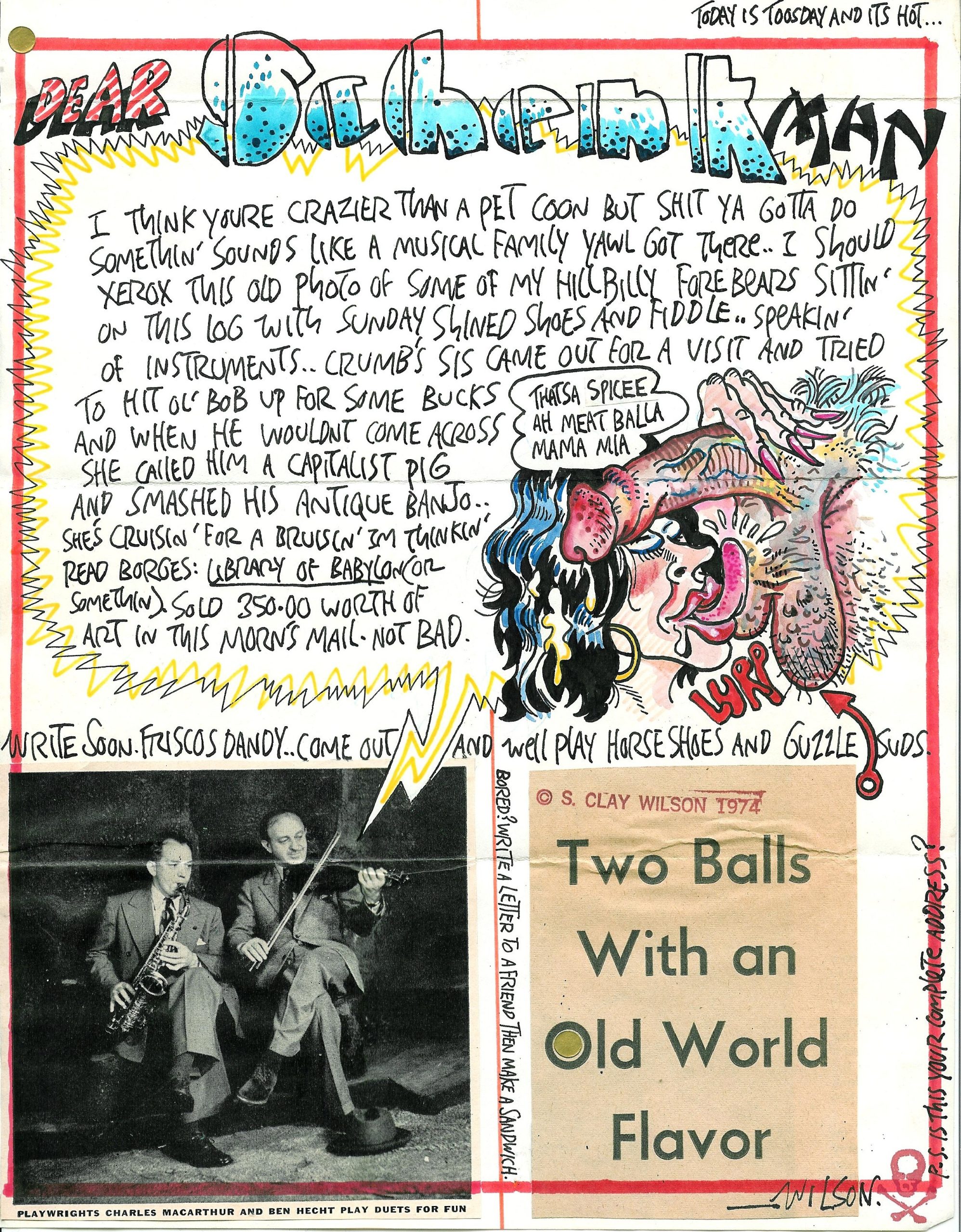
Letter to Joe Schenkman December 4, 1980:
Twas a joy to get your letter. I wonder if the mailmen get off on our zany letters with the jumpy envelopes. Well fuck ‘em if they can’t take a joke. Hoping you had a bountiful Thanksgiving with your cheese omelet. Did ya’ drink? We had a pretty excessive one — lots of turkey and deviled crab casserole and Irish whiskey and three kinds of wine and a shitpot of Aussie stout and cocaine. Got into a toot with the toot and stout and drank solidly for 33 hours straight. The come down hangover was a lulu I can tell you that. Paying the piper, etc. Remember that dead cat you gave me when we first met? You don’t? Send me the dancer stamp for Xmas; maybe I can score you a syringe stamp.
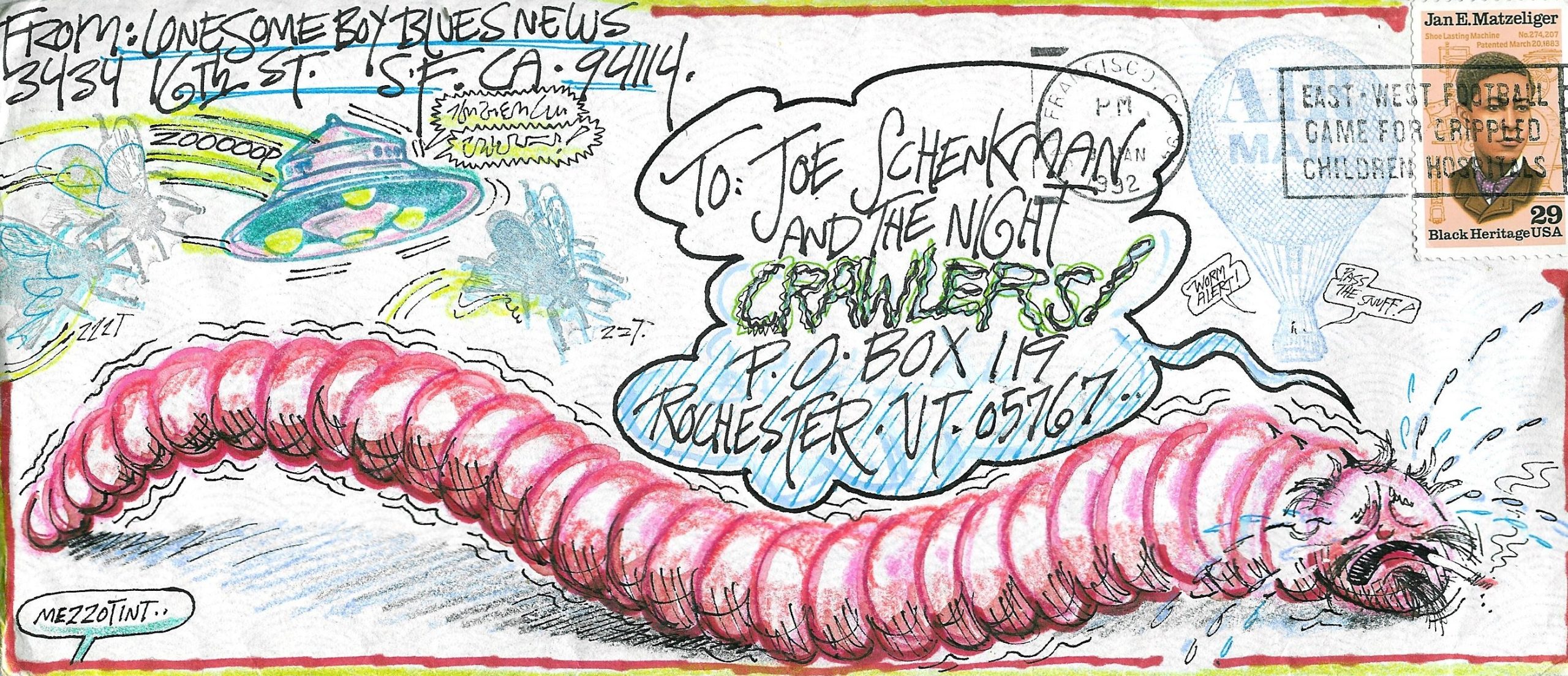
“He had great insights into psychology, and the way people thought, and was super educated about the ‘art world’ in general,” said Schenkman. “As Tom Waits would say of Keith Richards, he had ‘predator instincts.’ He often ‘hustled’ his work, and shamelessly, but part of him would be acting, too, so that he’d be parodying a hustler. It seemed like he could step outside himself and be absorbed in himself at the same time.”
Wilson always said fellow artist Alfredo Arreguin would be the perfect actor to play the Checkered Demon in a movie. They raised hell together whenever they found themselves in Seattle. They even got 86-ed from the Blue Moon Tavern, which is saying something.
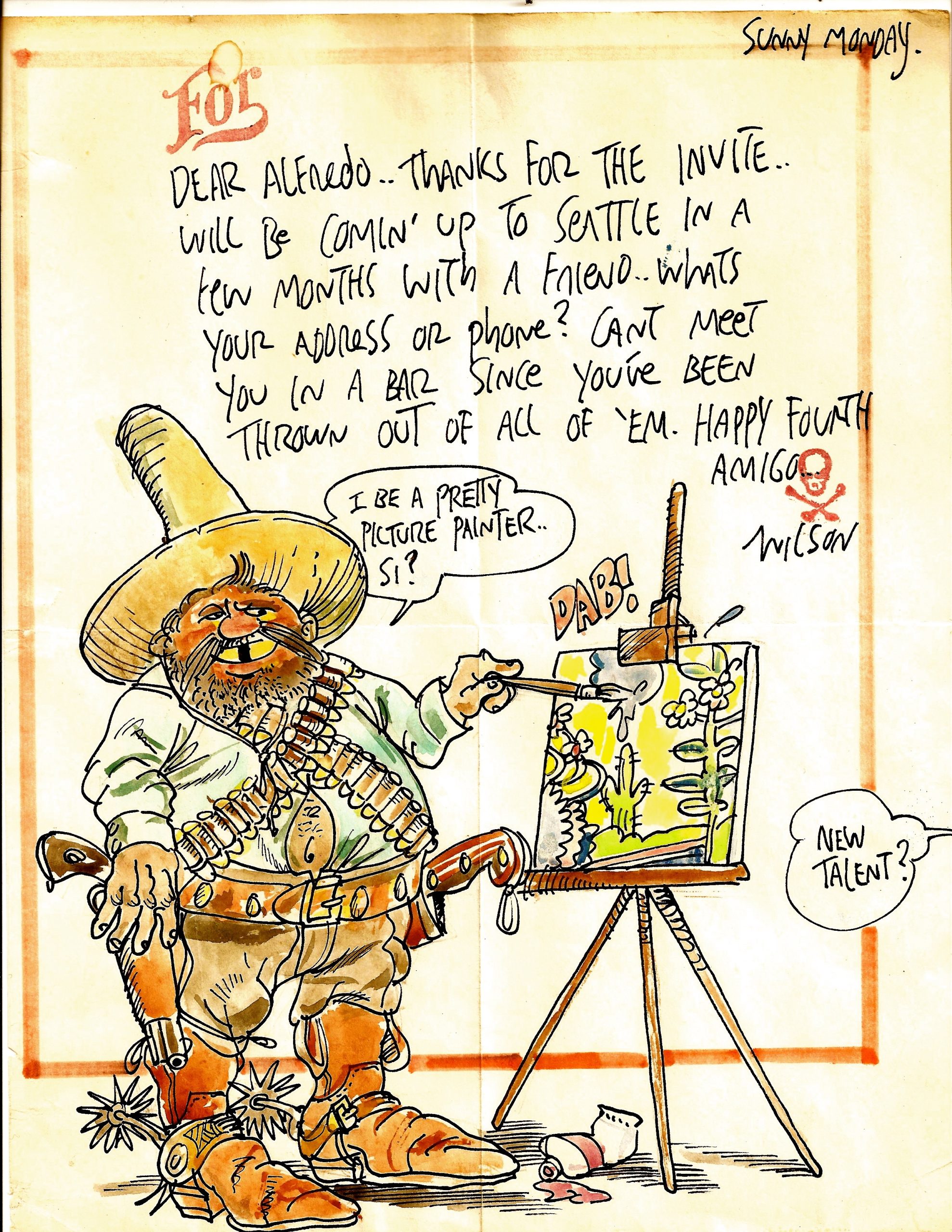
A more intimate form of correspondence included “cute notes” which he sketched on the sly for his lady friends and then stuffed them into their coat pockets or purses when they weren’t looking. Sabeth Ireland, who lived with Wilson all through the 1980s would often discover them when she got to work.
“The ‘cute notes’ he gave me almost every day still crackle with life and the joy of living in this world, with all its horrors and foibles,” said Ireland. “He really had the knack for living and he was a Sun. Or maybe it was a Black Hole. Either way, his energy was irresistible and nearly impossible to live without, and I'll always love him.”
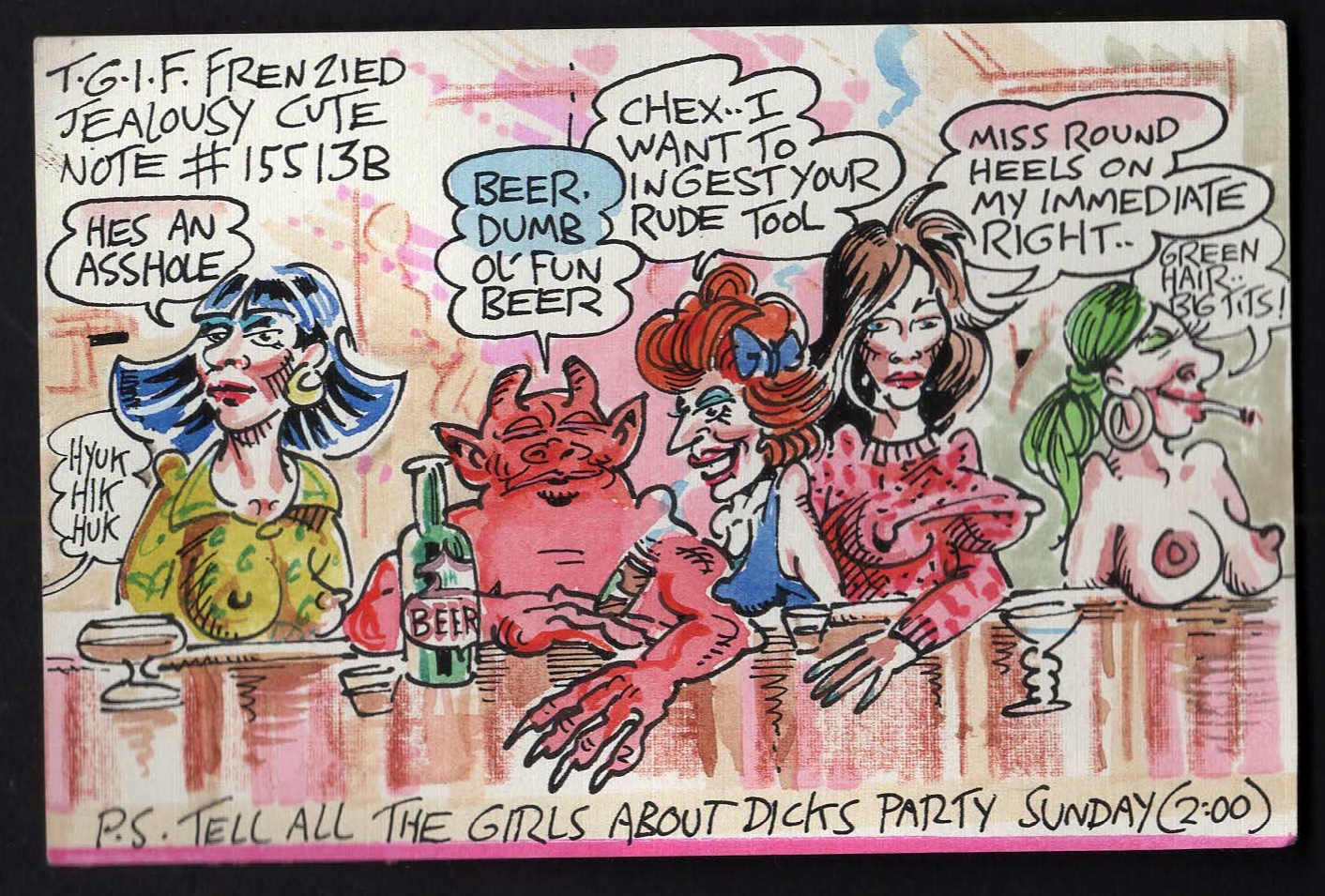
His love letters to Lorraine Chamberlain, who he married in 2010 often included pornographic images that depicted his true feelings. There were no rhymes of moon and June or comparisons to roses or violets. “I think we should decide to do something about this strung-out relationship of ours like get a shack in Shanty Town and lay in bed all day drinking beer and fucking and sucking and eating fried chicken and throw the bones on the floor like a pair of real down home heathen slobs,” he cooed instead.
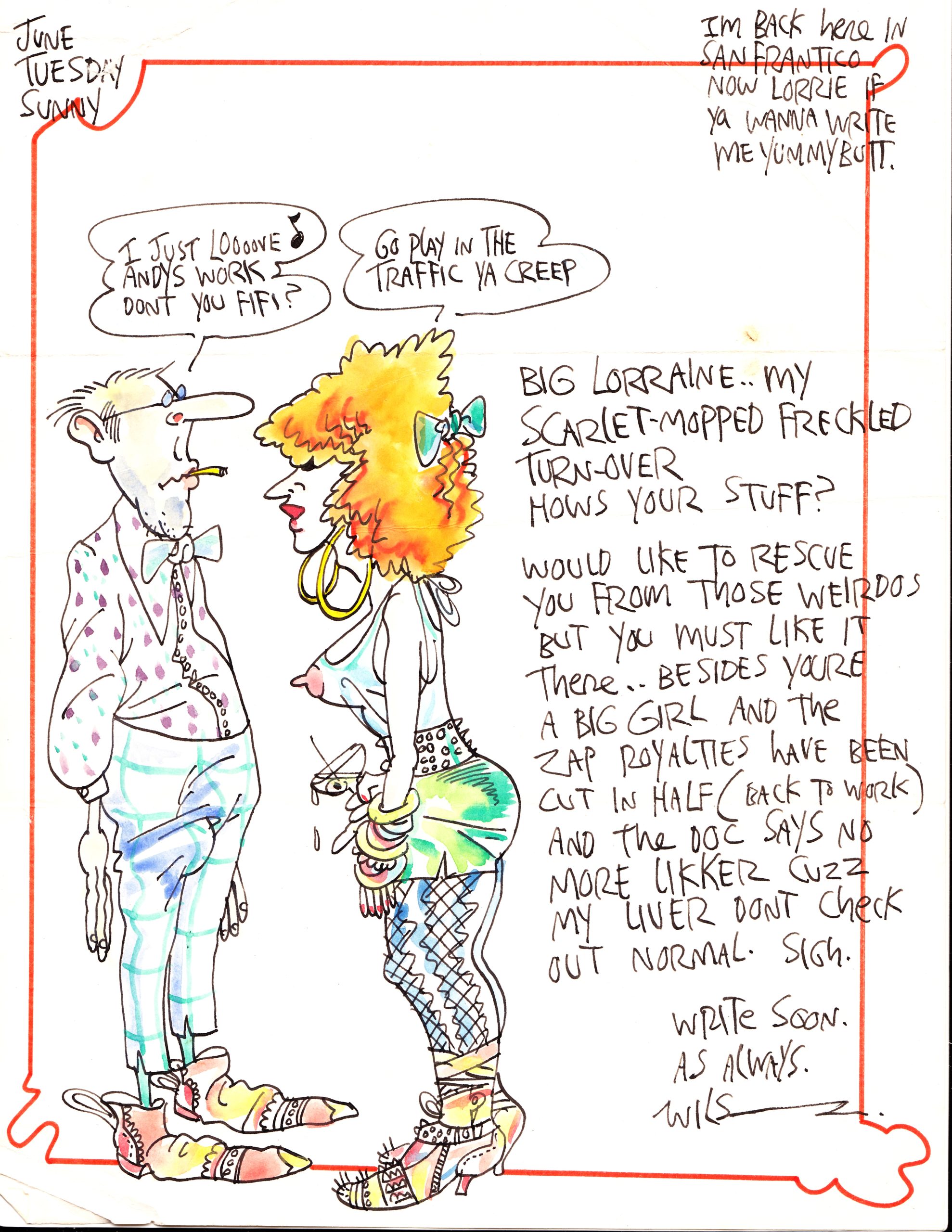
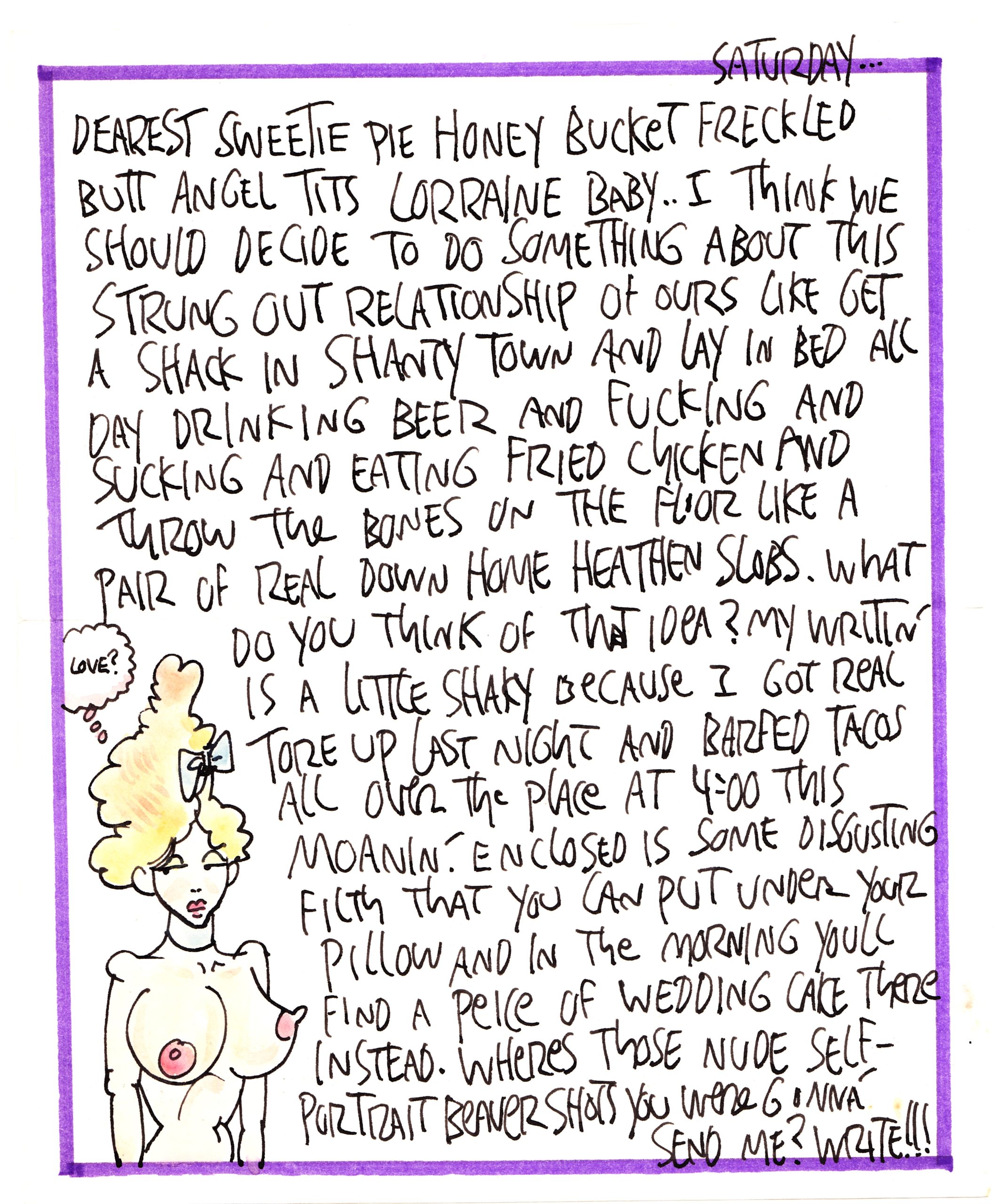 Circa 1975 Wilson wrote to Lorraine Chamberlain upon his return to San Francisco after a visit to New York. She worked with Andy Warhol’s Interview magazine and tried to convince them to feature Wilson’s art. Needless to say he ignored the doc’s advice about alcohol.
Wilson’s lifelong writing habit ended in the fall of 2008 when he suffered a debilitating head injury on a rainy San Francisco street late on a Saturday night. He remained in a coma for a week and the doctors didn’t know if he would ever recover, but when he they disconnected him from life support, he came awake and was able to talk and recognize his friends. His brain trauma permanently changed him though, and he began losing his ability to draw and write. Within a year he laid down his pen and stopped doing those things he enjoyed so much.
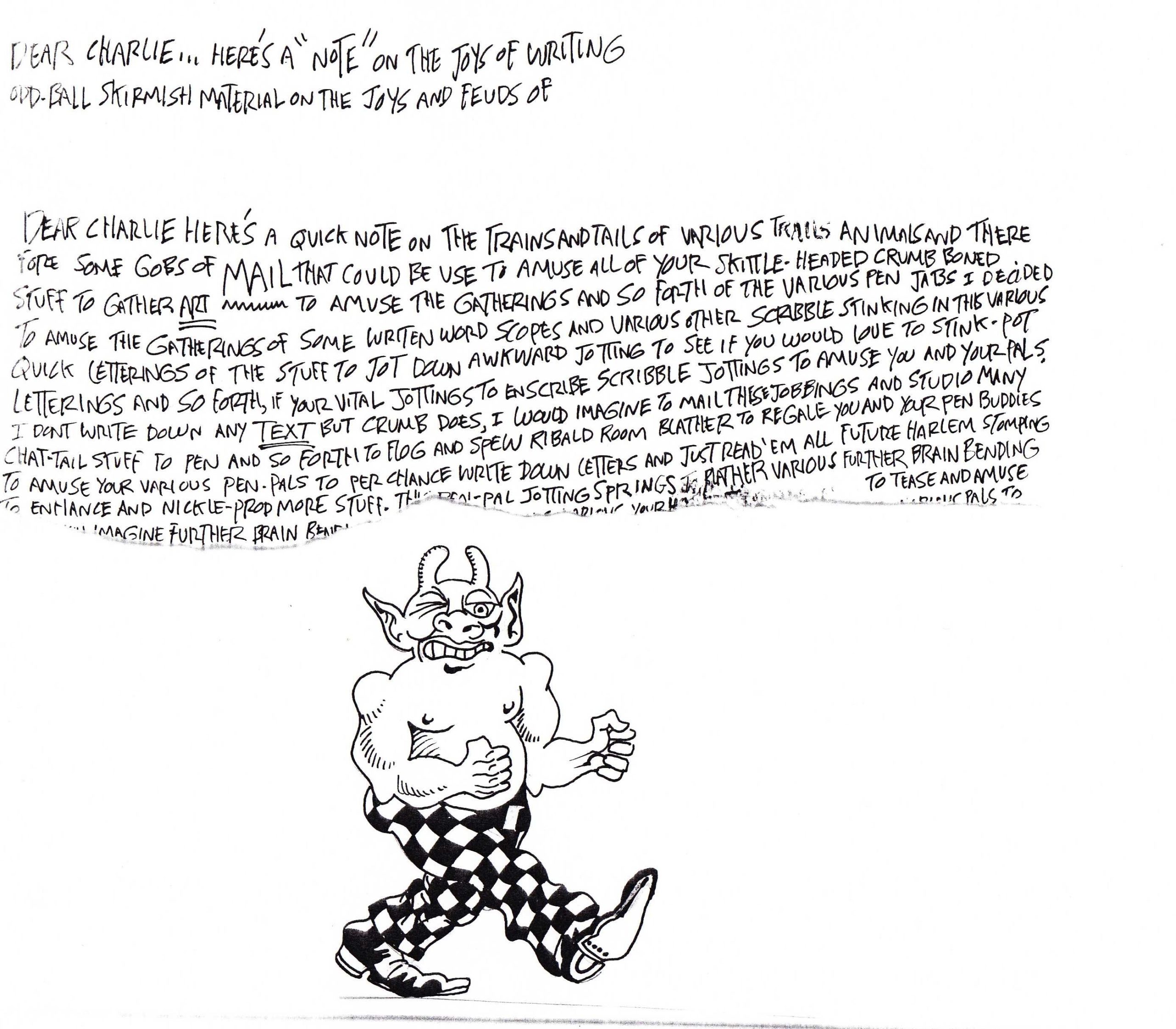
In February 2010 he attempted to write a letter to his old friend Charles Plymell, who kicked off his career by publishing a portfolio of Wilson drawings in Lawrence, Kansas in 1967. It began, “Dear Charlie … here’s a ‘note’ on the joys of writing odd-ball skirmish material on the joys and feuds of …”
He began again. “Dear Charlie, here’s a quick note on the trains and tails of various trails animals and therefore some gobs of mail that could be used to amuse all of your skittle-headed Crumb boned stuff to gather art.”
Lorraine witnessed the frustration at his inability to compose a logical sentence. She later wrote to Plymell, “Wilson spent over an hour trying to write you a letter yesterday. He kept tearing them up, making errors. I will keep him at it. It will be the first letter and/or postcard he has written in over a year. I will retrieve them out of the wastebasket and send them to you when he's not looking. Now he won't write. It's hard to get him to focus and keep working on something lately. I am really having a dark case of the blues today about this routine.”
I have half a dozen Wilson letters and cards in my files, composed by hand and decorated in his unique style. I prize them. In 1998 when I was interviewing Wilson at his home, he said to me, “Patrick, we’ve been friends for a long time.” I thought to myself, “We have?” I didn’t realize that that he saw me that way. I figured he considered me a nosy journalist, but because I’d kept in touch over the years and written intelligent things about him, I was on the side of the angels, or maybe it was the devils. In any case, the thousands of pages of mail that poured out of him over half a century add an all too human dimension to the artist that the world knew mainly as a taboo busting iconoclast. He could also be warm and charming and valued close ties with his extended artistic family.









 English (US) ·