
Abel Reyes | May 27, 2026
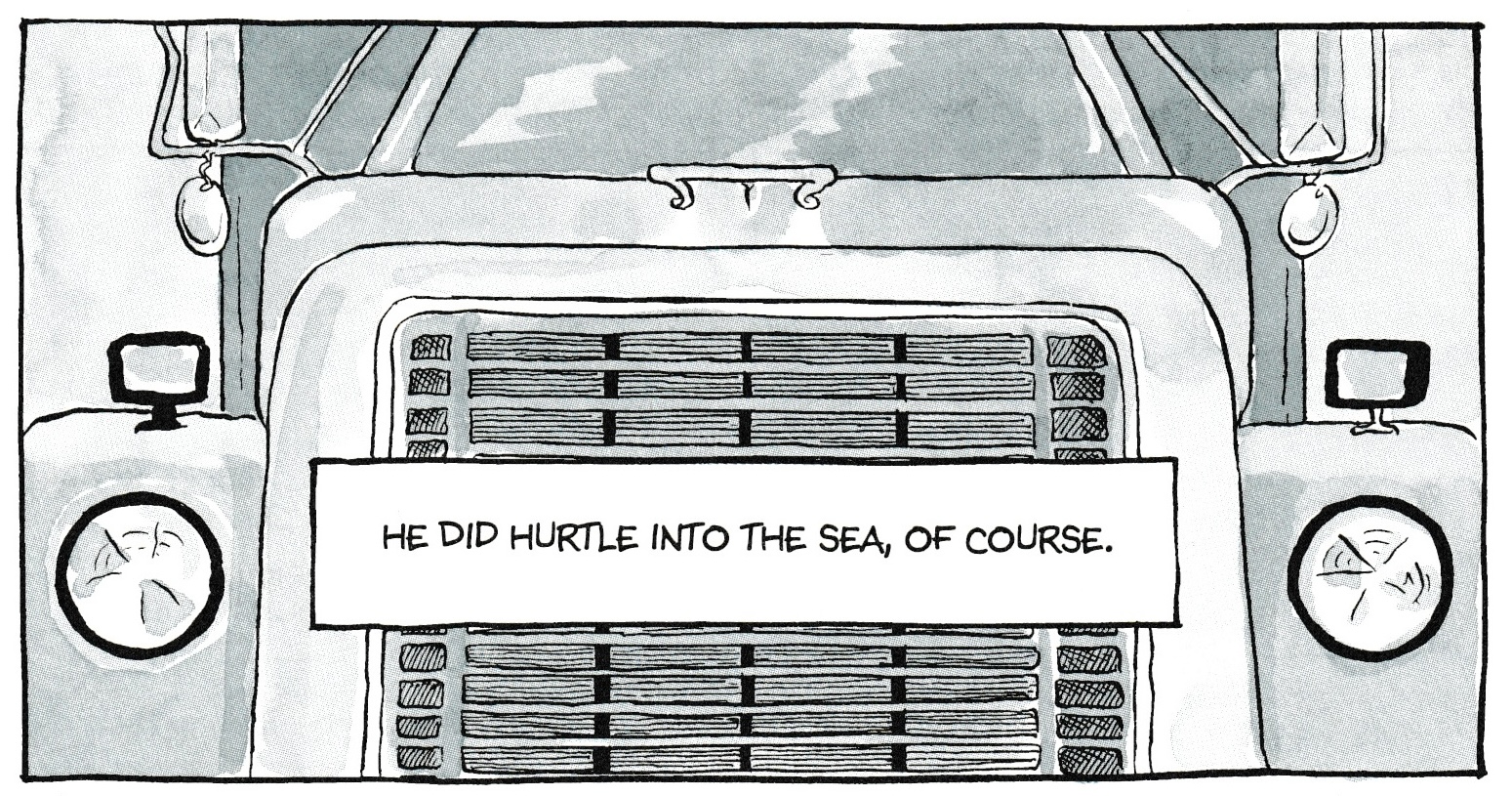
“Maybe it was the converse of the way amputees feel pain in a missing limb. He really was there all those years, a flesh-and-blood presence streaming off the wallpaper, digging up the dogwoods, polishing the finials ... smelling of sawdust and sweat and designer cologne. But I ached as if he were already gone.”
Here, then, you have Alison Bechdel’s first graphic memoir, Fun Home: A Family Tragicomic, distilled to a few sentences. Or rather, something like its pressure point. It is tempting to say that this is Fun Home in miniature, where presence and absence braided so tightly they become indistinguishable, the living body already spectral, the ache arriving before the loss. Or perhaps this passage better resembles Bechdel’s attempt at explanation, at thesis:
“I suppose that a lifetime spent hiding one's erotic truth could have a cumulative renunciatory effect. Sexual shame is in itself a kind of death.”
If either passage feels like it truly captures the essence of the book, then the final page feels like its wager. The ending of Bechdel’s graphic memoir about growing up in a small-town funeral home, coming into her lesbian identity, and reckoning with her closeted father’s life and death, has often been read as redemptive, as a belated act of trust that steadies the narrative of loss. Now, twenty years later, while the book has stood the test of time and secured its place in the contemporary literary canon, the question is not simply what Fun Home means, but why it chooses to stop exactly where it does.
The life of Bechdel furnishes the memoir with its stark coordinates. Born in 1960 in Lock Haven, Pennsylvania, the daughter of two English teachers who ran the town funeral home out of their Victorian house. Her father, Bruce, was a meticulous restorer who loved craftsmanship, pouring obsessive care into the house’s ornate moldings.
In college, Bechdel came out as a lesbian and only weeks later her father confessed to his own relationships with men and teenage boys. Shortly after that disclosure, he stepped in front of a truck and died, an event officially ruled an accident but one the memoir persistently circles as possible suicide. Fun Home braids these timelines into a formally intricate meditation on secrecy and inheritance.
Yet the Bechdel home was not only a funeral parlor but a literary archive, stacked with volumes that Bruce Bechdel lived through with almost devotional intensity. A lot of Alison’s coming of age takes place in these margins and underlined passages. She discovers the word “lesbian” in a dictionary; she recognizes herself in Colette and Radclyffe Hall; she begins to understand desire as something legible because it has already been written. At the same time, in Fun Home, Bechdel threads the myth of Icarus through her father’s life and her own. He the doomed aesthete flying too close to exposure, she the child balanced above him in a reenactment that promises a different outcome.
The memoir’s dense web of allusion stages inheritance as textual, as though father and daughter are bound by the stories that taught them how to imagine themselves.
In its finale, there are but two panels that seem to do incompatible work. The first is not the leap at all, but the truck. A stark image of the vehicle that killed her father, rendered with the same cool, documentary distance that has marked the memoir’s treatment of his death. It sits there as blunt machinery, as the unadorned force of accident (or intention) against which all interpretation falters.
The panel’s severity is almost inconceivable within the ornate architecture of the book that contains it. We are confronted with industrial mass and forward motion. The truck is a machine moving through space, indifferent to narrative design. A life rendered through art meets a death rendered as fact, and the machinery refuses to be absorbed into the book’s otherwise intricate pattern.
Only after this does the book return to the childhood scene of Alison midair, the father below, arms open. Between them lies the memoir’s final tension of whether an image of trust can coexist with the image of impact.
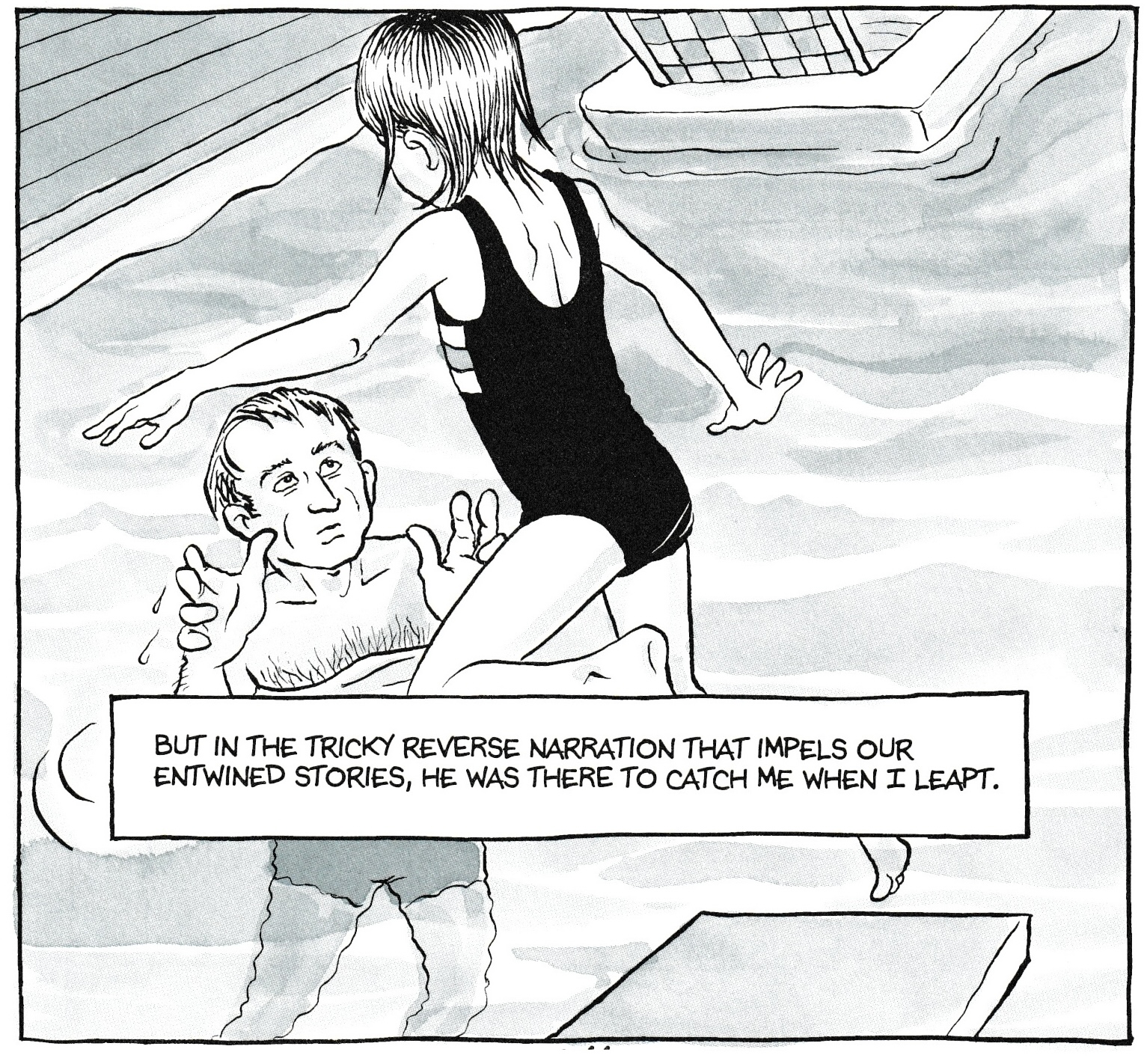
I first came to this image at nineteen, reading the book in college, and I remember the leap felt almost too graceful by comparison, too clean. What stayed with me was the sense that Bechdel had arranged these panels to leave us hovering in that thin interval where interpretation gives way to uncertainty.
What if the power of that final image lies not in the promise that he will catch her, but in the risk that he might not? What if the memoir closes not by resolving Bruce Bechdel, but by staging the impossibility of doing so?
The final panel is so arresting due to the quiet dissonance between what we see and what we are told. The caption assures us, calmly and retrospectively, that “he was there to catch me when I leapt.” But the image resists that certainty. The text declares a completed action while the drawing freezes the instant before contact.
Caption and image occupy slightly different temporalities. One resolved, the other suspended.
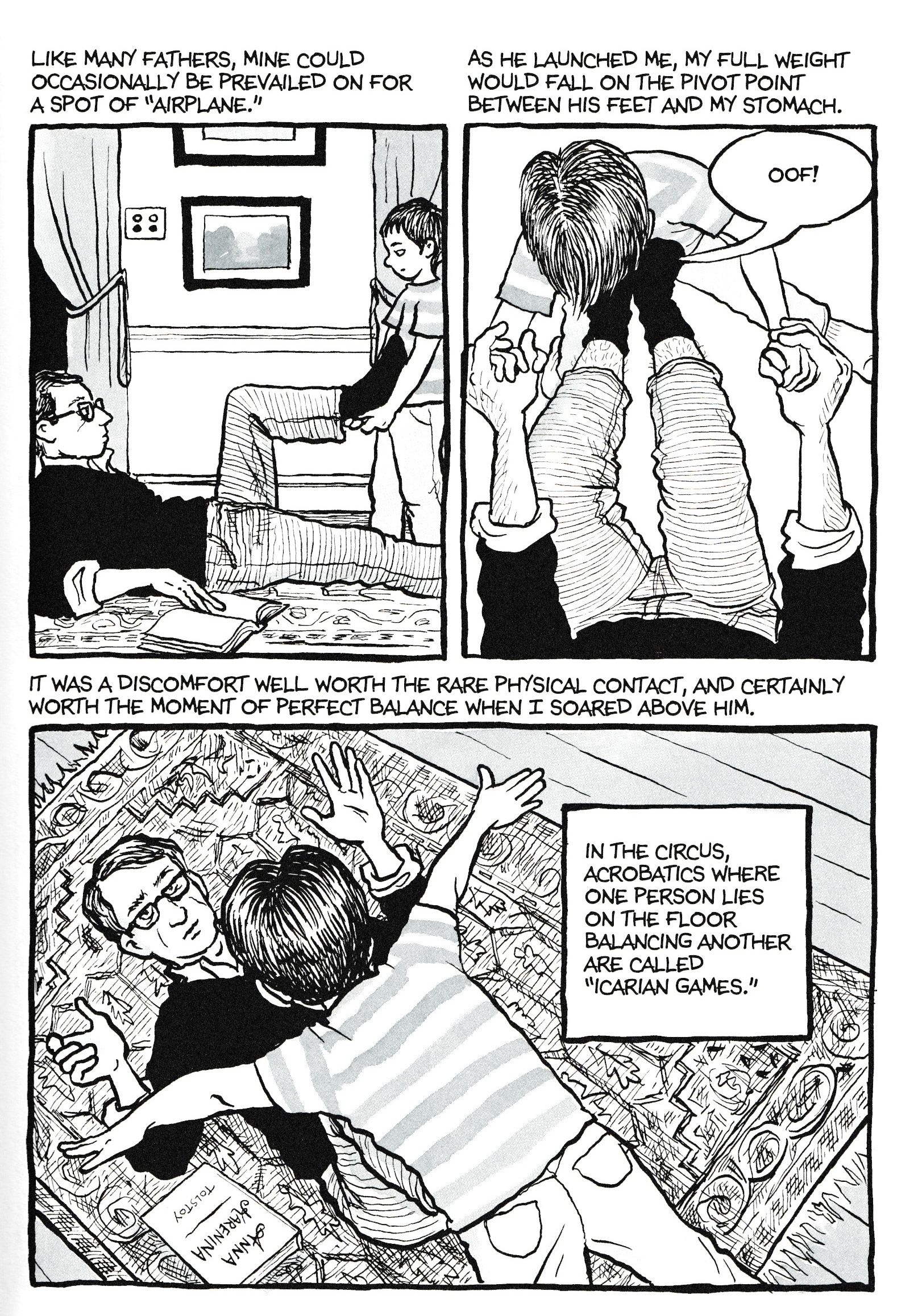 In the first chapter, Bechdel casts her childhood game of “airplane” as a revision of the Icarus myth. “He was there to catch me when I leapt,” the adult narrator tells us, aligning Bruce with the one who designs the apparatus of ascent. Alison frames their relationship through a classical narrative of ambition and collapse. The memoir begins with a myth about falling and ends with an image of it. The leap on the final page returns us to the opening metaphor, asking whether this is a story about a daughter still trying to decide which role she and her father were meant to play.
To return fully to Icarus is to remember that the myth is about a father who engineers escape and a son who mistakes ascent for freedom. Daedalus is both architect and enabler. Icarus chooses exhilaration over caution. The wax melts. The body falls. The tragedy is an overestimation of what the design can bear.
“But in the tricky reverse narration” in Fun Home, Bechdel casts Bruce as Daedalus but also Icarus. If the memoir opens by aligning father and daughter within this mythic structure, the final leap revisits it, to ask whether flight can ever be disentangled from falling.
This is where the redemptive reading exerts its pull. Readers want the ending to redeem because the narrative has trained us to look for patterns. The leap offers something emotionally legible like a present father present and a trusting daughter. We need him to catch her because if he does not, the story collapses into pure accident. The catch suggests that beneath the lies and repression there was contact, however fleeting. It grants the memoir a shape that feels earned.
But what does it mean that the book insists he does catch her? The caption reframes their relationship as reciprocal rather than doomed. Yet the drawing withholds the proof. In that gap, the myth of Icarus reasserts itself. Perhaps the leap is not a reversal of the fall but another version of it, one frozen before catastrophe. Or perhaps Bechdel is doing something subtler, acknowledging that even if the father was there in that instant, he was not there later, at the moment of the truck. The wings worked once. They did not work forever.
It leaves the ending formally consistent with the myth it invokes, that flight and fall are separated by a fraction of time. The redemptive reading depends on trusting the caption over the drawing. But Fun Home has always been suspicious of surfaces. Of finished facades that conceal instability beneath. Bechdel returns us to the logic of Icarus as an inheritance of risk. The memoir stages the desire for rescue, asking whether redemption is something we see or something we decide to believe.
When Fun Home was first published in 2006, George Gene Gustines of The New York Times described the ending in his review saying, “The top half of the final page shows the truck about to strike; the bottom half depicts daughter, in mid-leap, waiting to be caught in her father’s arms. The juxtaposition of the two images is compelling and striking. They also offer reader and author a choice: appreciate what was had or continue to yearn. In completing Fun Home Ms. Bechdel may have finally ended her longing.” The review captures something essential about the book’s reception at the time. The ending was widely understood as a form of closure. Since then, the memoir has been celebrated as groundbreaking in form and subject, praised for elevating the graphic narrative into the realm of serious literary memoir.
Twenty years later, that literary status is secure. Its formal intricacy has only deepened its reputation. Yet Gustines’s framing of the ending as a choice between appreciation and yearning now reads like an invitation. To say Bechdel “may have finally ended her longing” is to privilege the caption’s assurance over the drawing’s suspension. But between impact and embrace, what feels most durable about Fun Home is that it somehow preserves that longing.














 English (US) ·