
Shaenon Garrity | February 24, 2026
Maybe only a certain type of person is excited to read a collection of every interview a cartoonist ever sat down for. But everyone who reads The Comics Journal is that type of person, so forget about those smaller-number-of-interview-reading foobs. We’re roadside, man.
In Conversations with Lynn Johnston, Jeff McLaughlin has added to the net good of human achievement by compiling as many interviews as he can find with the creator of For Better or For Worse, one of the great newspaper comic strips, at a time when newspapers are rapidly becoming antiquities of a better-informed past. The interviews are presented in chronological order, along with a handy timeline of Johnston’s life to help keep events straight; some, inevitably, are repeated over and over in conversation, while others get only a brief mention.
For a career strip cartoonist, a job that traditionally consists of 51 weeks at a drawing table and one weekend letting loose at the Reuben Awards, it’s been a busy life. Lynn Ridgway grew up in Vancouver in the 1940s and 1950s, and attended the Vancouver School of Art, but left early to pursue a career in animation. She emerged from an emotionally abusive first marriage as a single mom, then married Rod Johnston, a dental student with a pilot’s license and dreams of becoming a “flying dentist” in rural Canada. The Johnstons moved to Manitoba, where they lived the kind of life that I, as an American, can only picture via the TV show Northern Exposure. (In one interview, Johnston speculates that she was lucky to be isolated from any fame For Better or For Worse brought.) They had a second child and a sheepdog named Farley.
Lynn found work as a medical illustrator. A gig livening up an obstetrician’s ceiling with cartoons led to her first book, David, We’re Pregnant!, and two more collections of comics about parenting. Her first publisher never paid her for David, We’re Pregnant! or returned her art. But the books reached the States just as Universal Press Syndicate, under the direction of editor Lee Salem, was looking for a new family strip to balance the single-career-woman zeitgeist of Cathy Guisewite’s Cathy. In 1977, Johnston was offered a 20-year contract with Universal, a remarkable show of confidence in her talent.
It’s never been a secret that For Better or For Worse borrows from Johnston’s own family. Homemaker Elly Patterson, who is drawn as a much frumpier version of Johnston, is married to a (non-flying) dentist and has two children, Michael and Elizabeth, whose first names are the same as the middle names of Johnston’s children, though the Patterson’s late-in-life daughter April is wholly fictional.
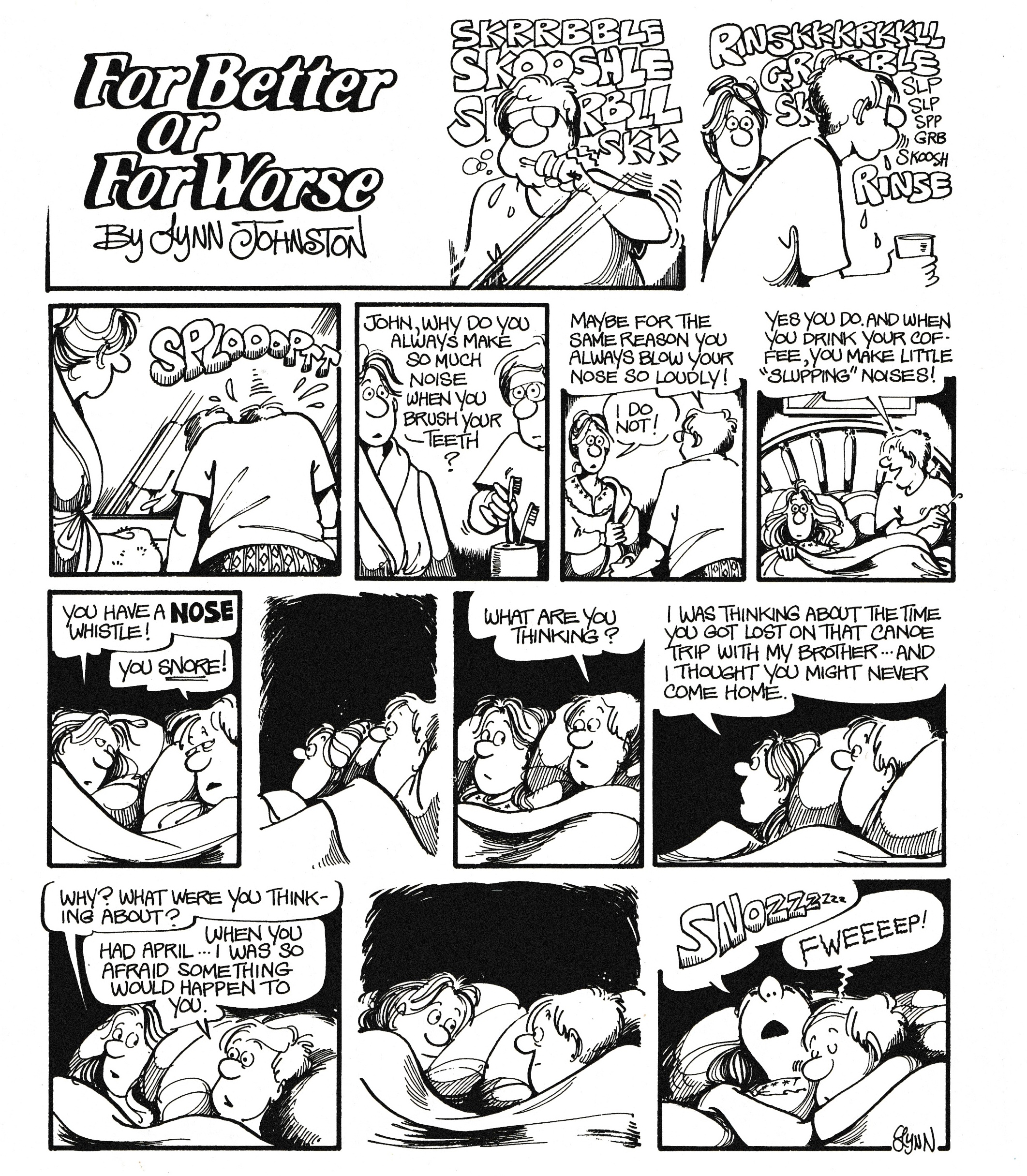 A typical For Better or for Worse strip, from the book Growing Like a Weed.
Because the strip deals with universal family themes and sitcom situations, it may be easy for readers in the U.S. to forget how Canadian it is. The earliest interviews in Conversations with Lynn Johnston hail from Canadian media and display obvious pride in a Canuck making good. In 1980, CBC/Radio Canada reports from “Northern Manitoba, fisherman’s paradise, where there are so many lakes, some of them don’t go by name but by letters of the alphabet.” Johnston is not only the first woman but the first Canadian to win the Reuben Award for best cartoonist of the year. She also holds the Order of Canada and the Order of Manitoba, the latter for the strip’s portrayal of Manitoban First Nations in a 1990s storyline.
In her interviews, Johnston comes off as sharp-witted and charismatic, much as Cathy Guisewite always did in her appearances on The Tonight Show with Johnny Carson, and almost too modest. She’s quick to argue that she received the Rueben Award too soon, due to the fallout from a campaign against then-upstart Jim Davis, though she often adds that Charles Schulz made her feel better about her win by confiding that he voted for her. She brushes off her tenure as president of the National Cartoonist Society as simply taking a job no one else wanted and stresses that the NCS old boys’ club was mostly welcoming, though “one of them kept drawing nude cartoons of me until I drew one of him.” On her own formidable drawing skills: “It’s like any job that you get good at. I mean, if you’re making leather straps, you’re going to get pretty good at those leather straps by the time you’ve done it for ten years, right?”
Johnston’s humor can get startlingly dark, though that’s hardly unusual for newspaper cartoonists; they’ve got to let it out somewhere. Talking to the Vancouver Sun in 2004, she reveals that drawing has become difficult because she’s developed dystonia, which “sounds like some small European country.” In a 2008 interview with MacLean’s, she jokes about her then-recent split from Rod Johnston over his infidelity, calling it a “Viagra divorce.”
At other times, she drops the humor. Johnston has long been up-front about growing up with an abusive mother. As a child, “I was angry. I wanted to fight, and I wanted to hurt people,” she says in an early interview. She’s fearlessly honest, even bitter, in a 1994 Hogan’s Alley interview with Tom Heintjes, at one point recalling looking at her mother’s body at the funeral and thinking of the Wicked Witch of the West vanishing into “a puff of smoke.” In more recent interviews, she seems to have come to terms with her childhood, and she mentions finding contentment in drawing her father as the Patterson grandpa.
None of these personal struggles are reflected in For Better or For Worse itself, in which the Pattersons remained a loving nuclear family through years of newspaper-friendly small-town adventures. In more than one interview, Johnston mentions that the two issues she never wanted to work into the strip were child abuse and infidelity — perhaps not coincidentally, issues that significantly impacted her own life.
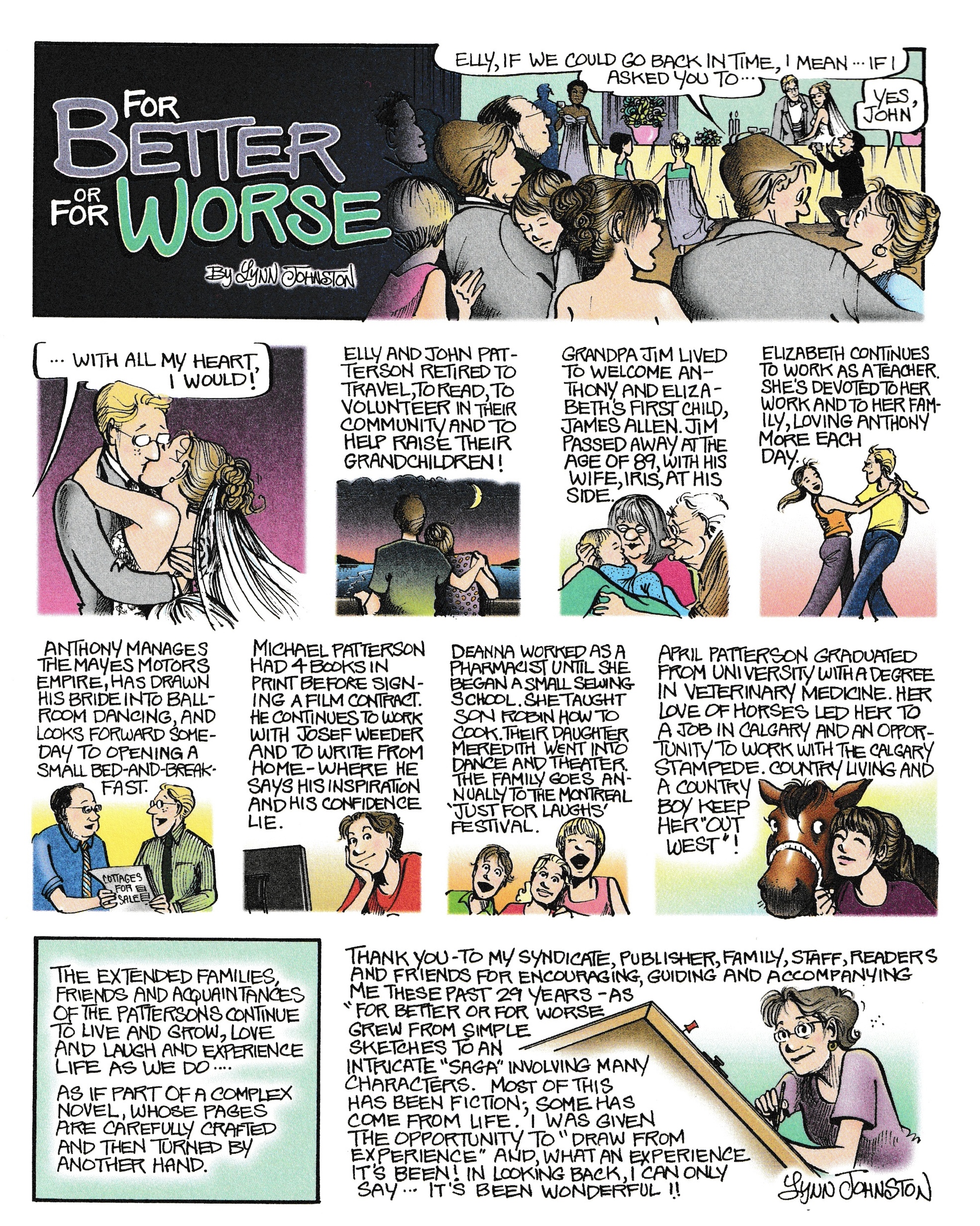 Johnston's final strip, from Just a Simple Wedding.
The strip did tackle serious issues over the years — alcoholism, deaths in the family, sexual harassment and assault — but it only attracted significant controversy when Michael’s friend Lawrence came out of the closet in 1993. Johnston is asked about this storyline many times and always responds with incredulity. “I really believed that people in this century would be willing to take the time to look at what I was doing before they fired both barrels,” she says in the Hogan’s Alley interview. “But this happened before the strips even began to run.” Well before social media, right-wing groups in the U.S. were effective at organizing hate campaigns. Johnston describes losing weight from the stress, then jokes, “I figure that if I ever get fat again, I’ll do the abortion issue.”
In its later years, For Better or For Worse became less of a sitcom and more of a soap. Farley the dog died a hero’s death, saving toddler April, a move that deeply upset Johnston’s friend Charles Schulz. Storylines increasingly focused on the love lives of the young-adult Patterson children. More than once, Johnston admits that she married off Mike and Elizabeth in part because their real-life counterparts had no interest in marriage. (Mike and Liz both marry childhood sweethearts; in a 2019 podcast interview, Johnston reveals that she’s living happily with a man she first met in the fifth grade.) The art style also grew more realistic, making it less conducive to humor. Or, as Johnston puts it in a 2020 podcast, “Once you give a character lips, it’s no longer a cartoon.”
The major downside of Conversations with Lynn Johnston is that we don’t get to see more of those lips. Only a few strips are included for reference — a shame, since the development of Johnston’s art from loose and funny to tight and dramatic is fascinating to follow. It would also be interesting to see examples of her post-For Better or For Worse art, which includes picture books and fabric design.
The last interview is with McLaughlin himself. Johnston, in typical self-effacing fashion, professes bafflement at the whole project: “I’m very flattered, and it’s wonderful for me, but you’re a professor. My head is spinning …” But in the decades For Better or For Worse ran in papers (39 years of its original run, followed by two years of “new-runs,” mixing old and new material), it had an historic impact. At the Toronto Comic Arts Festival in 2014, Johnston speaks “in conversation” with Kate Beaton, a Canadian cartoonist of a later generation, who tells her, “your presence on the comics page said to people like me, ‘You can do this.’ And that’s huge. That’s huge.” The moderator, Raina Telgemeier, also grew up on For Better or For Worse.
For Better or For Worse draws so much from Johnston’s life while concealing so much else. In several interviews, Johnston describes the strip as a version of the world she can control. In the Foobiverse, people get married and stay married, beloved pets die for a reason, parents are mostly wise and good, and no one sends hate mail to Lawrence. For millions of readers, the story of the Patterson family was important — for some it was huge. But some of us need the story of Lynn Johnston, too. This book is for us.








 English (US) ·