
Brian Nicholson | February 17, 2026
In a Comics Journal interview with the cartoonists who made up the collective effort Freak, Mara Ramirez was the only one who identified their comics as experimental. In a cohort of artists whose comics embrace traditional values of being well-drawn and tightly choreographed to tell character-based stories built around frequent punchlines, Ramirez’s experimentation shies away from the recognizably on-model and speaks in feelings more than jokes. The nature of approach varies; a contribution to issue 4 of Domino Books’ Jaywalk anthology deprioritizes drawing to a point some likely wouldn’t consider it comics at all. To maintain a practice of experimentation means different projects call for different styles, depending on aims.
In Flea, the artist prizes the intimacy of a small book, with a few scant images per page — I’d normally call them panels, but should emphasize there’s no panel borders — that accumulate into scenes over the course of page turns. A reader must physically engage in the experience of the object, and so become entangled with Flea, the character, as she moves through the world. Characters exist as if drawn in a single line, reducing them to shape, like a more shambolic take on Saul Steinberg’s elegantly drawn jazz forms. Scenes flit about in time, beginning with her as a child, being bad at sports. Each segment comes off more like a short poem, with each page indicating a break between two-line verses, than a chapter in a novel where the tiers of a page analogize to paragraphs.
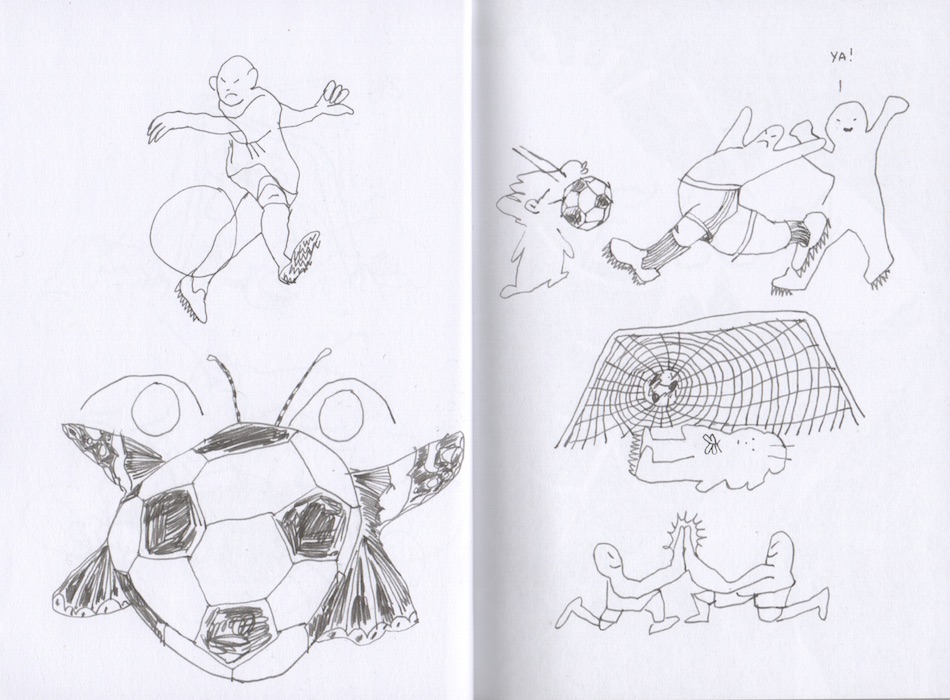
Flea is a transgender woman, neglected as a child by an alcoholic mother, whose desire to be “seen” — witnessed — as an adult manifests as a kink for public sex. Discussing the book in terms of the main character’s identity category likely belies the actual experience of reading the book: It is more indicative to think of that kink as a transgressive act — something which literally makes practitioners into sex offenders if they get caught — than as something meant to be processed by the ideal audience as “relatable.” Flea is throwing tantrums, upset, throughout the book. I catch myself unconsciously referring to the book in my head as “Brat,” but that’s something else. This is a work of fiction about a difficult character whose actions are contextualized partially by their upbringing, but that upbringing is depicted in a way meant to play as a scene of comics in Ramirez’s own rhythms, rather than be processed by a reader primarily as upsetting circumstances. It’s not, really: A drunk mom can be scary, and lead to negative coping mechanisms, but can also be intermittently fun. Mom dances with Flea, and while spinning her around, Flea’s hair catches on fire. To whatever extent this is frightful, it’s also Ramirez’s engaging with the form of dance the same way Jules Feiffer did, as line. No need to cast blame on a person who is not real, no need to judge any of these characters as being good or bad.
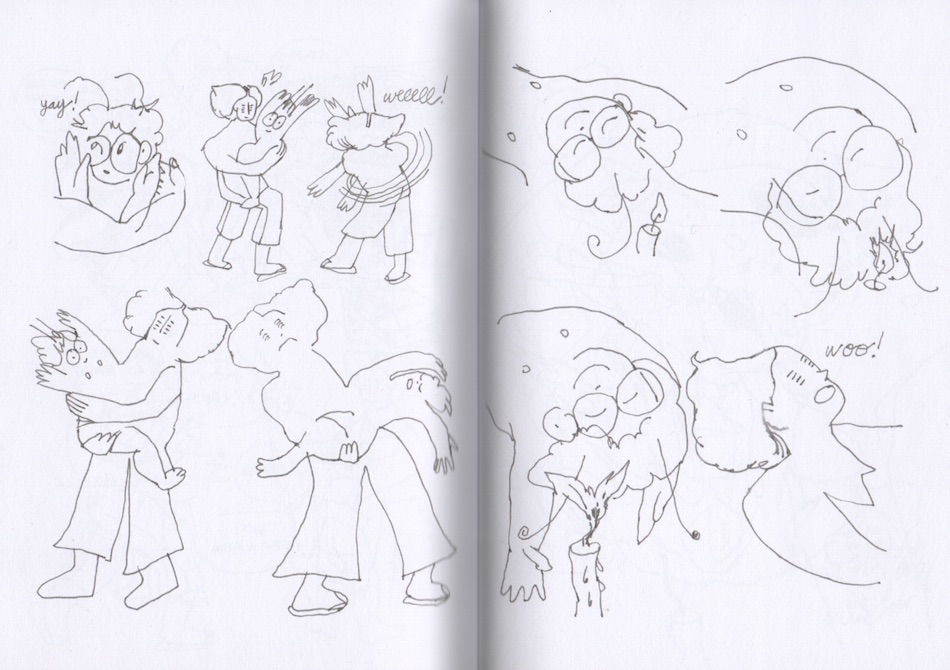
The drawing is always pleasurable, with a ratcheting up of detail occasionally to remind you Ramirez has great skill and knows the drawings are good even when they are not showing off. The book’s endpapers, detailing legs in silhouette, walking in shoes done up with bows wrapped around the calves, is a clearer indication of gender performance than you’ll get from Flea’s design-defining feature, antennae. Those antennae are a feature shared with Grandma, an indication of a spiritual kinship unshared by mother and aunts. Dad is absent, what we see of Flea’s upbringing is her mother’s side of the family, in which no men are present. Their dinners are described, in Flea’s internal monologue: “The only time when you hear quiet is when they begin to eat. But it’s always interrupted by someone saying how quiet it it is when there is food.” We can see the size of the book, the scantness of the drawing, as intended to function within this context, prizing quiet communication in the smallest gestures, capturing them like someone speaking in whispers, to describe the obnoxiousness of the world’s shouting people, always talking over each other. We also see it said that Flea likes a word that rolls around her mouth when spoken, like “Hullabaloo." This suggests a twee affectation absent elsewhere in her characterization, but does suggest how the cursive-like curlicues of Ramirez’s line are pressed upon the page so pleasurably.
They are also put down indelibly, in what looks to me like first-thought-best-thought penmarks, and in their sloppy insistence upon their rightness they are also that word used so often as to lose all meaning, punk. “Punk” is a term some people throw around as if it were so much the transcendent value that to be named as such puts something beyond judgment, as if it were not always a contested term within the community itself. For my purposes today, it is that very contentiousness, that willingness to get into fistfights because some people simply do not like you and things escalate, that I am referring to as defining the spirit of the book. For any sad stuff that happens, the attitude taken towards it is one of insensitivity, laughing off any indignity. “Yeah fuck that cunt ha ha ha ha,” sez Flea at one point, black eyed and kicked out of the venue.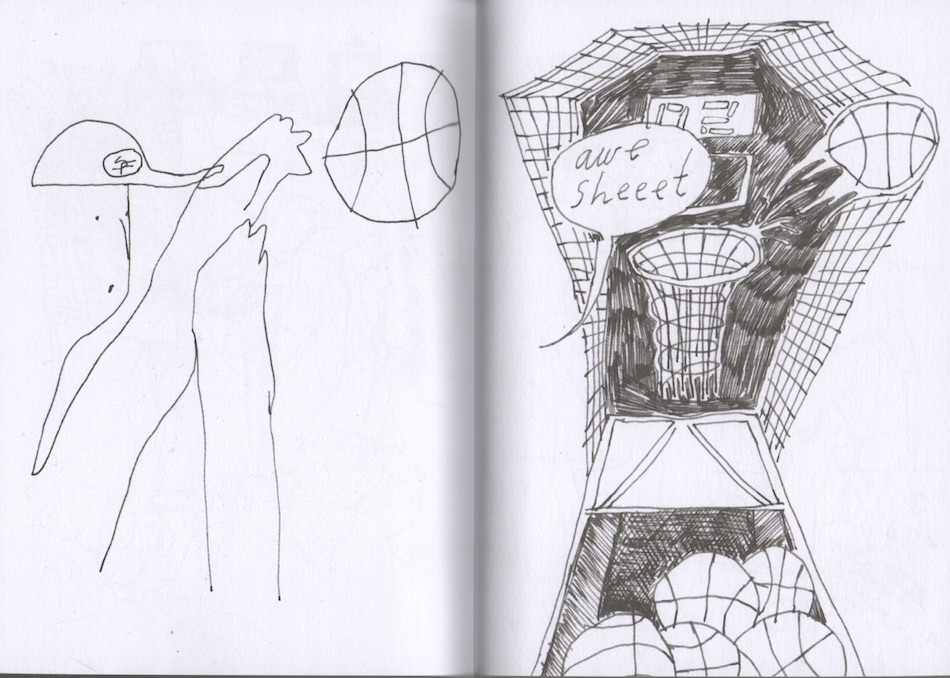
The cover design of Flea feigns damage, folded corners and scuff marks, and has the bar code sticker for a Fuji apple on it. The back cover has the Mr. Yuck face used on hazardous materials. Despite only ever being meant to serve within a specific context, any label can be removed and affixed to something else. Throughout the book, drawing sizes fluctuate, suggesting pieces were drawn larger and shrunk down, others are something close to actual size, and perhaps some pieces are blown up. But there on the front cover is a post-it note: a sticker like the others, only it’s also a space to scrawl upon. Identifiable by its dimensions, and recognizable relative to the Fuji apple sticker, we see Ramirez’s doodle at what reads as actual size, and so we are reminded: The only true identifier of a person is the mark they make.






 English (US) ·