
Kevin Brown | May 26, 2026
Graphic nonfiction is a challenging genre to work in. Quite often, the need to relate information overtakes any type of narrative, as well as the art. Infected for Science struggles with that tension, as there are a number of scenes with talking heads conveying important information; however, the inspiration for this book helps offset some of those issues.
When Sydney Halpern was doing research on vaccine trials in World War II (she also wrote the more scholarly Dangerous Medicine: The Story Behind Human Experiments with Hepatitis, which won the George Rosen Prize for a significant contribution to the history of public health and social medicine), she discovered the drawings of David H. Miller, one of the participants in those trials. She uses him as one of the main characters here and includes his drawings, giving an energy and narrative thrust to her story.
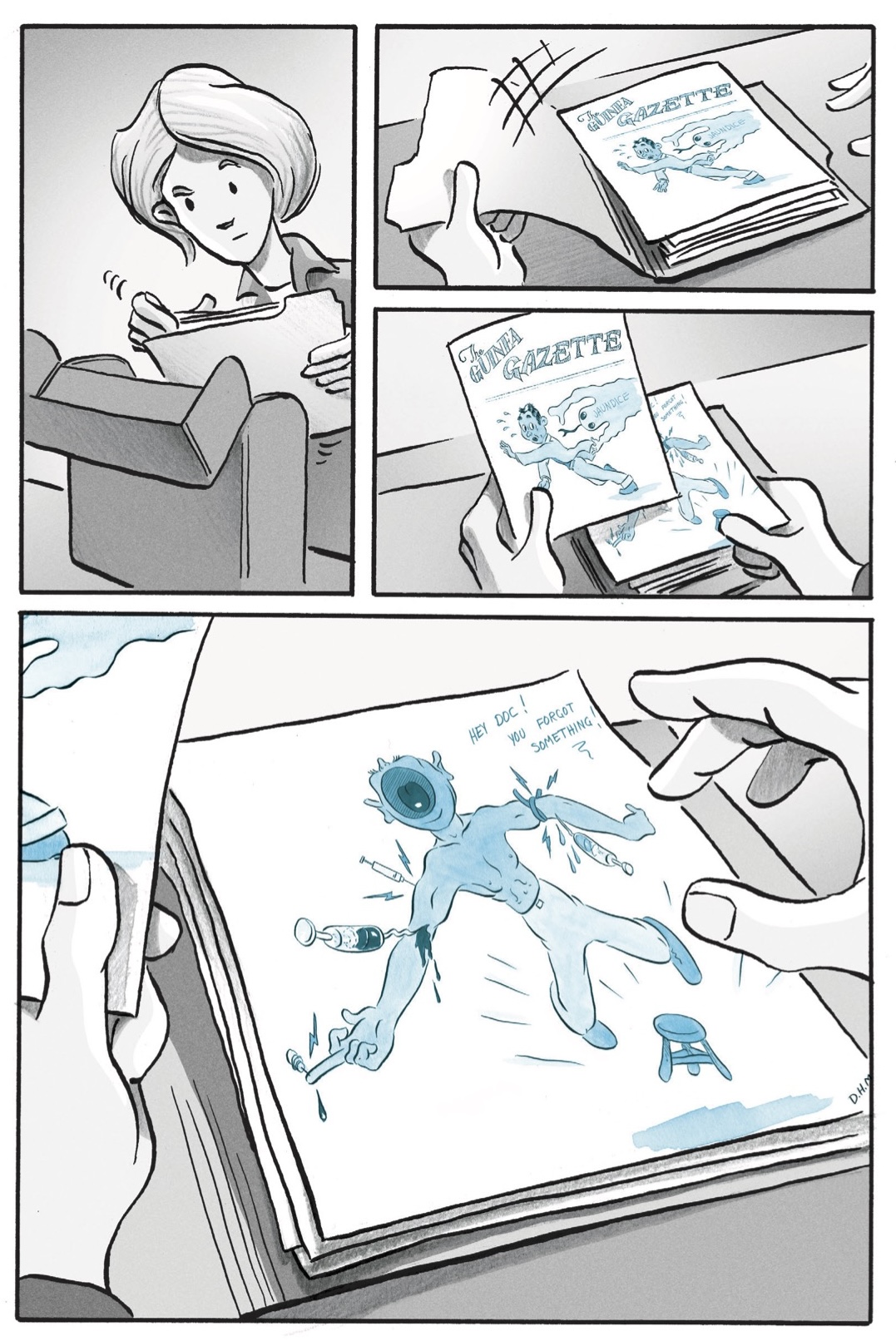 Halpern moves back and forth between the medical trials during the war and her own research, until she is ultimately talking to Miller’s descendants about what she discovers along the way. Much of the contemporary storyline is where the book slips into the typical information conveyance — the portrayals of the World War II era are much livelier, especially when Miller’s artwork shows up.
That's not to imply that artist Trygve Faste’s work isn’t good, it’s just not meant to be the center of the book. His work outside of Infected shows that he can create more active, lively scenes, but the storyline here is less kinetic, which leads to a more realistic, matter-of-fact style that puts the facts of the story at the core (along with those talking heads). Miller’s artwork, on the other hand, seems to jump off the page, as he draws cartoonish caricatures, clearly inspired by a love of jazz and dance.
The WWII storyline follows Miller, a Quaker and conscientious objector who still sought to serve his country during the war. He works in forestry for a while, but that doesn't feel meaningful enough. When he hears about a hepatitis study, he signs up for it. He and about thirty others agree to be infected, so doctors can study various treatments. The first round goes well, with almost nobody becoming truly sick, but, during the second round, at least two members of the camp are hospitalized.
The more contemporary story follows Halpern’s research, but most of it relates to her conversations with Miller’s children. She essentially frames Miller’s story via these conversations, as he apparently never spoke about his time in the camp. That structure works well enough, though it does take away a bit of the suspense, given that it’s clear Miller survived the camp and returned home to have children and raise a family.
The men who signed up for these tests didn’t quite know what they were getting into before they arrived, as the doctors point out during their initial meeting that the death rate from hepatitis is one in a thousand, making it clear that the volunteers could, in fact, die from this study. However, none of the men withdraw, signing a consent statement freeing the army and researchers from any liability. Part of that commitment admittedly comes from the men not wanting others to see them as cowardly for not fighting. One of the characters even says, “I’m not willing to kill for my country — but I am willing to die for it.” Dave adds, “Being in risky experiments for the benefit of others was our way of being soldiers.”
The ethical dilemma of using humans for such studies runs throughout the book, as Miller’s children ask Halpern about it on a regular basis. Near the end, Halpern points out that such studies are still fairly common, though with even darker ethical questions. A nearby camp in Trenton, New Jersey, was assigned to help with a study at a mental institution that was participating in such studies. There were also similar experiments at prisons, as researchers promised to write letters for prisoners, which could help them in their parole hearings.
Not surprisingly, Halpern references the Tuskegee syphilis experiments, pointing out that researchers withheld treatment in such studies, even allowing men to die of the disease. In a clear connection, the hepatitis studies only stopped in 1972 when information about the Tuskegee experiments became public. One of the last hepatitis experiments was performed on children with developmental disabilities.
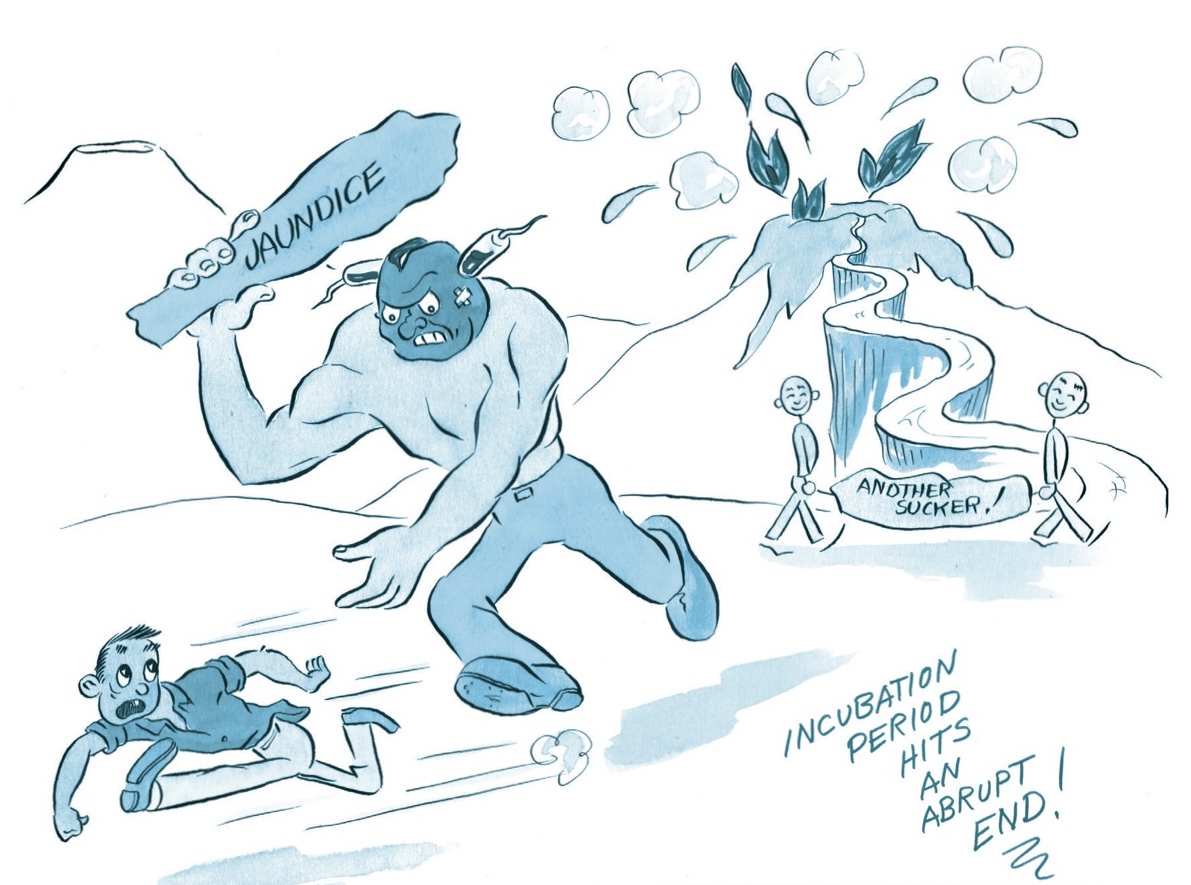
The most interesting contrast in the book comes through Miller’s artwork. Halpern presents the men as brave and willing to help the country, but the art that Dave produces reveals real fear, often using gallows humor to do so. For example, at the worst point in the study, when ten men are in the hospital, including two on feeding tubes, Halpern includes artwork by Miller that shows a man being chased by a large figure with a demonic face, wielding a club labeled JAUNDICE. In the background, two smiling figures carry what looks like a covered corpse on a stretcher, with the title ANOTHER SUCKER! just in front of a path leading up to a volcano where they seemingly will sacrifice him.
Many of the drawings mock the experimental process itself, as Dave draws images of the researchers measuring and weighing them, pulling them into clearly uncomfortable poses, while one of the doctors ogles a nearby nurse. When a doctor is injecting a patient with dye, the patient leaps off the stool, looking more like a dancer than patient, save for the shocked look on his face, as the dye or blood squirts out of his arm. In a similar scene, a naked doctor seems to be using a jackhammer on a patient’s arm, though the jackhammer is labeled JAUNDICE. The patient, again, looks like a dancer, this time with a high kick, though his face is one of pain and suffering, in contrast to the doctor, who seems to be enjoying the moment.
Dave’s drawings reveal the true feelings of the men who, while certainly willing to give their lives for the good of the research and their country, also were fearful of what could happen to them. The drawings never give the men much agency — the doctors/demons are attacking them, and the men are always suffering. But Miller’s drawings provide a richer view of a complicated moral and ethical situation that most readers won’t have heard about. That art helps offset the more staid, informational parts of the book, and help bring life to an important historical moment.












 English (US) ·