
Gary Groth | February 6, 2026
Those of us of a particular generation who grew up obsessing over comics tend to share the same-albeit-unique memory: The first time we met a real-life comic artist. For me, that comic artist was Sal Buscema. By the time I interviewed Sal Buscema, I had been editing and publishing a fanzine for a year and a half; as I recount in my original intro, I discovered that Sal lived a few miles from me. How was that possible? Screwing up my courage, I called him and haltingly stumbled through what would pass for an introduction and asked if I could interview him for my fanzine. He agreed, we made a date, and my dad drove me — and my tape recorder — to his home. Meeting Sal was one of the greatest events of my young life. Here was a real, live cartoonist who sat down at a drawing board every day and created something from nothing. The fact that he was John Buscema’s brother only made him more mysterious and glamorous. I couldn’t have been more thrilled if I had met one of the movie stars I watched on the big screen— a Kirk Douglas or a John Wayne. In fact, given a choice, I probably would’ve preferred to meet Sal.
Sal lived in Springfield, Virginia, as I did, a suburb of Washington DC, in an unpretentious middle-class starter house (as I did). One bedroom was devoted to his studio. This was the first interview I conducted in person (I had previously sent questions to artists through the mail, to which, believe it or not, the likes of John Romita and Steve Ditko actually responded with answers!). I deduced that I did this interview over the summer of 1969, which would’ve made me 14 years old. Although I don’t have a specific recollection, I’m sure I lugged a gigantic reel-to-reel tape recorder into his home (cassette tapes had only started being sold a few years earlier, and were much too technologically fancy for me to have had at that time). Sal was incredibly gracious and infinitely patient, not just this once, but repeatedly: acutely aware that I could easily make a pest of myself, I would wait a respectable amount of time (4 or 5 nail-biting months?) after one visit, call him and ask if I could visit again. Invariably, he welcomed me over, spending a couple hours suffering my worshipful prattling. Not only that, but each time I visited him he casually handed me a piece of original art — pages from comics he was working on that he (not his editor) rejected. I still have them, of course, and they I realized they would be the perfect accompaniment to this interview. A year later I put on a comics convention (with substantial help from my father) at the Crystal City Marriott (5 minutes outside Washington DC), and asked Sal to give the keynote address (all conventions then featured keynote addresses by comics luminaries). I can’t remember the specifics of his address, but I remember it being a short, dignified speech about comics as an art form. He also (again, graciously) drew the cover to the program book. I have no idea what he thought of a 15-year-old putting together a comics convention, but he obviously took it seriously enough to be a part of it and for that, and for his innumerable acts of kindness and generosity, I am grateful.
If you can forgive my idiotic questions (I was clearly tapped into the raging controversies of the day: what happened to Frank Giacoia, for God’s sake, why was Zip-a-tone used so much, and what about that Comics Code Authority?), the interview is a little snapshot of what it was like to be a journeyman artist in mainstream comics in 1969. My belated thanks and appreciation to Mr. Buscema, as I rightly called him, for encouraging this now-71-year-old kid.
— Gary Groth, February 2026
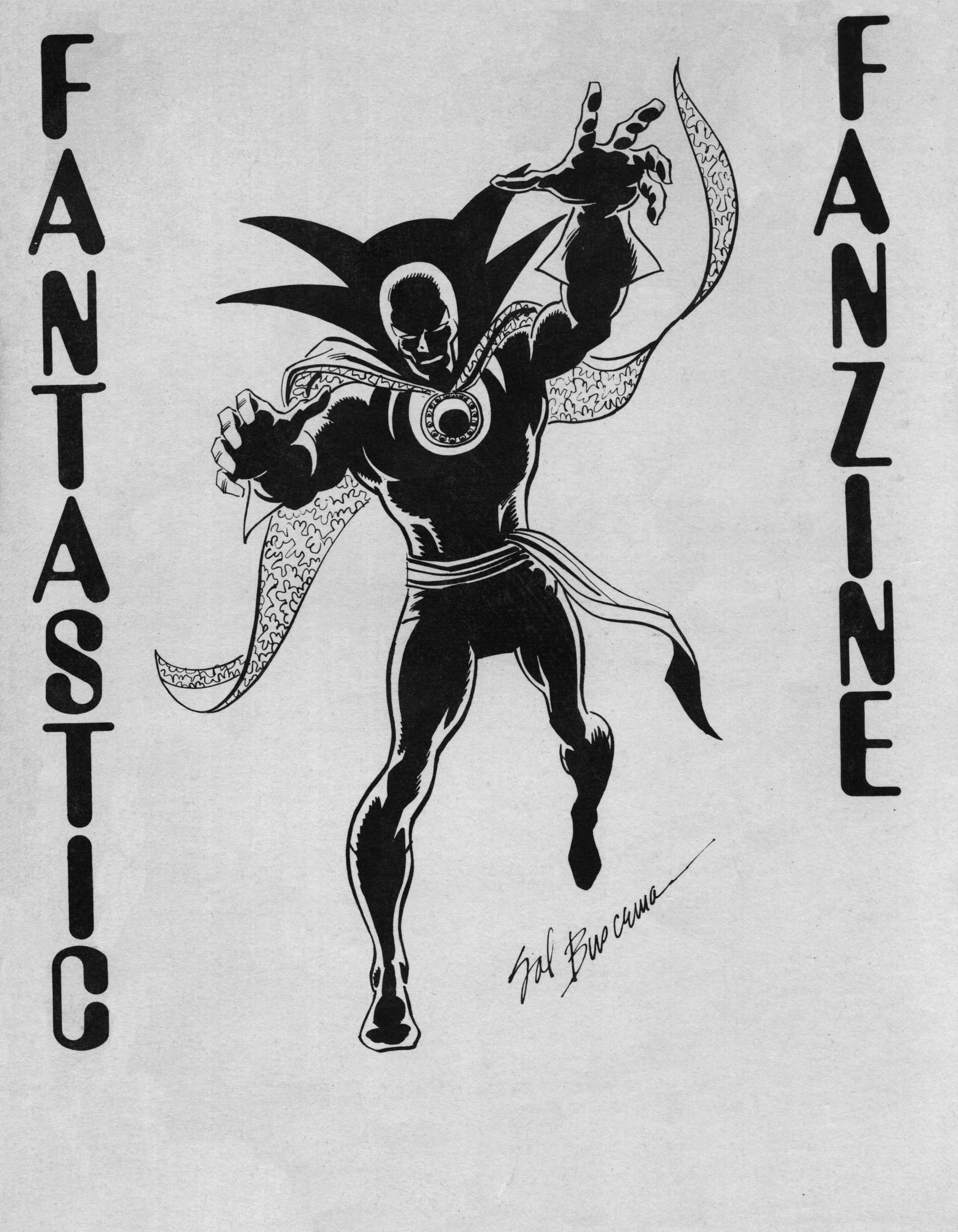 Sal Buscema's original cover art for FF#8-9, 1969
(EDITOR'S NOTE): Several months ago, about April first, I was paging through some of the newest Marvels and came across an interesting item in the MARVEL BULLPEN BULLETINS. The page listed where some of Marvel’s artists and inkers lived; Sal Buscema (pronounced Byu, as in the beginning of beautiful, sem - a) lived in Virginia. I decided to try my luck, so I called up the operator and asked for the number of a “SAL BUSCEMA.” To my utter astonishment, she gave it to me!!! That night, I called him up and found that it was the Sal Buscema. I asked for an appointment for an interview, and he granted me that pleasure on the following Saturday. Mr. Buscema lives in a fairly large residential section right here in Springfield. Sal stands about 6 foot and is as pleasant as you can get!!!! While over at his house, he let me look through 15 pages of a brand new Avengers strip (#69, I believe), and his art is FANTASTIC. His style is somewhat like his brother’s (as you could see from the cover he did for us). He has a 6-month-old son, and who knows, he might grow up to become another artist for Marvel. The interview took several hours, several hours that I will never forget.
Could you give us a brief capsule history of your career as an inker/artist?
BUSCEMA: Well, let’s see. I’ve been a professional artist for 13 years, and when I first got into the art field, I wanted to get into comics; I wanted to be a comic book artist, but at the time, the comic book wasn’t as popular a field as it is today. There weren’t as many good companies, y’know, like Marvel and DC and some of these other outfits, so I decided to go into advertising and it was a very nice career and I enjoyed it very much, but I still always had this thing about comics in the back of my mind. And then John went into comics about a couple years ago, he started working for Marvel. I decided that maybe that was an opportunity for me to try to do it for the first time, although Johnny and I used to work on comics years ago; then he got out of it and went back into it. I used to work with him, but that was about the only experience I had in comics so I wanted to do them on my own finally; so very simply I worked up some samples and Stan Lee saw them and I guess he liked them because he started me on some inking & now I’m doing some penciling… the Avengers & that’s about it.
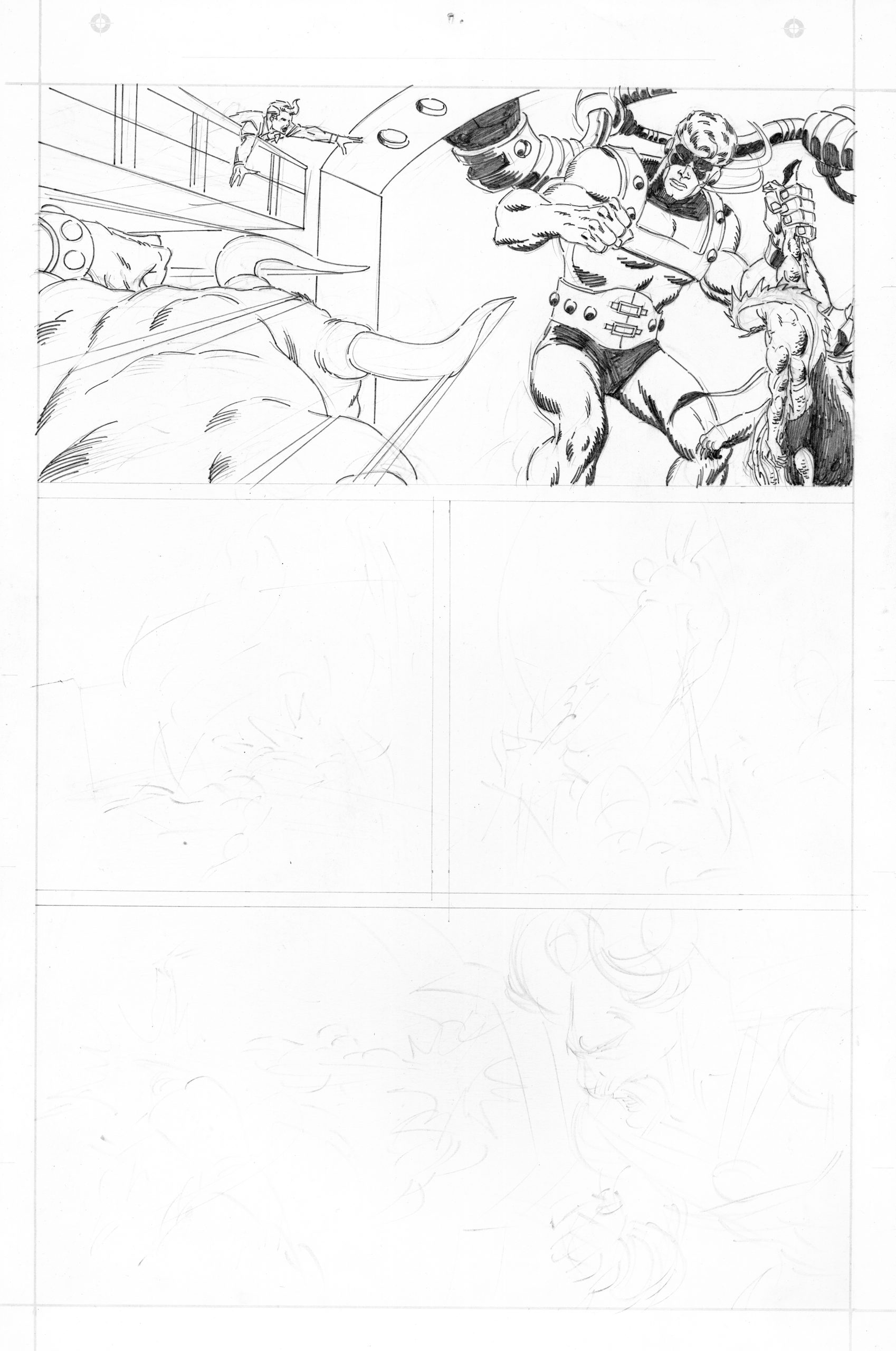 Sketch for Avengers #72, January 1970. "Did You Hear the One about Scorpio?" was written by Roy Thomas.
Can you explain a little of your technique you use in your inking?
BUSCEMA: As far as technique is concerned, Gary, it’s kind of difficult to explain it in those terms, using the word “technique.” I guess I just do simply what comes naturally. I try to follow the artist's drawing as closely as possible because he worked on it very hard and he doesn’t want it changed that much, so I’m not going to change what the artist does that much or at all if I can help it. I just try to use a little bit of thick and thin lines, give it a little variation, nice solid blacks, and that’s about it. Otherwise, I just do what comes naturally to me. I don’t really concentrate on a particular technique. It’s almost like your own handwriting; the way you draw or ink is the way you write your name. It’s something that’s very personal and very natural to you & to no one else.
What materials do you usually use in your inking?
BUSCEMA: Oh, that’s an easy question. All I use is a brush and black India ink, period.
Which Marvel magazines do you consider to be the best inked?
BUSCEMA: Oh, let’s see. I would say THE FANTASTIC FOUR, which is Joe Sinnott and then of course, Frank Giacoia (pronounced Ji-coy-a), was inking CAPTAIN AMERICA for a long time, and I think that was one of the best, too. I think he also inked the SUB-MARINER for a long while, and I think that was also a very well-inked book.
Do you have any preference over one material to another?
BUSCEMA: Well, no. As I said, the only thing I use is a brush and India ink, and as far as brands are concerned, maybe I shouldn’t say this, but I prefer Winsor Newton Brushes and I use Pelican India ink.
Is there any special reason that you ink your brother John’s pencils a lot?
BUSCEMA: I don’t know, maybe I was just lucky. I think probably because they tried me on Johnny’s drawing, and his stuff is kind of difficult to ink because he draws so well and if you deviate just a little bit, it kind of loses his style of drawing. So I was able to follow his style of drawing without changing it at all and just going over his drawing very carefully, and just try to pick it up that way, and I guess they liked the first job that I did and I just kept on doing it. Of course, you know I’m not going to be inking The Surfer, anymore?
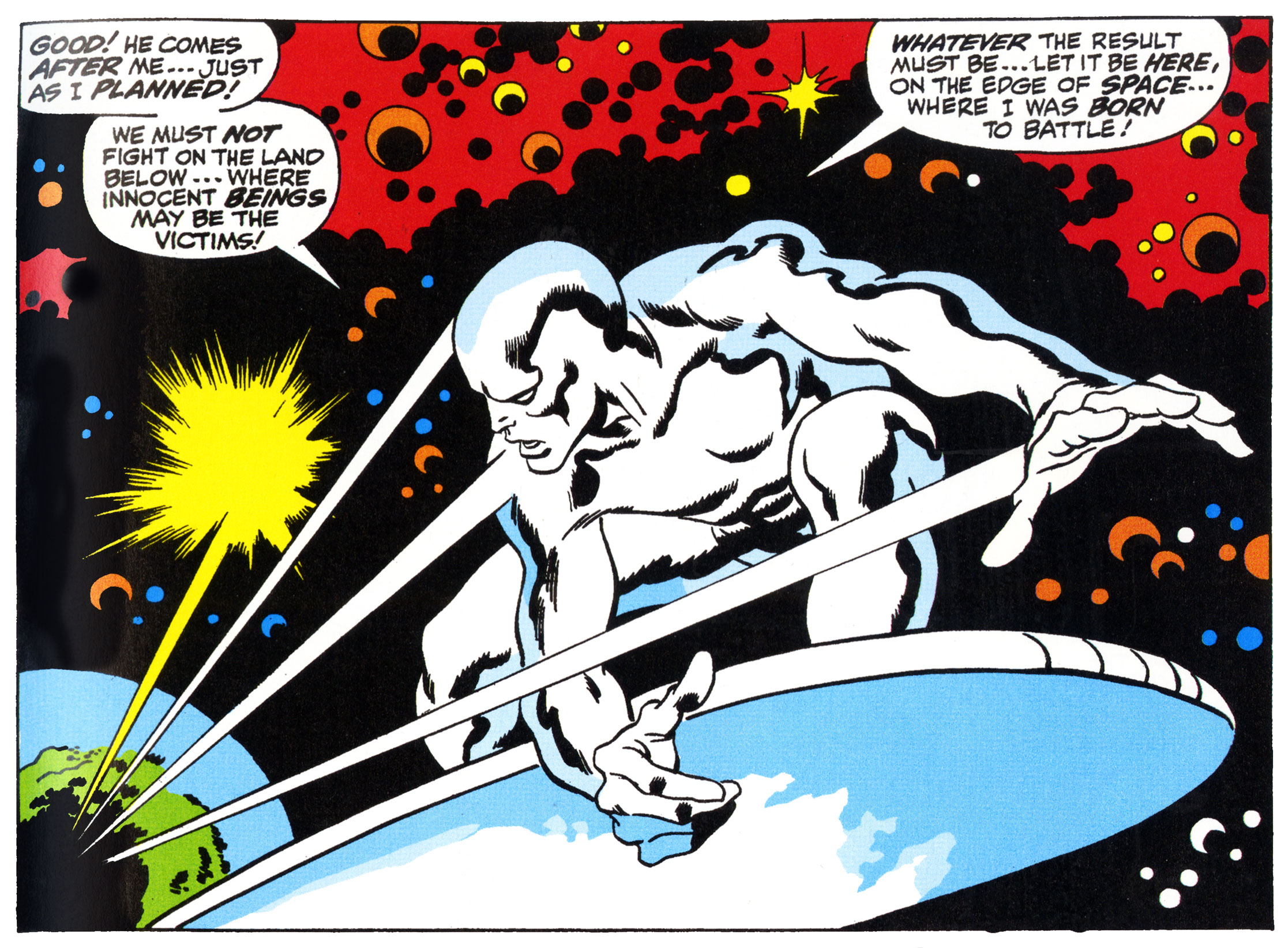 The Silver Surfer #7, August 1969, written by Stan Lee, penciled by John Buscema, inked by Sal Buscema.
Why not?
BUSCEMA: Well, because I’m going to be doing the penciling and it’s going to be taking up most of my time, see?
Who, in your opinion, are the three best inkers at Marvel now?
BUSCEMA: The three best inkers? I would say Frank Giacoia, Joe Sinnott, and… oh gee, there’s a whole bunch of other good ones really; it’s hard to pick out the three best. Maybe Tom Palmer. I like his inking very much. I think he’s a good one. And I should say Sam Grainger too, because he’s going to be inking my stuff.
Do you know if Tom Palmer is really Jim Aparo of the Aquaman series?
BUSCEMA: If he is, it’s news to me, Gary. I really don't know.
Do you know what ever happened to Frank Giacoia at Marvel?
BUSCEMA: Do I know what happened to him? As far as I know, he’s still around. He’s still working for Marvel; as a matter of fact, I think he’s doing an Avengers book, which will probably be out in a few months. I think they might have Frank working on some penciling. Living down here, it’s kind of difficult for me to keep up with what’s going on in New York and all the guys up there, but he’s still working for Marvel, I know that.
There’s been a lot of controversy in Fandom about Marvel’s so-called overuse of Zip-a-tone. Could you give us your views on this?
BUSCEMA: Yeah. Hope I don’t get fired for this. I don’t like the Zip-a-tone on comics. I think it looks much better without Zip-A-Tone, because I think Zip-a-tone has a tendency to make the areas where it’s put look kinda muddy. It’s not a very clean, crisp-looking thing. I think you notice that they are not using Zip-A-Tone anymore, or if they do use it, it is very, very little, and they use it very seldom.
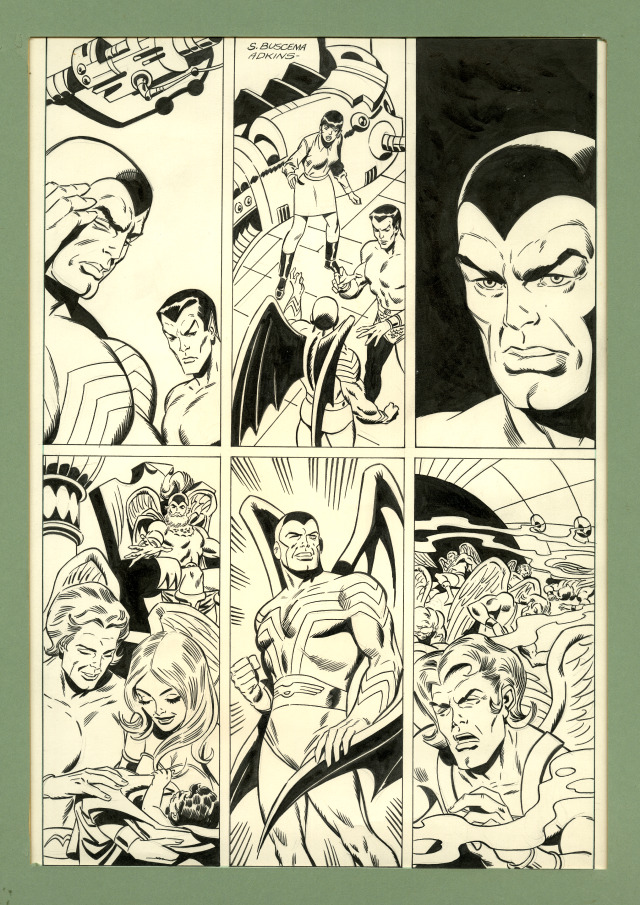
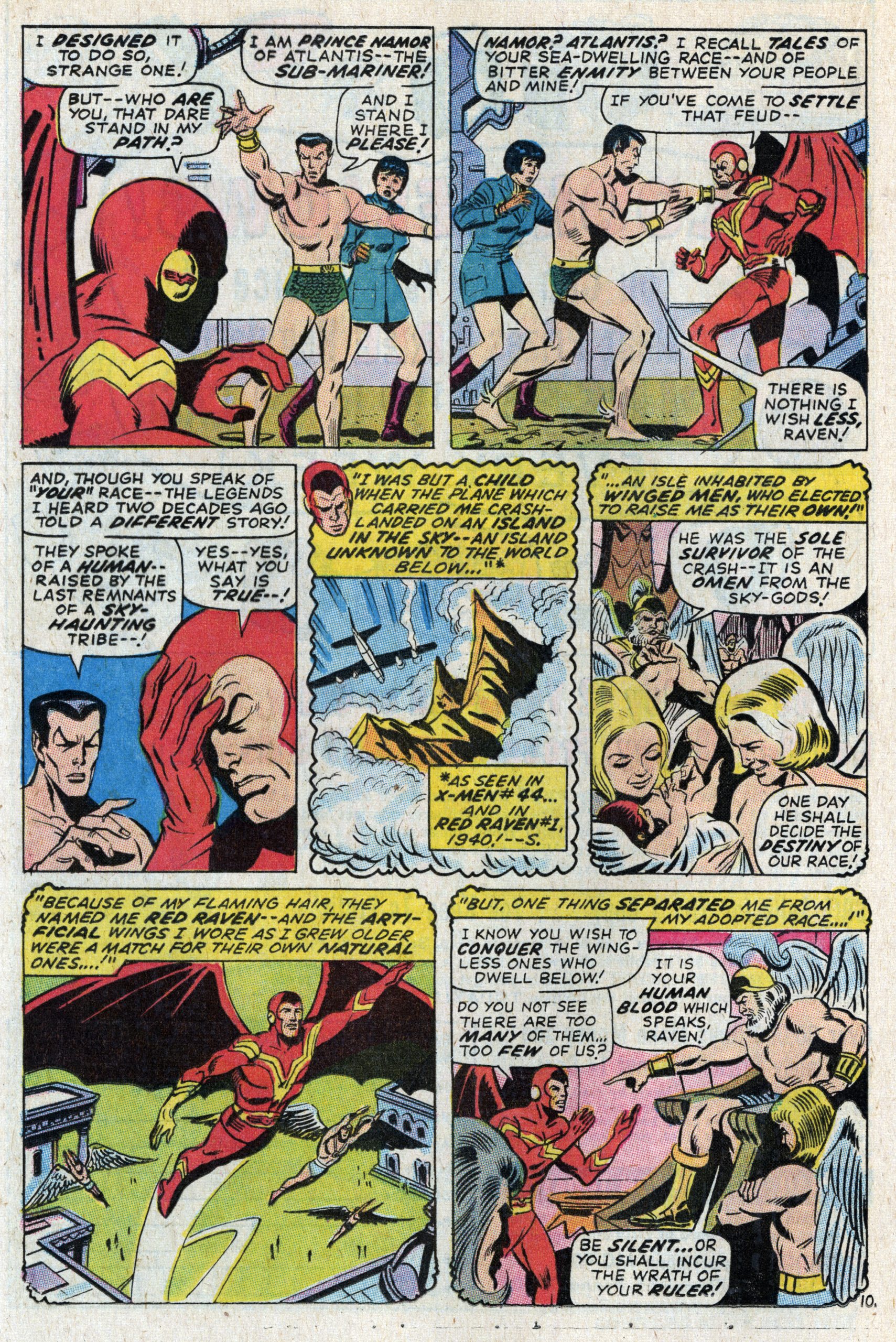
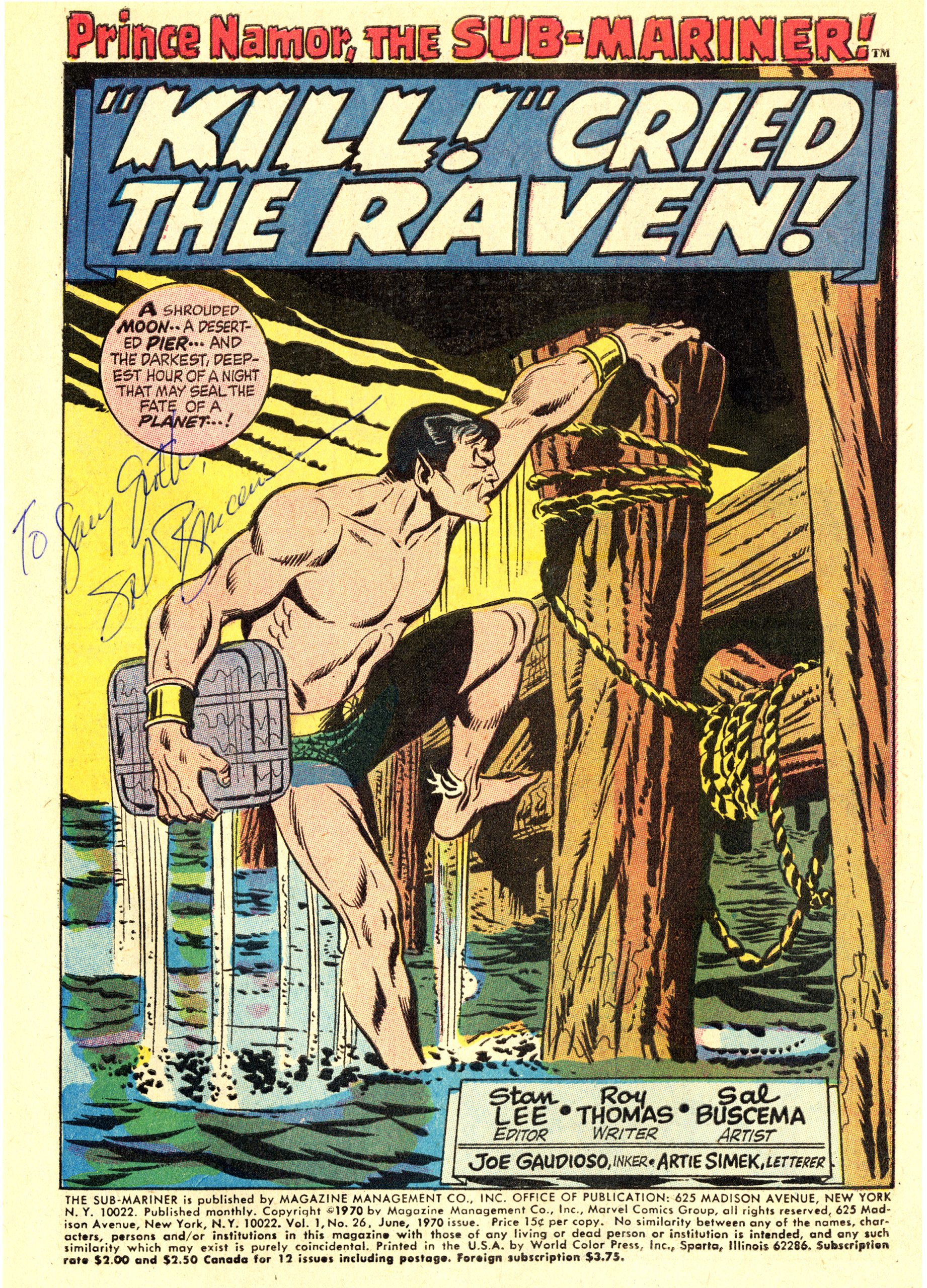
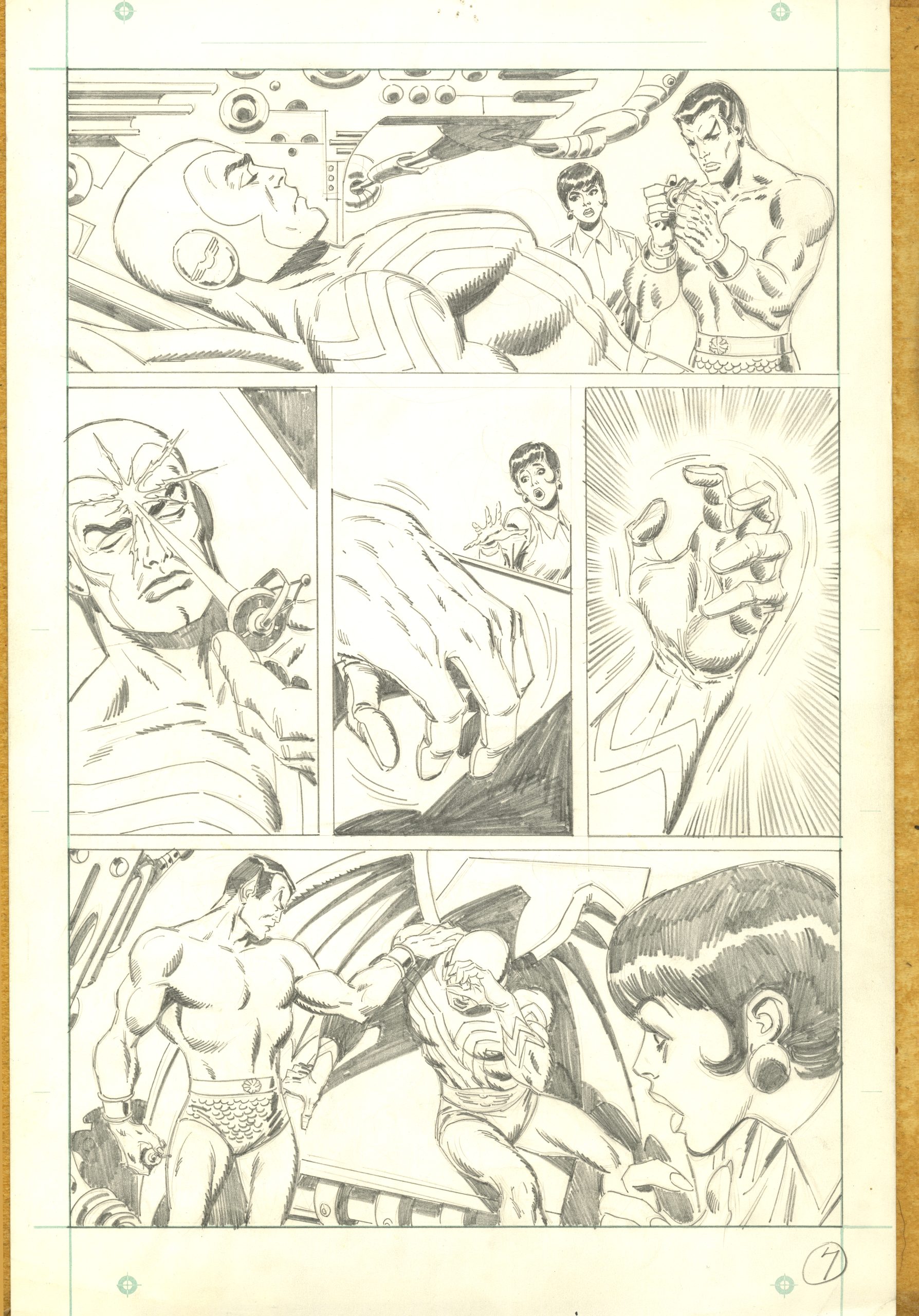 Alternate unpublished page from Sub-Mariner #26.
On the average, how many 20-page magazines at Marvel could you ink a month?
BUSCEMA: On the average, I think I was doing one 20-page book a week for Marvel, which amounts to 4 a month; that would be on the average. If they had any tough deadlines, I guess I could do more than that, but just a regular work week, about one book a week.
Do you have any choice as to who you prefer to ink?
BUSCEMA: Of course, I love inking Johnny’s stuff, and I guess Jack Kirby, since they’re both GREAT.
If you had a choice, what three Marvel titles would you ink?
BUSCEMA: Well, I was inking the Silver Surfer, as you know, and that would have to be one of my choices and I’d like to ink Thor, I guess I’d also like to ink… ohhhh, probably The Fantastic Four or maybe Captain America because Johnny is doing The Silver Surfer, and Jack Kirby is doing The Fantastic Four, Thor, and Captain America. I think those are really exciting books, and they’re a lot of fun to work on.
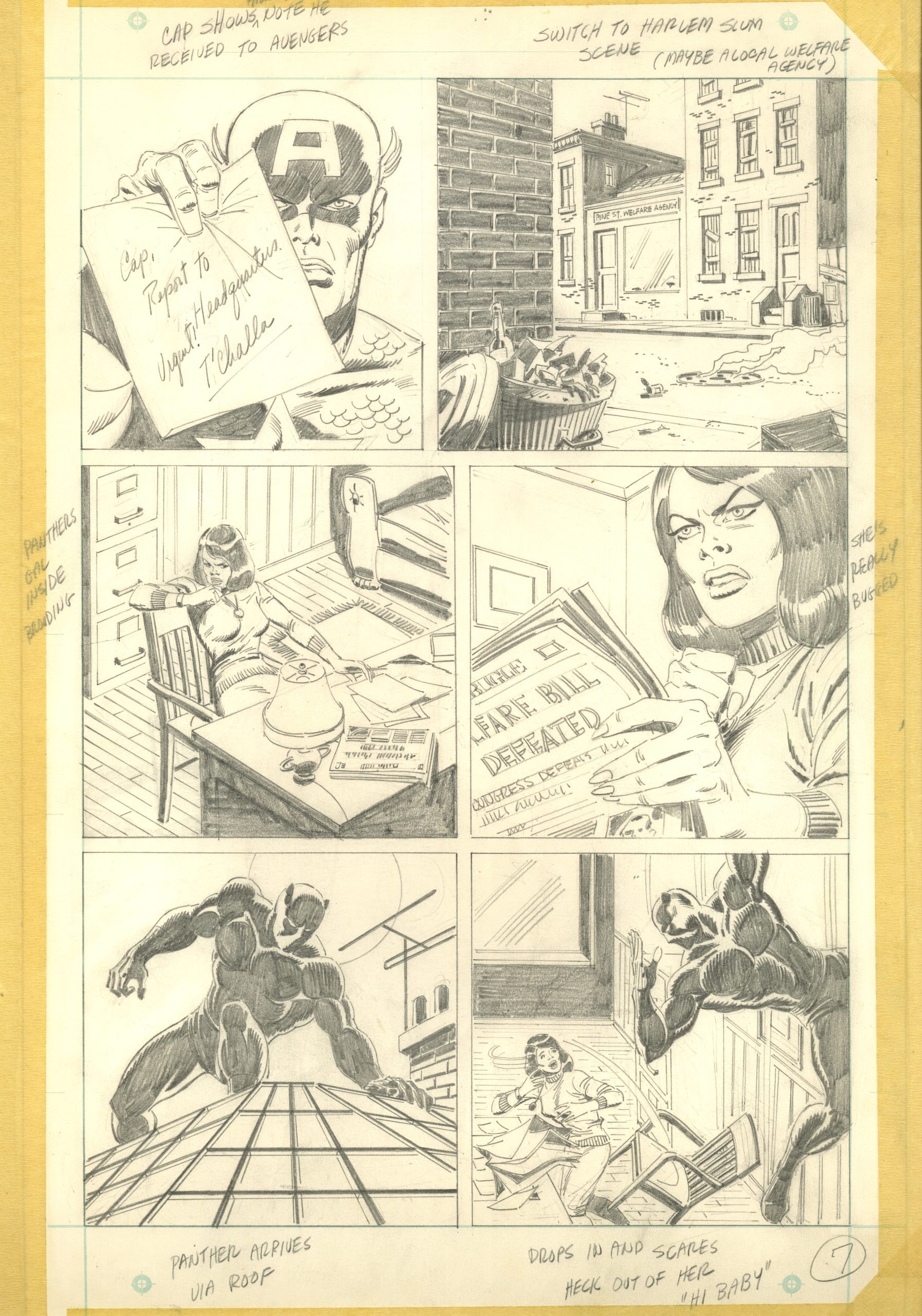 Alternate unpublished page from The Avengers #78, July 1970, written by Roy Thomas and penciled by Sal Buscema.
Well, didn’t your brother John do CA# 114 — the latest one out?
BUSCEMA: Yeah, I think that was just a one-shot thing, though, Gary. He just did it the one time. And I don’t think he’ll be doing it again because he’s pretty busy with a whole bunch of other things. I was fortunate enough to ink that one.
Do you know if they’ll have a permanent artist on Captain America?
BUSCEMA: I’m not sure, but I think that Gene Colan may be doing Captain America, but as I said, I’m not sure.
How are your brother's pencils to ink?
BUSCEMA: Personally speaking, I think his penciling is very, very difficult to ink, because his drawing is so faultless. As you know, he is a tremendous draftsman. He draws beautiful figures, and it’s a very difficult thing to follow his drawings and not deviate from them. In other words, his drawings are so good that if you go off just a hairline, you spoil his drawing. So, it’s really tough to follow and takes quite a bit of concentration.
Could you tell us the cycle that goes in the comic book to plot it, pencil it ink it, letter it, and then back to Stan to edit it?
BUSCEMA: Sure! First of all, the artist and the writer usually get together. The writer will naturally have an idea of what he wants the story to be about. They’ll talk about it for a while, kick ideas back and forth. In my case, Roy Thomas usually sends me a synopsis, and he has a lot of ideas in there. And I’ll try to put some of my own ideas in there too. Then I’ll draw the story up, whether it’s a 10-page story or a 20-page story, which is a full book or whatever!!! Then it will go back to the writer, to Roy, Stan, or whatever. They will write the dialogue for the story. Then from there it goes to the letterer. He puts the lettering in, the balloons, and also inks in the panels or borders. After that, it goes to the inker; he inks it. I think after that, they photostat the pages down to size, about the size of the comic book when it’s reproduced. And then it’s colored. And then from there it goes to the engraver, and it’s printed. And the next thing you know, it’s on the newsstands.
Does the letterer use any basic lettering, or does he hand-letter all of it?
BUSCEMA: As far as I know, it’s all hand-lettered. I don’t know if they use any preset type or anything like that. I think it’s ALL hand-lettered.
When you were a teenager, did you use to read comics?
BUSCEMA: Yeah, I used to read comics like crazy when I was a kid.
What were your favorite titles?
BUSCEMA: Gee whiz, I don’t know. I guess I used to like Captain America. I liked Batman, which is a competitive company. I used to like a lot of these strange horror-type magazines that they used to come out with, too. I thought they were really wild. It’s kind of difficult for me to remember, though, Gary. It was a pretty long time ago. But I was a real avid comic book fan.
At about what age did you really become interested in the pop art form of the comic magazine?
BUSCEMA: Well, that’s kind of a tough question to answer. I think this is just something that evolved. That comics have just sorta grown up like every other art form. And they have to keep up with the times. And the “pop art,” the “mod art,” is the type of thing that’s being done now. And comics are very much a part of that. As a matter of fact, I think pop art might have evolved from comics. And having always been interested in comics, I guess I kinda was always interested in that kind of art.
How did you go about joining Marvel?
BUSCEMA: Well, as I mentioned before, I just sent some samples up there of my work, and I’m very happy to say that they liked what I was doing. And as I told you, they started me off as an inker to familiarize me with the work they do, and then, when they thought I was ready, they let me handle some penciling, which is what I’m doing now.
Have you worked for any other comic company besides Marvel?
BUSCEMA: No, I haven’t worked for anyone but Marvel. As you know, I’ve only just started in comics, when you first started seeing my inking, which I started less than a year ago. I haven’t worked for anyone else, and I don’t think I would like to work for anyone else, because I think Marvel’s the best. It’s as simple as that.
Is that the reason why you didn’t go to DC first instead of Marvel?
BUSCEMA: Yeah! I think that’s a pretty good reason right there!
I understand that your career as an artist will start with The Avengers. Will this be the first comics strip you penciled for anybody?
BUSCEMA: This is the first book I’ve ever penciled.
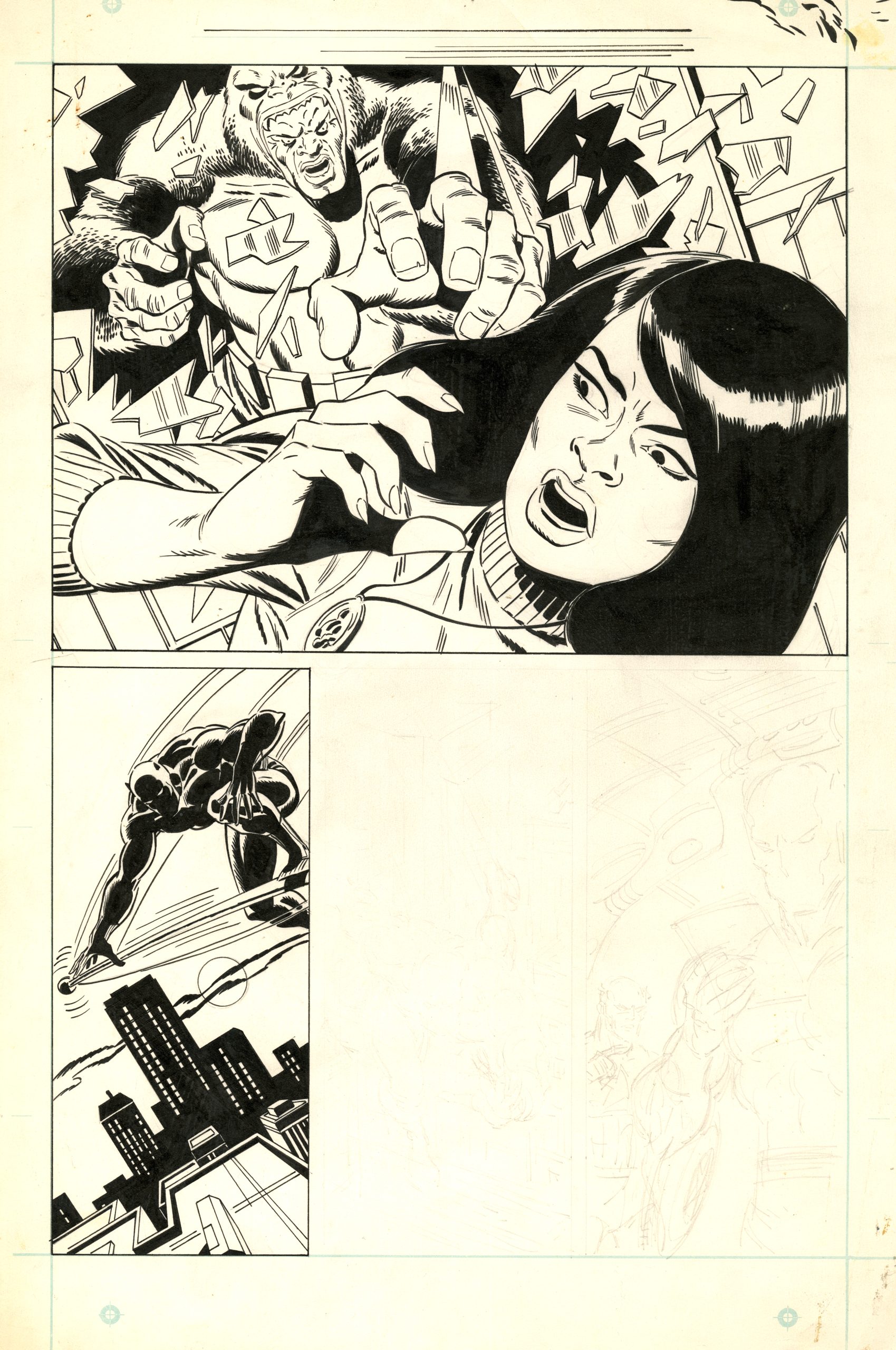 Unfinished alternate page for The Avengers #79, August 1970. Written by Roy Thomas, inked by Tom Palmer.
Will you quit inking for Marvel altogether and let penciling dominate your career?
BUSCEMA: It looks that way, Gary, and I think the reason for this is because... again, I must say that they liked my penciling, and I guess that I’m going to be kept pretty busy with my penciling. I’d like to ink; maybe in the future I might be able to ink one of my own jobs, but I really don’t know right now if I can or not.
Could you tell us why Marvel has made a new policy of having at least 3 issues of a particular title done in advance?
BUSCEMA: I really can’t answer that question. I don’t know why. What you mean is that a book marked September will come out in say, June or something like that, right? I really don’t know why. I think it’s just a matter of scheduling, and that’s the way it works out. These books just come out in advance.
Are you drawing any other titles for Marvel at present?
BUSCEMA: Not right now. I hope to be in the future.
What revolutionary changes in the “comic world” have you noticed since you first started reading comics to the present time?
BUSCEMA: Well, let’s see. I think, just basically, that the artwork has improved tremendously. I think that the layout of the pages are quite a bit different than they used to be. If you look at some of the real old books, the pages have a lot of panels on them you very seldom saw a full-page panel or even a double-page spread, which is what they use quite a bit today. Just generally, I think that comic books today are a lot more exciting, they’re a lot more FANTASTIC than they were years ago, and I think that in itself has been a tremendous improvement. I think that just generally they have grown up and have gotten much better all the way around; better drawing, better inking, better writing, better layout. Even I think the coloring is better today than it was years ago. It’s just a much superior product.
What is your ultimate goal in the comic world?
BUSCEMA: To beat Jack Kirby… or John Buscema, because they’re both GREAT!!
Could you give us your opinion of the Comics Code Authority; should it stay as is, be abolished, or just be revised?
BUSCEMA: Well, I think it should stay. It’s a good thing. It could probably be revised a little bit. I think, perhaps they stop the comic industry from doing some thing that I think might be good, some types of stories; but just generally, I think that it could be reviewed and could be brought up to date little bit and be made a little bit more realistic because I personally feel that the kids of today are pretty sophisticated, and I don’t think they’re going to be influenced by any little realisms we have in comics.
What is your opinion on changing the present format of the comic to resemble that of the Silver Surfer mag? (Refer to The Marvel Tribune #10)
BUSCEMA: As I said before, I think there’s room for improvement, no matter how good the product is. This thing about them being called “comics”… I think if you look through the magazine… wellllll, I see what you mean — they call it Marvel COMICS group. I think you can chalk that up more to tradition than anything else. In other words, what would you call them?
Graphic Stories?
BUSCEMA: Graphic Stories? Okay, maybe so. That’s a good name, but they’ve been called comics ever since they came out, and it's true they’re not funny, and everybody knows they’re not funny, and I’M not even aware of the word “comics”. When somebody asks me what I do, I say, “Alright, I’m a comic book illustrator!!” They don’t say, “Do you do comical stuff like Donald Duck or Bugs Bunny?” They don’t ask me that kind of a question. They say, “Oh, what characters do you do?” And they know immediately that I’m doing this type of thing----the SUPERHERO type of comic. They’re not humorous --it’s true. Maybe you could write to Stan & tell him about “Graphic Stories.” Maybe he’d accept the idea and change the format. I don’t know. This is kind of a sticky question, and not having been in this business for long, you’re kinda catching me off guard, and I really haven’t formulated that many opinions about these things you’re asking me about. Such as the Comic Code, which you asked me about before, and this thing. But as far as comics, in general, there’s no question in my mind, and I don’t say this because I work for them, but I really feel this way: I think Marvel turns out the best book there is. I think their books are great. They’re tremendously improved over what was being done a few years ago. But I think they can be made even better, and I think this is something that they’ll really try to do, they’ll always try to do it, so that their books will sell more and so on and so forth. And they’ll be a whole bunch of new artists coming in… who knows, maybe you’ll be one?
Is it hard work being an inker?
BUSCEMA: It’s not physically hard, no, because you’re sitting down in a comfortable chair. You’re sitting at a table inking someone else’s work. It takes talent and ability… certainly. I wouldn’t say it’s hard. I don’t think anything is hard if you enjoy doing it!! No, personally, I enjoy it and therefore don’t even consider it work. To me, it’s a lot of fun. I think penciling is quite a bit tougher, actually, because there, you not only have to worry, but you also have to worry about telling a story, and you have to think about making your pages exciting and all this stuff; that type of thing.
At this time, do you know who will ink your Avengers artwork?
BUSCEMA: I think I mentioned before that Sam Grainger might be inking it, and he’s a good one, too.
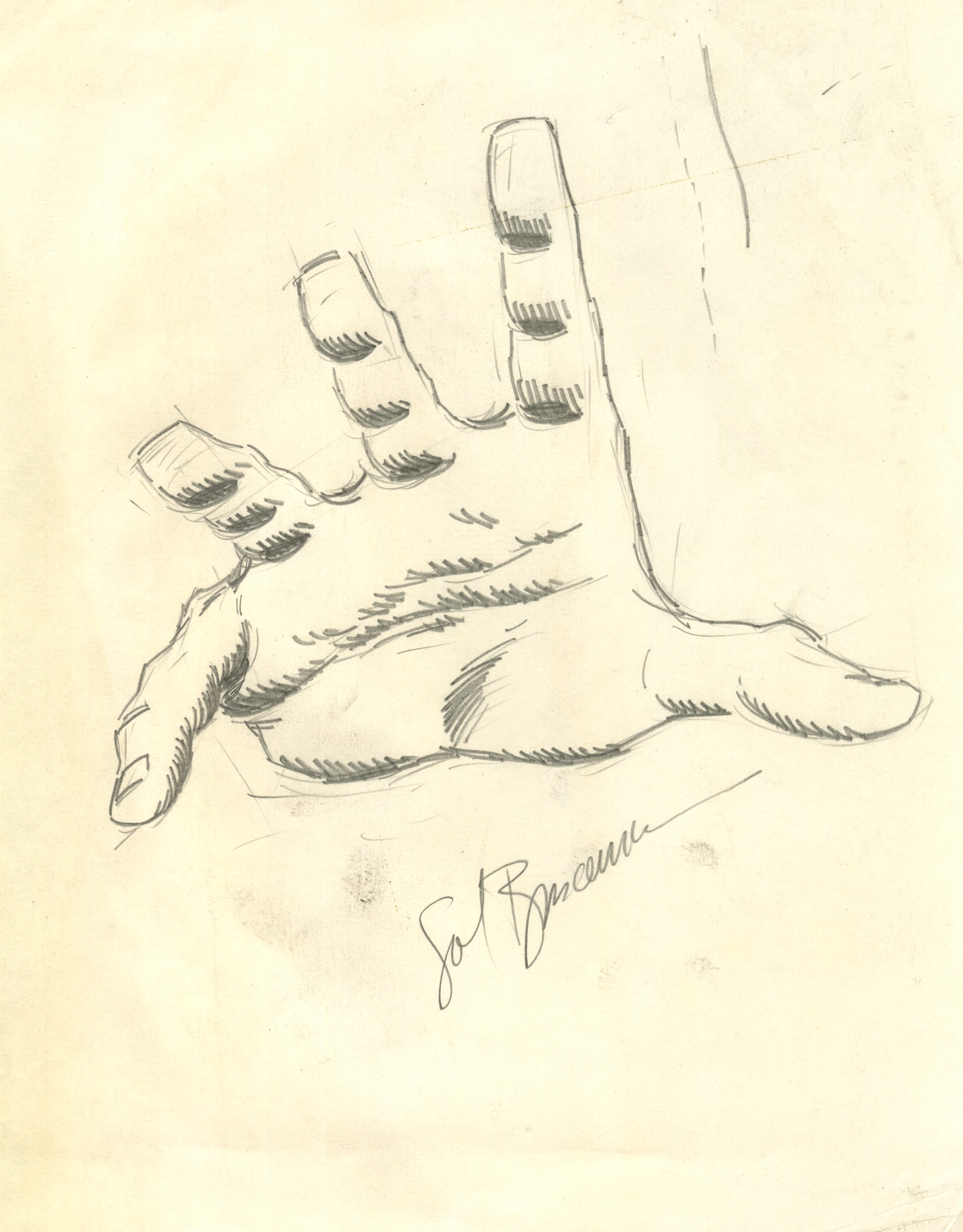
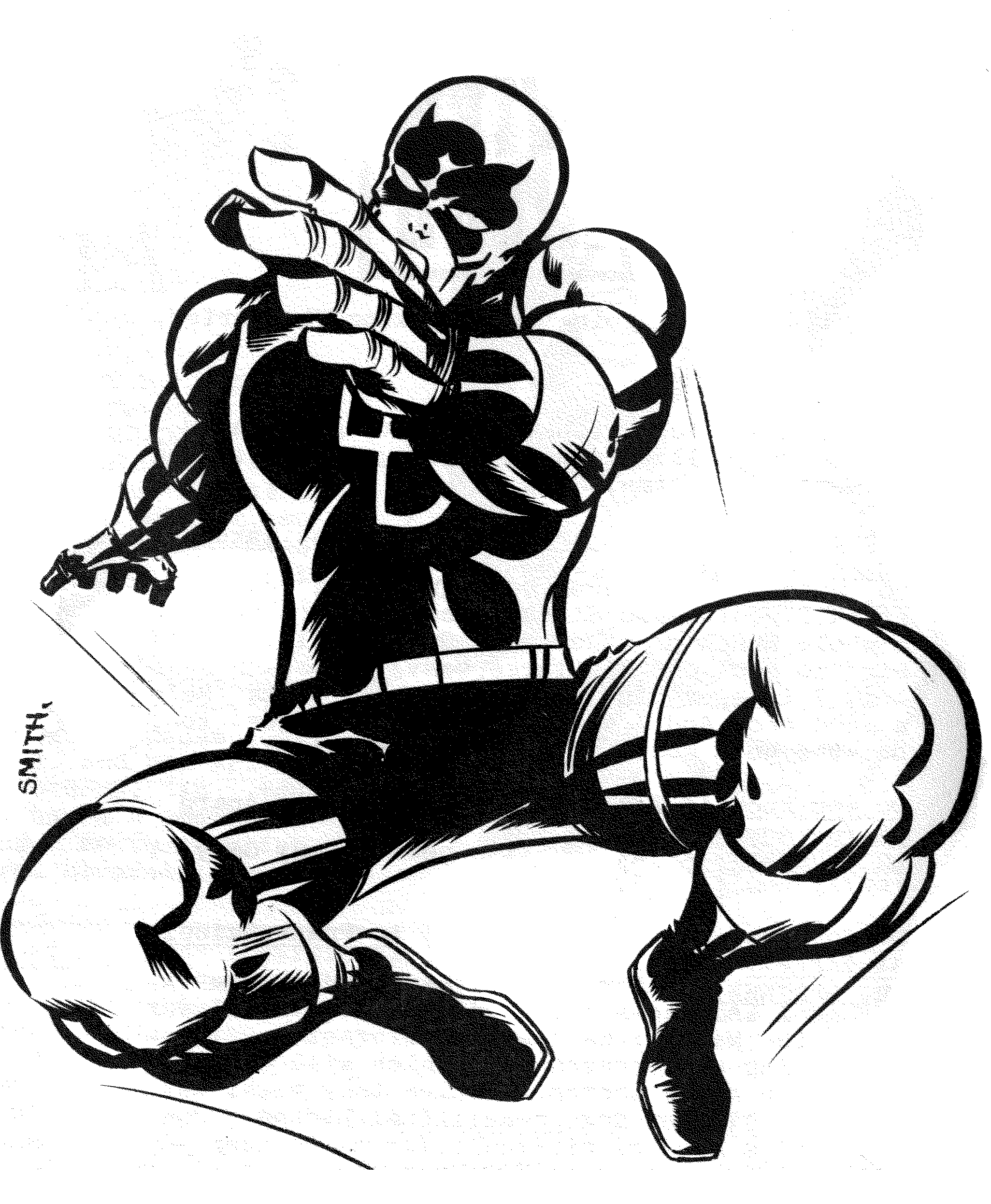 Barry Windsor-Smith spot illo that ran in the interview
Do you have any advice you would give to an amateur artist just trying to break into the field of comic books?
BUSCEMA: That's a darn good question, and I would like to give some advice; actually, I feel sometimes I need some advice, myself. The best way I can answer that, Gary, is to say this: I think the most important thing in comics as in any art field, is to draw well and the only way a person can learn how to draw well is by studying and by drawing, drawing… and drawing and after that drawing some more; as much as you possibly can because drawing is a very difficult thing to do; it doesn’t take weeks or months… it takes years to become a good draftsman, a good artist. It’s a lifetime proposition. It’s the type of thing where you never stop improving. You have to constantly learn and learn and learn and I think that’s the best advice I can give any aspiring artist is to practice all the time because of the old adage “practice makes perfect” - and it couldn’t be more true when it comes to doing comics or any illustration and the only other thing I can say is to study the comic book artists like Jack Kirby and John Buscema and Gene Colan and another one of my favorites that doesn’t work for Marvel is Joe Kubert, (pronounced Que-bert ), who works for DC who is a great one. He is just tremendous… and study these guys and see how they lay out a page and this type of thing. Don’t copy them, just see what they do and then try to do the same thing in your own way so that you can be an individual, not a copyist.
Would you like to ink your own artwork? Would you like to write your own scripts as well?
BUSCEMA: To answer the first part, yes, I would love to ink my own art, but as I mentioned before, it’s going to be a little difficult because I think I will be pretty busy pencil-ling and I won’t have the time to ink. I hope to, maybe once in a while but I really don’t know if I can and as far as the writing is concerned, well, just like drawing this is something that you need a talent for and Roy and Stan and all the other writers up at Marvel are all very talented writers and it is something that you have to know how to do; it’s not something that you can pick off the top of your head; just like drawing is something you have to know how to do and you have to have a talent for it so I’d love to be able to write some of my stuff but I just don’t think I could because I don’t know how; It’s as simple as that.
WOULDJA’ BELIEVE THE END OF THE INTERVIEW????
Could you tell us on what basis an inker at Marvel gets paid?
BUSCEMA: I think on the same basis as the artists; I know, as an inker, I was being paid by the page. I don’t know if everybody is in the same situation. There might be some that are salaried, but I was being paid by the page.
Do you get paid more for a cover than an inside page?
BUSCEMA: No, you get the same amount for anything you do, covers, splash pages, inside pages, or anything.
What 3 Marvel titles need improvement, and how would you go about improving them?
BUSCEMA: Well, as I said before, in general, I really can’t think of any 3 particular books that need improvement, but as I mentioned, I think Marvel puts out the best books in the business. I really think they’re superior -they put out a really fine product, but I feel that no matter how good a product is, it can always be better, and just generally speaking, I think that all of the books can be improved and made better than they already are.
Could you tell us about any new developments in the Avengers series?
BUSCEMA: We’ve got a new character coming in 3 or 4 months that is a really interesting character. I won’t tell you his name… you’ll have to find that out for yourself, but I have to develop the character, draw him up & it’s sort of according to Roy Thomas’s description, and he’s really something a little different. You might find him pretty interesting. The book will be out in about 3 or 4 months, as I said before.
Could you give us any scoops as to new Marvel titles, character development, or anything else to interest Marvel fans?
BUSCEMA: I think Marvel will be coming out with Romance books, Love Stories… that type of thing. And I also think they’re coming out with some Mystery books, and you might be seeing these pretty soon. I’m kinda looking forward to the Mystery books in particular, because I think they’re really gonna be good---kinda like way-out stuff.
What age do you consider to be the ideal age to start work at Marvel as an inker or penciller?
BUSCEMA: The sooner the better. I would say that a guy has to go to high school, college, and then, if he wants to get into this kind of business, I think the best thing for him to do is start as soon as he can. When he gets out of college, in his early 20’s at the very latest. Because if you take notice, the best artists in the business today are the guys that have been in it for a long, long time. Guys like Jack Kirby, John Buscema, Gene Colan, and Joe Kubert, and all these top-notch guys, are guys that have been in the business for fifteen to twenty years, maybe even longer. And they got that good because they worked at it a long, long time, and they worked real hard at it, and that’s the only way to do it, to get an early start and really persevere.
Mr. Buscema, is this your first interview? If it is, it’s another FF first; we also had the first Barry Smith, Gene Colan & John Romita interview?
BUSCEMA: You missed me by two weeks. I gave another interview to another magazine about two weeks ago, but as I mentioned before, your interview was longer, and I think you had a lot of really interesting questions in it.
As a whole, what did you think of FF# 6–7??
BUSCEMA: Well, as a whole, I think you have a really good magazine. The only thing I can tell you is to keep up the good work, and as I mentioned about The Marvel Comics, no matter how good a thing is, it can always be better, so just strive for improvement and keep up the good work. It’s a really good magazine. I haven’t read it yet, but I will read it because I think you have some interesting articles in there. I also think the artwork is very good.
Thanks, you’re a real ego booster. We feel that this issue is a great improvement over last issue. To top the interview off, could you tell us how old you are?
BUSCEMA: I sure can, I’m 33 years young!
THE EVER LOVIN’ END






 English (US) ·