
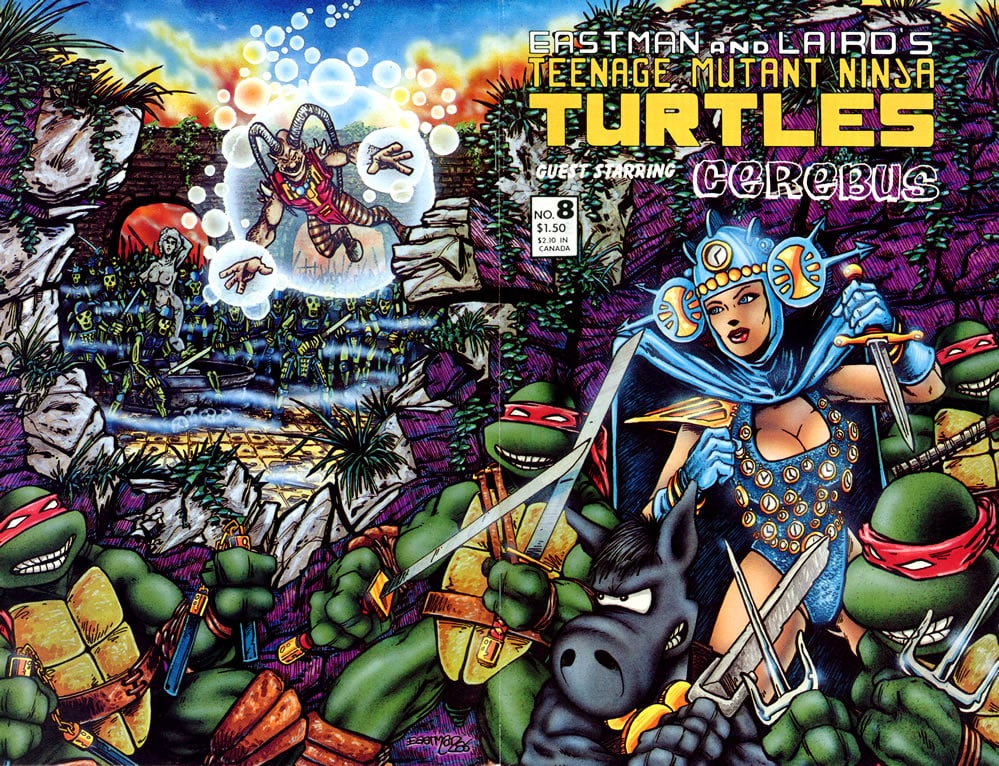
Teenage Mutant Ninja Turtles #8 is officially our Comic Book of the Day, offering an incredible and history-making crossover that stands as the definitive testament to the golden age of self-published comics. Released in July 1986, this landmark issue brought together the two biggest powerhouses of the independent movement: Kevin Eastman & Peter Laird’s Turtles and Dave Sim’s Cerebus the Aardvark. For fans who want to see how the underpinnings of creator-owned freedom can spark absolute magic, this issue is a definitive portal into a masterfully composed time-travel epic.
The creative powerhouse and authority behind this industry-shaking project includes:
- The Scribes & Visualists: Kevin Eastman & Peter Laird
- The Guest Creator: Dave Sim (Cerebus)
- The Publisher: Mirage Studios
- Release Date: July 1986
The history of the issue is rooted in the deep camaraderie and mutual respect shared between the early pioneers of the independent black-and-white boom. During the mid-1980s, self-publishing was a tough, high-stakes battle against the distribution monopolies. By teaming up for a massive, cross-property event, Eastman, Laird, and Sim proved that creators didn’t need the backing of corporate giants to make a massive splash. The resulting Team Up with Cerebus became a cultural phenomenon, establishing a standard of solidarity that remains highly respected today.
The Temporal Chaos of Teenage Mutant Ninja Turtles #8
What readers should prepare for in Teenage Mutant Ninja Turtles #8 is a tale that finds its heart in the professional and cosmic vacuum of a temporal heist. The story kicks off in the sewers of New York, where Leonardo, Michelangelo, Donatello, and Raphael are suddenly confronted by a frantic, clock-bearing girl named Renet. Described as an apprentice “Timestress,” Renet has committed a cardinal sin: she has stolen the highly coveted Time Scepter from her master, the formidable Lord Simultaneous.
This act of rebellion triggers an immediate and high-stakes chase across the centuries. When Lord Simultaneous tracks the thief to the 20th century, a moment of panic causes Renet to activate the scepter, sending herself and the Turtles hurtling through the timestream. They materialize in the year 1406, landing directly in the middle of the gritty, medieval world of Cerebus the Aardvark. This sudden shift in setting highlights the flexible nature of the adventure genre, throwing the high-tech, pizza-loving ninjas into a world of swords, sorcery, and cynical mercenaries.
The pacing of the issue allows for a deep dive into the contrast between the teams. While the Turtles are driven by a noble desire to help Renet, Cerebus is a hard-boiled soldier of fortune who primarily cares about his next paycheck. The interaction between the dry, sarcastic aardvark and the energetic, bickering brothers provides a rhythmic tension that carries the reader through the 15th-century conflict. As they become entangled in a siege at a local baron’s castle, the action reaches a chaotic, sword-swinging peak that is beautifully cataloged in TMNT Entity review archives.
The Debut of Renet and the Time Scepter
Visually and lore-wise, Teenage Mutant Ninja Turtles #8 is an outstanding achievement for the franchise, introducing concepts that would become central to the cosmic and magical side of the Turtles’ universe. This issue marks the very first appearance of:
- Renet: The young, scatterbrained Timestress who would become a recurring ally for the Turtles.
- Lord Simultaneous: The nigh-omnipotent master of time and keeper of the scepter.
- The Time Scepter: The reality-warping artifact that allows for cross-dimensional and temporal travel.
These characters didn’t just stay in the indie black-and-white pages; they transitioned into the mainstream, appearing in the 2003 and 2012 animated television series, the IDW publishing runs, and even receiving their own high-end action figures. For fans who enjoy exploring flashback reviews, this debut represents the “Year Zero” of the franchise’s temporal mythology, showing how a single guest story could expand the lore for decades.
Furthermore, the art in the issue is a unique, collaborative masterpiece. While Eastman and Laird handled the pencils and inks for the Turtles and the backgrounds, Dave Sim personally drew Cerebus within the panels. This combination of styles, preserved in crisp black-and-white on high-quality newsprint, gives the book a tactile, hand-drawn texture that feels incredibly raw and personal. As noted in retro retrospectives, this seamless artistic blend is why the book remains a favorite subject on Cerebus history blogs and fan forums alike.
Speculator and Collecting Guide for TMNT #8
For the serious collector, the acquisition of Teenage Mutant Ninja Turtles #8 is a mandatory goal for any serious Bronze Age portfolio. Because of the historic nature of the crossover, this book is highly liquid and continues to see stable, long-term growth. According to GoCollect values, high-grade 9.8 copies of the first printing command significant premiums, making it a blue-chip target for independent investors.
However, when hunting in back-issue bins or online auctions, you must understand the hierarchy of printings to avoid counterfeit or later editions. The Key Collector database identifies several distinct printings:
- First Printing (1986): Identified by the lack of a “printing” credit on the inside cover, the standard larger size of early Mirage issues, and the high-contrast cover art featuring a vibrant blue background behind the logo.
- Second Printing: Features a specific “Second Printing” notation on the indicia page.
- Third Printing & Beyond: Often printed in a standard modern comic size, with colors that differ slightly from the original 1986 pressing.
According to Cerebus Wiki records, the first print run was roughly 135,000 copies—a massive number compared to the ultra-rare first issue, but still finite given the global popularity of the characters. Tracking down a high-grade copy with sharp corners and clean white pages is a pensive-free investment that will always hold its value. Whether you are a fan of the Turtles, Cerebus, or simply a historian of independent publishing, this issue is a mandatory piece of sequential art history.
When the final page is turned, Teenage Mutant Ninja Turtles #8 stands as a triumphant monument to the power of independent comics. It is a book born from friendship, executed with absolute artistic freedom, and delivered directly to the fans without corporate interference. As the Turtles are eventually returned to their own time by Lord Simultaneous, and Cerebus is left to his mercenary duties, the reader is left with a sense of wonder that defined the best parts of the 1980s. Don’t miss the chance to experience this ultimate crossover when you dig through the bins this week!
📢 Join the Conversation
Who had the best lines in this epic crossover—the cynical Cerebus or the pizza-loving Michelangelo? Do you think the introduction of Renet and the Time Scepter was the best sci-fi addition to the TMNT lore? Join the conversation on X and tag us @comicbookaddt to share your thoughts on the ultimate indie team-up!
Follow our community for more updates:







 English (US) ·