
This post is a republish of a post from my old site, and it has not been updated.
10. Arkham Asylum: Living Hell (6 issues, 2003)

I’m thrilled to be able to recognize Dan Slott. He writes “typical” superhero stories: Nothing metaphysical or groundbreaking, just damn good plotting and writing. People like Slott and Mark Waid can be overlooked when “great” writers like Grant Morrison or Frank Miller are being discussed, but they shouldn’t be. The stories Dan Slott writes are the meat and potatoes of the comic book industry.
In this mini, he and Ryan Sook went off the beaten path to focus on Batman’s rogues gallery. It’s funny, scary, and fabulous.

9. Batman: Year 100 (4 issues, 2006)
Paul Pope’s take on Frank Miller’s dystopian future for the Dark Knight might not have been as revolutionary as The Dark Knight Returns but in many ways it was…Better. The book explores a totalitarian Federal government’s conflict with Gotham City’s police force (led by Commissioner Gordon’s grandson) as the GCPD and the Feds fight to capture Batman. Colors by the great Jose Villarrubia round out a miniseries that was high on atmosphere and full of dark menace. It’s one of my all-time favorite Batman stories. And it won an Eisner.
8. Green Lantern: Rebirth (6 issues, 2004)
Green Lantern: Rebirth was the first Green Lantern comic I ever read. I bought (and cherish) the old Neal Adams Green Lanter/Green Arrow series, but mostly because of Oliver Queen. I’ve always thought GL was stupid. In fact, my favorite Lantern stories are (a) the one where Robin beats the snot out of him in All-Star Batman; and (b) the one where Batman punches out Guy Gardner. So it took a lot for me to read Rebirth. It took tons of critics saying how great it was. It took several years after it was actually published. It took me liking Geoff Johns’ runs on Teen Titans and Action Comics enough to want to read more of his work. And it took a friend of mine giving me all six issues for free.
But I’m glad I read it. It was a great story, and a great rendition of one of comicdom’s best standards: The comeback.
The books since Rebirth didn’t excite me nearly as much—including Blackest Night (which hI liked but didn’t love) and Brightest Day (which I bailed on about halfway through)—but this one still stands out for me as a great example of how you can still take an old dog and make him seem young, fresh, exciting and new.
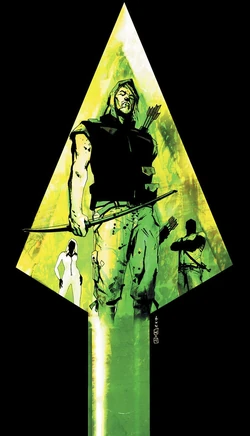
7. Green Arrow: Year One (6 issues, 2007)
Andy Diggle and Jock, the team behind The Losers, reimagine Oliver Queen’s time on the island and his return to civilization in a gritty, neo-realistic reboot that stayed true generally to the original legend but added more heft. It’s been the template for every Green Arrow story ever since, including the TV’s “The Arrow.”
And the art, by Jock, is as amazing as you’d expect.
6. The Secret Six (6 issues, 2006)

Gail Simone’s Secret Six is one of the greatest team books in comic book history.
5. Robin: Year One (4 issues, 2001)

To me, DC is usually at its best when it is at its most innocent. Marvel has done a good job at cornering the cynicism-as-realism market, but DC’s best known heroes—Superman, Wonder Woman, Green Lantern—are all kind of epically hopeful at their core. In contrast, Marvel has Captain America, and that’s pretty much it for “big” idealists (unless you count Spider-Man, but he’s more laughing at danger than a source of inspiration). Batman is really the one DC dude who’s whole central theme is desperation. That’s why Robin is his perfect counterweight. And my favorite Robin story of all is Year One by Chuck Dixon, Scott Beatty, and the brilliant artistic team of Javier Pulido and Marcos Martin—and the great Lee Loughridge on colors. It’s beautiful, and Robin’s character has never been better shaped or understood.
4. DC: The New Frontier (6 issues, 2004)
Darwyn Cook’s revamp/elsewords book about the silver age days of DC’s big six, culminating in the creation of the Justice League of America, won all the awards. Seriously. Four Eisners, four Harveys, and a Shuster (a Canadian award—but still somewhat valid). It also got made into a pretty good DVD animated movie.
Visually, it’s the most beautiful book on this list.

3. Superman: Birthright (12 issues, 2003)
You pretty much can’t go wrong with Mark Waid and Leinil Francis Yu. This was the first Superman origin reboot of the 21st Century, intended to replace the previous reboot–John Byrne’s Man of Steel.
It will seem familiar in some spots to the Man of Steel movie, which borrowed some of the story elements. But not nearly enough of them, as this is one of the best Superman stories ever done and the Man of Steel movie….Wasn’t.
And sadly, it only stayed canon for 6 years when Geoff “anything you can do I can’t do better” Johns came along with Superman: Secret Origin. Which was soon itself repealed by Geoff “anything I didn’t do better I can do worse” Johns.
2. Shazam!: The Monster Society of Evil (4 issues, 2007)

So, you’re DC and the creator of one of the most popular and best received kid-oriented indie books is willing to do a job for you. What do you assign him?
The big red cheese of course!
As a character, Captain Marvel has rarely (ever?) been in a comic that was anything more than fluff. But when Jeff “Bone” Smith took the character through four oversized, specially bound issues, the I finally understood why Shazam could, and should, matter.
The book wasn’t overly funny or silly (any more than you’d expect from a comic with a talking tiger and an evil worm), but it had the perfect soft, innocent tone of a young boy trapped in the body of a superhuman. I’m sure it didn’t fit in with regular DC continuity, and I didn’t care. The whole thing, from the words through the art, was transcendent.
1. Seven Soldiers (multiple series, 2005)

Marvel can call its main writers “architects” but when it comes to event design, it doesn’t get much better than Grant Morrison’s “Seven Soldiers.” Like a good mini should, it elevated C-list characters and was just “outside” enough that regular DC programming could continue uninterrupted while Frankenstein, Shining Knight, Zatanna, Mr. Miracle and the rest did their thing. And as for art, how do JH Williams III, Ryan Sook, Cameron Stewart, Yanick Paquette, and Frazier Irving, among others, grab you?
The story was told in two one shots, one at the beginning and the other at the end, and seven miniseries, each focusing on one of the titular Seven Soldiers’ battling to save earth from an alien force. Morrison’s assembled seven were originally intended to be an answer to each of Marvel’s main Avengers members, but he managed to throw in his typical weird and wild angles with characters like Dan the Dyna-Mite and Buffalo Spider.
Each of the seven minis had a unique artist and voice, allowing Morrison to tell stories in the style of most of the major comic book genres. You can tell how much fun an ubergeek like Morrison had on this project. It was so good, in fact, that it won the Eisner. It’s been collected in several volumes, and if you only buy one of the miniseries on this list, I’d have to say go with this one based on sheer variety and the massive talent associated with it.
HONORABLE MENTIONS:

Superman: Red Son was good, but just not good enough for me to include. Ditto Batman and the Monster Men and Catwoman: When in Rome. They’re all worth your time and money, but they just didn’t make my top ten. I also really liked Batman: The Long Halloween and Justice League: Generation Lost.
And, of course, JLA/Avengers was money. But it wasn’t pure DC.






 English (US) ·