
Brian Nicholson | May 28, 2026
In the days of MSPaint, I gravitated towards the spraypaint tool. Throwing up pixels in a scatter plot, so that the longer you held down, the closer you would get to a solid color, felt more forgiving of the twitches a mouse would register. I see a similar shading on the edges of Ben Sears’ figures. This is one of the reasons I see his art and think of Aardman Animations, as these marks feel like the faint trace of a fingerprint in a figure made of clay. There’s nothing amateurish about it, but the nature of Sears’ finesse bears the mark of childhood experimentation with powerful tools, which makes his stories of child characters feel intuitive rather than calculated.
In Young Shadow & The Watchdogs, his cast of kids has summoned spirits from beyond the grave. Necromancy: the most powerful tool of all! Young Shadow, the superhero star of Sears’ previous entry from Fantagraphics, is here playing baseball on a team with his friends, in a book whose release is fortuitously tied to the start of baseball season. As the previous comic focused on fairly straightforward superhero action, this sequel feels like a lateral move, elaborating on character and tone to tell a story where conflict is not resolved with punching. In a premise fit for Halloween, a haunted glove summons the ghosts of a baseball team the Watchdogs have to win a game against in order to survive.
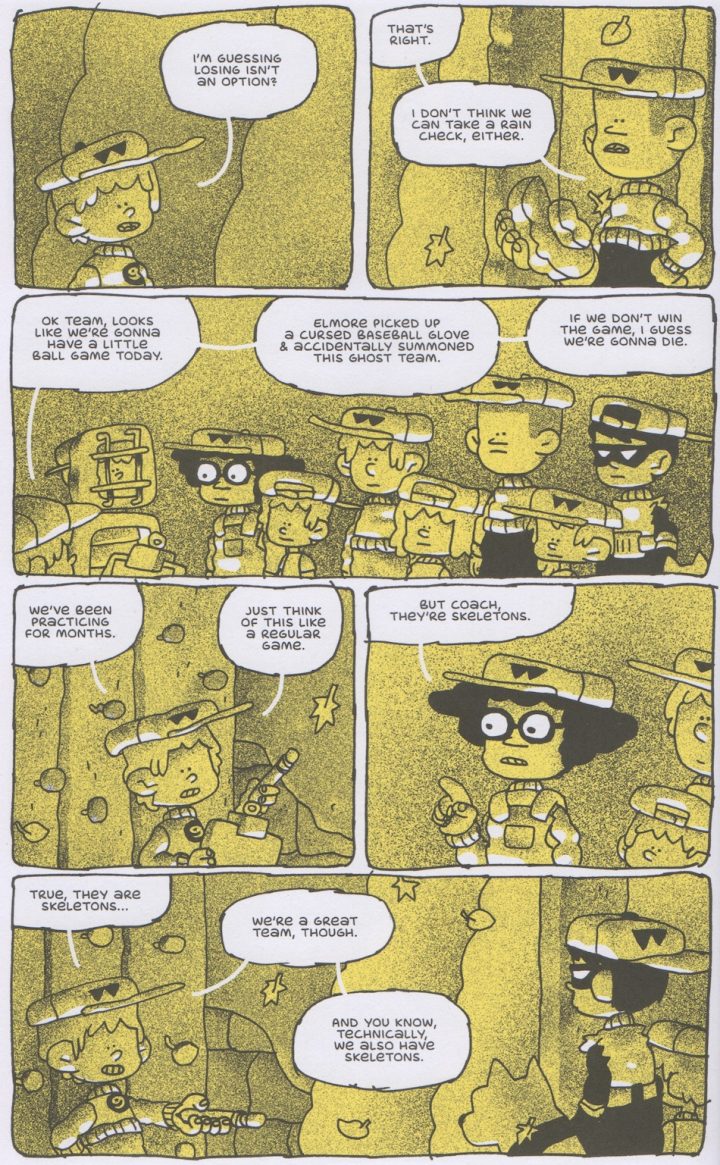
It’s the nighttime, as opposed to the daytime of the Plus Man books, published by Koyama Press. Those were in full color. Young Shadow & The Watchdogs reprises the color scheme from the previous Young Shadow book, although what was closer to an orange there is a purer yellow here. (A self-published Young Shadow minicomic, Tunnel Vision, is risograph printed in blue.) The yellow wavers, alongside the texture of that spraypaint greytone grain, casting a lambent light upon the page. The visual world breathes a bit more; there’s more quiet, less dialogue. I detect a Mat Brinkman influence in Sears’ love of architecture made up of individual bricks. In all of his work, the sense of shape of individual elements gives a sense of the shape of the larger world. There’s a sense of exploration of geography I associate with video games, rendered in a form that feels low-poly.
Ben Sears is a cartoonist I can see becoming a Mike Mignola-type, essentially; a person whose visuals are so strong and evocative one alternately wishes they would just gesture to plot and pursue atmosphere, or tighten up their character writing to be a little bit funnier and more precise. He’s such a distinct stylist that any kind of variant cover or commission of popular characters is guaranteed to be fun and compelling. In his own comics, his character designs are cute, but the personalities he writes don’t yet sparkle in such a way that someone looking at the character sheet of the Watchdogs in the front of book will think, “Oh, I love that guy!” at the sight of any of them. Still, the single-color, original paperback graphic novel treatment given here is something I think would benefit Mignola; it is both affordable enough to feel low-stakes and accessible but sumptuous enough to flatter the material.
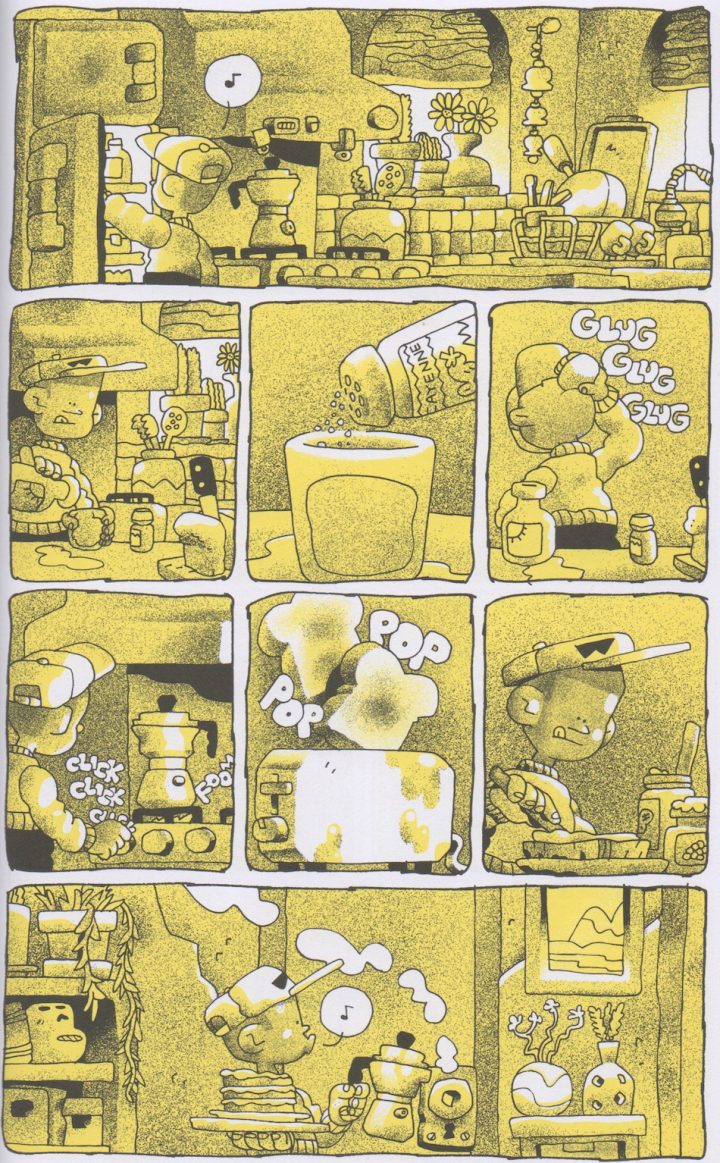
As it is, Sears is doing right by his future self the same way a young Mignola did, by making all-ages work so that kids who see it now will fall in love with it and follow him for years to come. There is a tendency for well-meaning adults to suggest comics like this to kids who don’t like to read, boys specifically. There’s a sense of play to it, and a lack of character interiority one can see appealing to someone who would rather just be playing a videogame. It’s Sears’ work, and Jason Shiga’s Adventuregame Comics, I’m most likely to suggest to anyone shopping for a gift for their nephew. Admittedly, if someone wanted a comic about baseball specifically, I would point them to Mitsuru Adachi instead; but also admittedly, I personally am not in the market for a comic about baseball anyway. This sort of sports-themed spin-off is like the Mario Tennis to Young Shadow’s Super Mario World, using visual language to hook me into a structure I wouldn’t necessarily pursue otherwise. I prize Sears’ work over others in this kids’ comics space because there is such generosity to what he’s doing, in the visual richness he gives his environments. His drawings are not simple glyphs that utter simple dialogue and offer something a child can briefly appear to be engaged with in a simulacrum of reading. The drawing provides its own language which can be thought through and imitated, and so begin to examine dimensionality and shape, and show how looking at something in order to figure out how to draw it is an education in examination, fully outside school’s structure where examination is something kids are subjected to to ensure they’ve received an education.
I spoke with Ben when the first Young Shadow book came out, and one of the questions I had for him wondered why his characters were kids in the first place. I feel like he responded with an “I don’t know,” but I had my own theories as they related to that book, and I have a new set of theories now, as they relate to its sequel. They’re kids because they take pleasure in what they do. They drive around, work in animal shelters, are superheroes: This is stuff that a kid can think of as fun, but which casting adult roles in for the sake of “realism” would become bogged down in cynicism and complaint, the way work is. Sears’ minicomic Empanada features service-worker protagonists complaining about customers, but they also have a conversation about their sense that they’ve let their parents down, indicating that despite the squatness of their proportions, they should be taken as adults. Here, we’ve got kids playing baseball for fun, worried about being able to beat a team of rich kids, sucked into playing against a team of adults, with personal grievances against each other, whose fate essentially damns them to play baseball. I don’t think it’s a spoiler to say that the Watchdogs win the game, at least in the context of me speaking to readers who are presumably adults and aware of enough genre tropes that they suspected this team of kids would not end the book exiled to the underworld. Childhood is about the freedom to explore and have fun with the paths before you that you might not pursue in life. Sears’ work, at this point in time, still embodies a similar potential, that the cartoonist he might become can follow its own path, sidestepping any traps that might befall the practitioner of superhero work or kids comics.





 English (US) ·