
RJ Casey | March 25, 2026
Hello esteemed members of the Selection Committee. As you may have heard, this year’s tournament will be a little different. Instead of basketball teams, the field of 68 in 2026’s bracket will be populated with cartoonists. Of course, receiving automatic bids will be the winners of each conference. Those include Genre (i.e. strip; one-panel gag; autobio — medical calamity), Region (Philadelphia; Chicago; Burbank; etc.), and School (such as SAW; CCS; and comics that are CCS-coded). We are here today to take any and all pitches on inclusion and seeding in the comments. Thank you for your valuable contributions.
In the meantime, here are some comics I’ve had my slimy eye on:
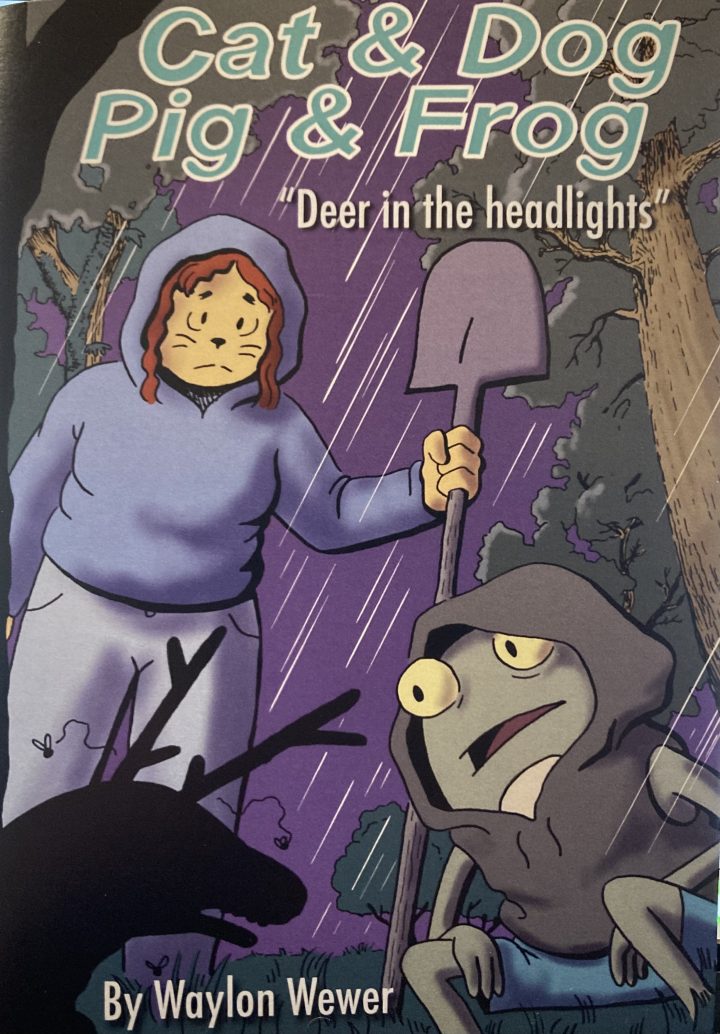
Cat & Dog Pig & Frog #2 by Waylon Wewer
Waylon Wewer’s character design should be commended. I don’t know any of this artist’s previous work nor am I familiar with this cast of characters, yet they all have clever and no-sweat distinctions. The pig’s got a soul-patch goatee. The dog has ill-fitting tube socks. However, the two characters who become the focus of this short story are Cat, who hits and kills a deer man with her car, and Frog, who helps cover up the crime. Frog ties cinder blocks to the dead deer’s antlers with jumper cables and they send him to the bottom of the river, a method he supposedly learned “in the military.” They vow never to speak of any of this again. Later, seemingly meant to be humorously, they have to bring the body back up to land in hopes of getting a monetary reward.
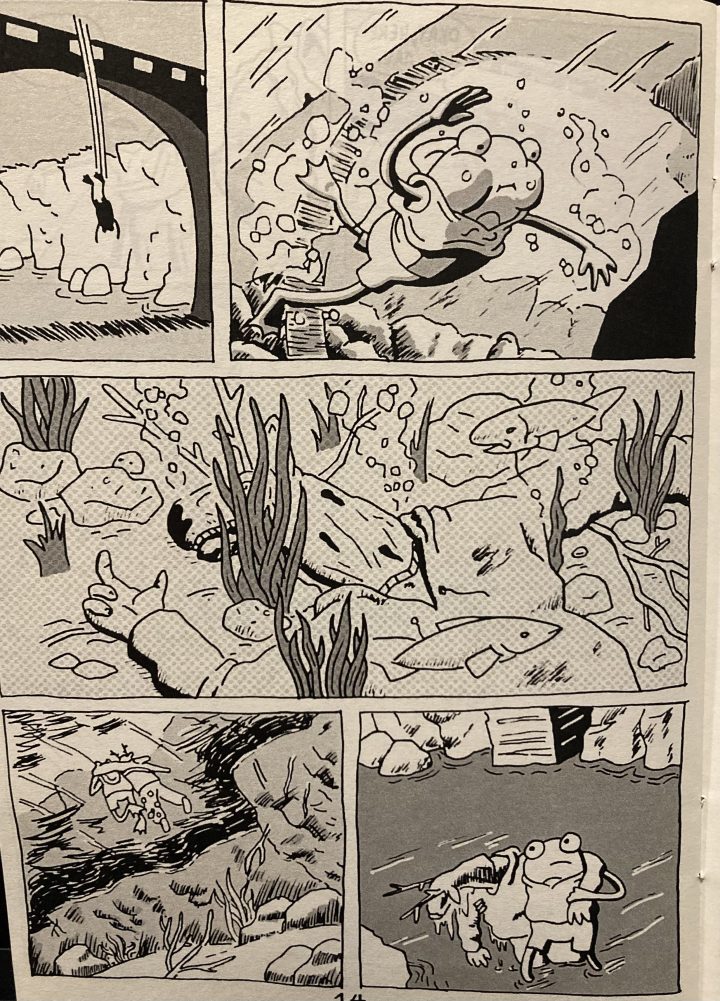
The plot is not overwrought and Wewer sprinkles in a few nicely composed panels, like when Frog has to return to the river and swim towards the bottom. And I’m all for new voices in the Funny Animal space. (Say it with me: Bring back Critters.) Though when there’s a good, as often is the case, there’s also a bad and ugly. Directly after the vehicular murder, the two co-conspirators go to Pig’s house to watch a movie, using the opportunity to collect potential alibis. As the movie plays, Cat starts having flashbacks. Wewer alternates every other panel with scenes from the movie and then Cat and Frog dumping the body. The issue is, these flashback panels, they happened literally a couple pages ago in the comic. Narratively, who are these for? I’m not an amnesiac! And now I have to mention the ugly aspect of “Deer in the Headlights.” Cat and Frog get the leech-ridden carcass back into Cat’s car because a news bulletin has gone out stating someone who fits the deer’s description is a suspect in an armed robbery case. Frog says to Cat, “Great news! That guy you killed was wanted by the police! You don’t have to feel bad, he was a violent criminal.” I am not necessarily by any means looking to comics for ethics and morality, nonetheless — even if it’s to serve as a punchline — “he’s a suspected criminal, it’s OK he died,” is a little more than I can stomach. Cat & Dog Pig & Frog ends in a nice, self-contained tiny bow, but storywise Wewer has to be more subtle or creative. Probably both.
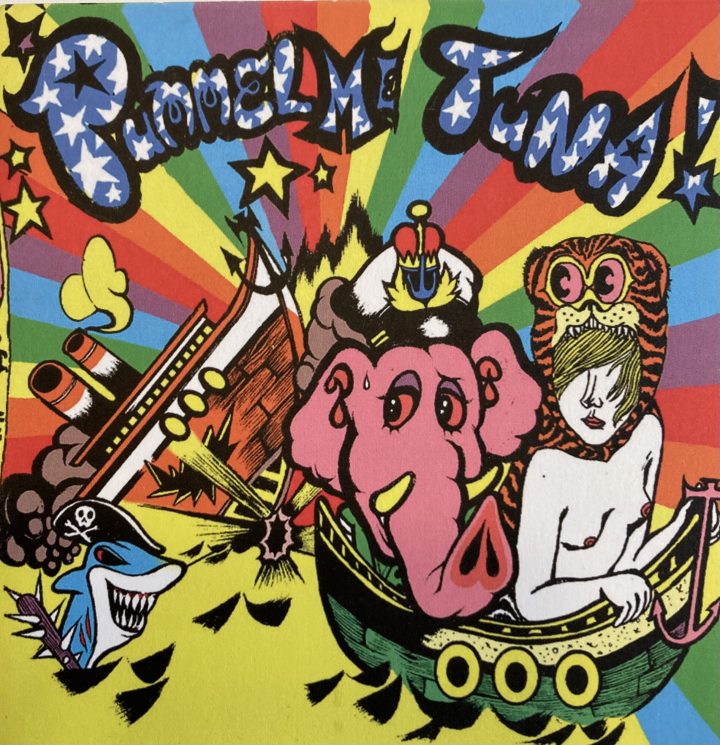
Pummel Me Tuna! By Juliette Collet and Nate Garcia
From the very first rendition of this column, I promised to comment on comics that “get stuck in my craw or become thorns in my side.” Nothing fits that description better than the current work of these two contributors, which has been bugging me for more than a year. Not too long ago on this very website, I stated confidently that Collet was the “north star” of modern comics. I also said that Garcia was “an artist who is hurling everything against the wall to see what will stick, but when you’re as talented as Nate Garcia, absolutely everything sticks.” I’m trying to convey my bafflement not only about this accordion collaboration of theirs that came out in 2025, but also toward Collet’s Ms. Understood series and Garcia’s “Ranger Danger” instagram serial. I’m no artist, so this may be lost on me, but it is completely perplexing to see artists with generational talent seemingly halt their rapid progression to make a large number of nonsensical sex romps where no one (character and cartoonists alike) appears to be having any fun.
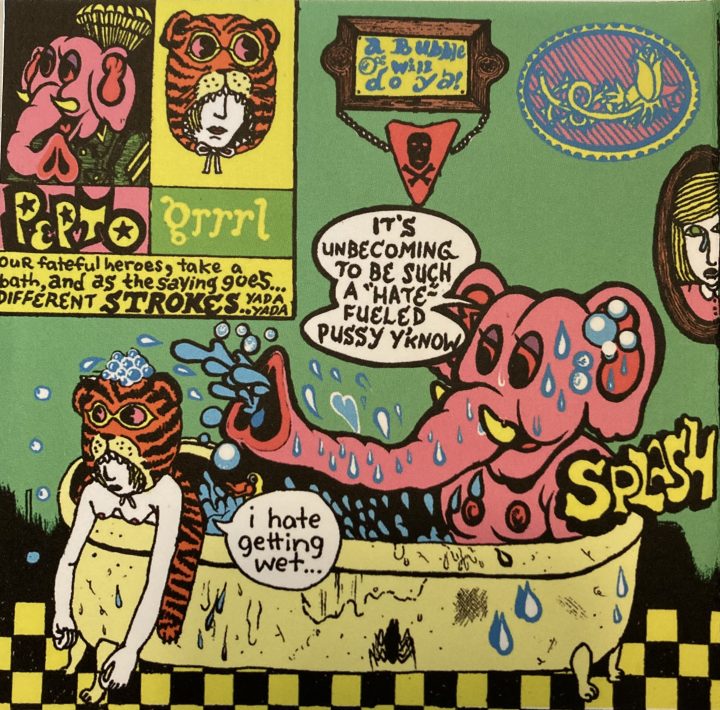
Tuna is a foldout in cardstock and full color. The coloring is the only redeeming value here — the yellows, pinks, and blues are mallets, and good counterweights to the hazy pastels seen in far too many art comics. One side of the accordion features four square panels with Pepto, the elephant with jutting nipples, and Grrrl, donning a tiger pelt shawl, on a ship making a few quips. The opposite side has the two characters in a bathtub uttering risque single-entendres. In this work and the others previously mentioned, we’re mostly dealing with images rather than sequential storytelling, which makes it all the more unrewarding. I can’t categorically plant my flag on the side of clarity but I can say that I’d rather read a simple narrative than Garcia and Collet limping through lackluster adventures in disassociating. In spite of all this, I haven’t lost hope! It was just a short time ago that this duo of natural born earthshakers not only had their finger of the zeitgeist but were the ventricles making the medium’s heart beat. My wish is that Tuna is either the end of something or beginning of something else. Immense talent will always and forever chase these two. But right now, they’re proving to be faster.
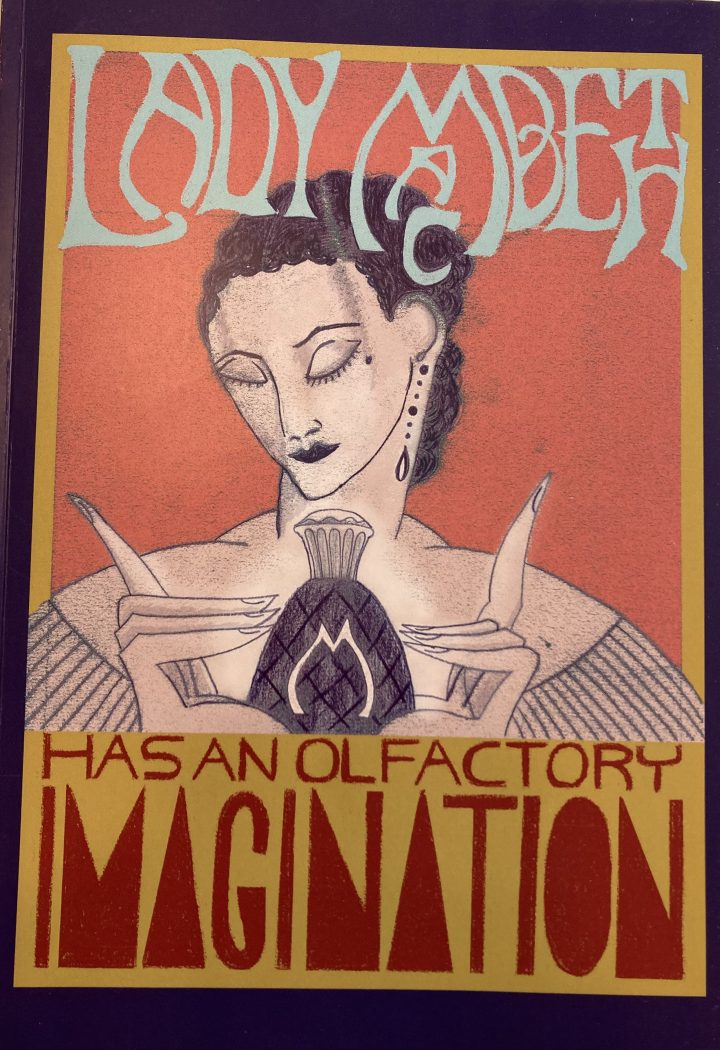
Lady MacBeth Has an Olfactory Imagination by Blaise Moritz
I’m not much of a Shakespeare fella, but I can smell well. While that quality is a major flaw at zine fests, it may give you a nose ahead in this murder (?) mystery (?) about the connections between the dream world and the sense of scent. Blaise Moritz draws with a thin, slightly flat line — reminds me of Ian Sundahl or “Arrivals and Departures” favorite Nicole Rodrigues — that can veer into Cubism. All of the lettering is done in large capitals and it makes sense that Moritz has a background in poetry because every so often he’ll play with some interesting line breaks. The book is eight chapters long, with each new interval in the tale featuring a standalone illustration in colored pencil — a sharp contrast to the stark black-and-white pages of the story itself.
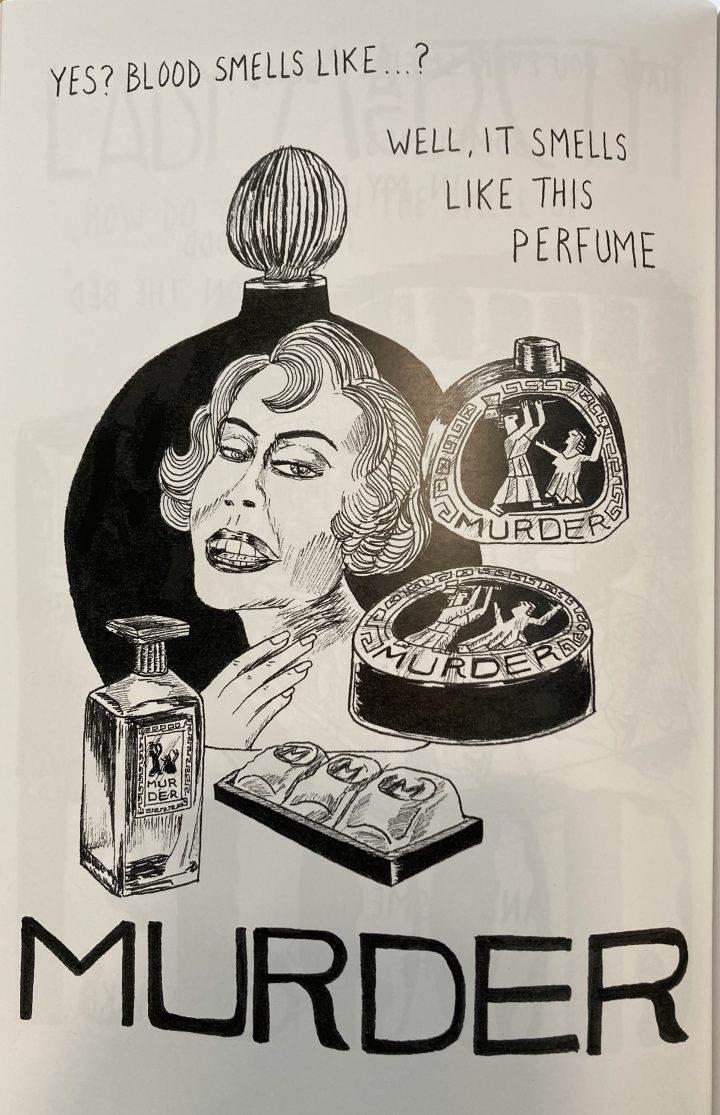
Lady MacBeth is a Post-Victorian perfume proprietor. We’re made to believe that she’s considered a real artist in the industry and is celebrated for her craft. In her sleeping dreams, MacBeth sees bloody deaths again and again and tries to capture the visceral smell of blood in an elegant bottle. Is she doing this in an attempt to tamper down the nightmares? Does she feel like this new fragrance has real market potential? Or is she admitting to something (or foreseeing the future)? Moritz sets the story in large places laid bare, like an unadorned factory, an expansive mansion, and the surrounding woods. Near the halfway mark we’re introduced to a character who constructs dollhouse dioramas to aid in homicide investigations. These elements all give Imagination a real stageplay feel that not only sets it apart from other comics, but alludes to the title and titular character. A dog and his detective companion are on the case when Macbeth meets her fate and a party is held to celebrate the new perfume named Murder. Lady MacBeth Has an Olfactory Imagination is an aroma-filled enigma that’s worth unpacking and a work that demands multiple rereadings. Just take a deep breath first.
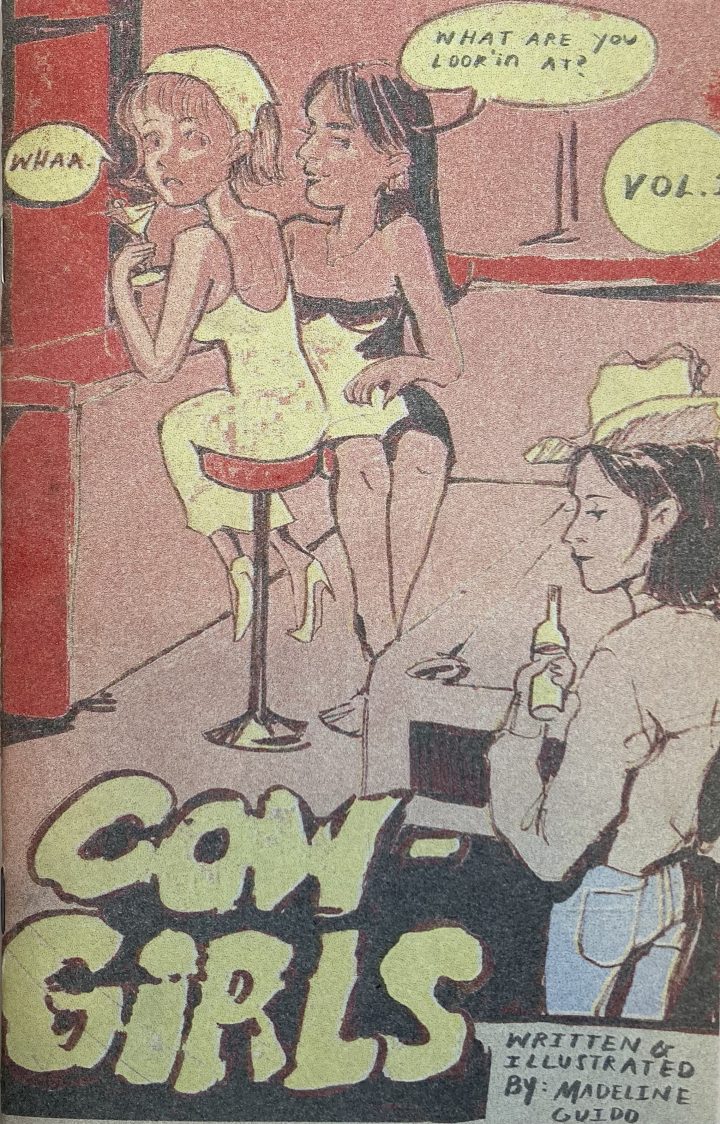
Cowgirls by Madeline Guido
Cowgirls does the neat trick where the cover is actually panel one of the story. Unfortunately that’s all it’s really got going for it. Rose and Brisa are Betty and Veronica in a poolhall, scoping out the only other lady in the place. Rose is interested and wants to meet the lone behatted traveler and does so by making a fool of herself at the billiards table. Madeline Guido has a knack for expressive eyes, but often in this short eight-page story the inking is so thin it gives the comic an appearance of being unfinished. Guido is a painter first and — naturally, for better or worse — her panels come off as underdrawings.
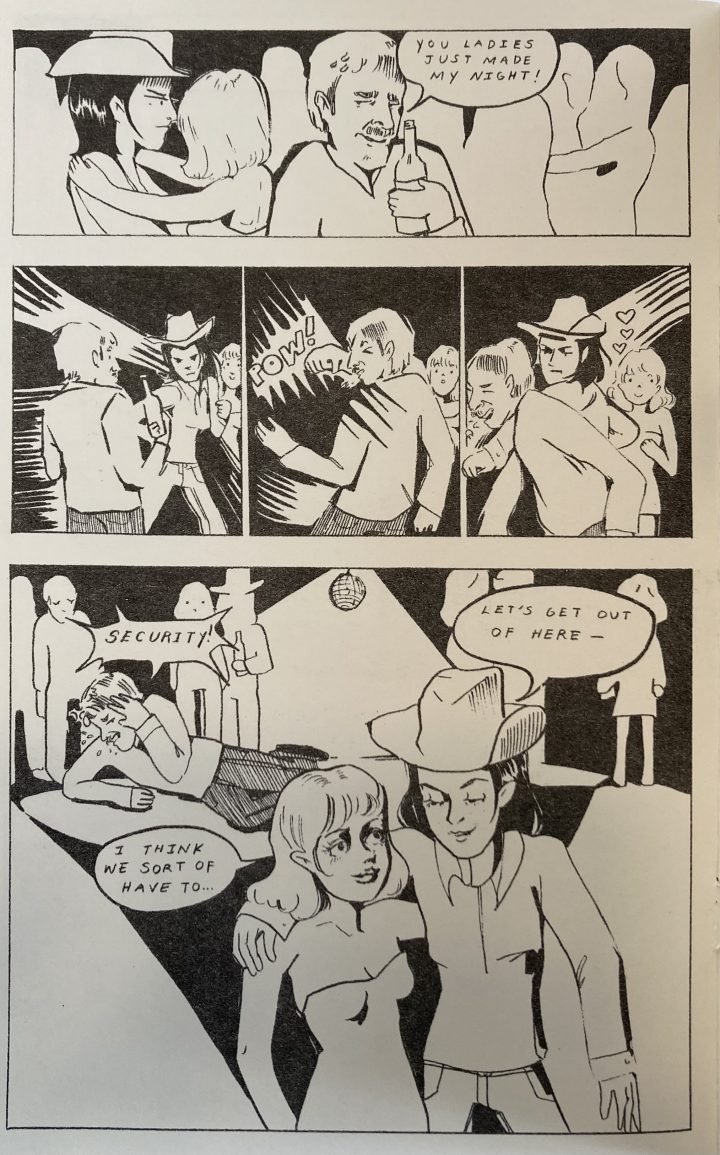
Rose finally gets a chance alone with the traveler after being rudely interrupted by a man at a bar. Throughout Cowgirls every guy looks exactly the same to the point of confusion. That probably doesn’t matter (or may be the point) when you’re doing the sapphic two-step. Before the mysterious Lee must depart she slides a letter to Rose through the door saying, “We’ll meet again.” Rose was standing inches from the door when the paper came through the mail slot — she could have just opened the door and met again then and there, right? This comic feels like something promotional that would have come free when you purchased the single of Chappell Roan’s “The Giver” rather than a fully fleshed-out piece of art. That in itself isn’t necessarily a condemnation of Guido’s, who appears to be new to cartooning, but Cowgirls is surely a one-and-done reading experience.
At-large invitations to the tournament will be awarded to cartoonists:
- Who have a bizarre publisher alliance
- Who’re too old to be an edgelord
- Who’s keeping legacy IPs alive by the string of their teeth
The cartoonist who wins the coveted Neal Adams Memorial Iconoclastic Award will be given a first-round bye as well as a trophy in the shape of a gold-plated slice of bread because one time at a convention I saw him with at least nine pieces of toast on a plate.
Be steadfast in your judgement and I’ll see you next month, I hope.
Questions, love letters, and submissions to this column can be directed to @rjcaseywrites on Instagram.








 English (US) ·