
Cynthia Rose | March 17, 2026
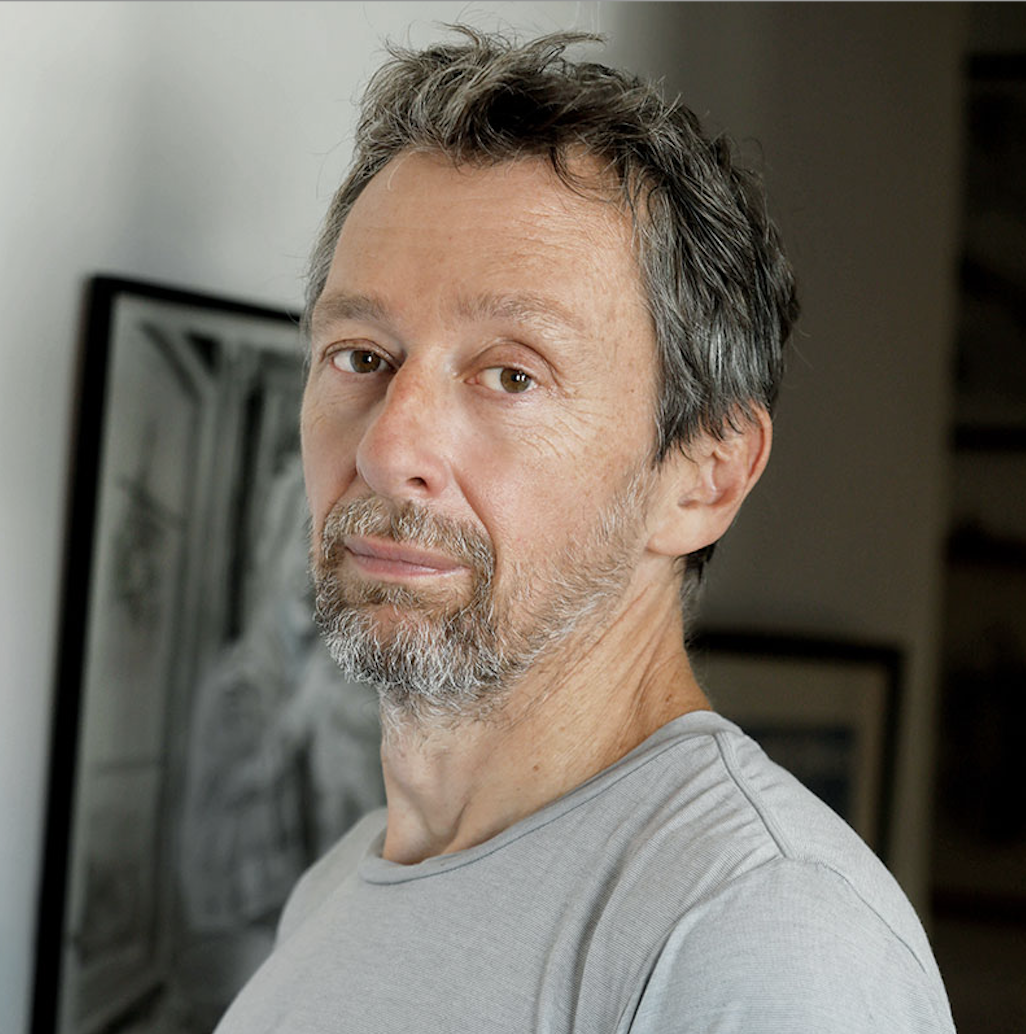 Clément Oubrerie. Photo courtesy of Rita Scaglia for Dargaud
On March 1, three months after his 59th birthday, the auteur Clément Oubrerie passed away. For French comics, it's hard to measure the loss. In any era, artists of his inventiveness are rare and Oubrerie was notable for the range of his accomplishments. He collaborated with very different people, explored numerous genres and was published by a variety of imprints: Delcourt, Les Arènes, Dargaud, Rue de Sèvres and Gallimard. With Joann Sfar and Antoine Delesvaux, he also co-founded the animation firm Autochenille. In 2010, Autochenille produced Sfar's Le Chat du Rabbin (which won the Cèsar, the "French Academy Award", for best animation) then, in 2013, released Oubrerie and Marguerite Abouet's Aya de Yopougon.
Oubrerie's oeuvre tackled West African adolescence during the 1970s, Voltaire's love life (and his campaign for religious tolerance), a Russian poet in the wake of the revolution, the birth of Cubism and that of modern dance – even the advent of plastic surgery. Oubrerie was also a lifetime militant, promoting creators' rights and wider horizons in comics. "Clément's commitment to diversity and transmission," wrote his editor at Dargaud, "made him a pillar of both comic books and our publishing house."
But none of this really explains Oubrerie's greatness. Yes, he was a wonderful draftsman of incredible talent. Some of the paintings and sketches he made for personal reference are even better than the art in his pages. But his profession is blessed with many gifted souls. What really amplified Clément Oubrerie's art was an inherent irreverence that amplified his genius for envisioning character.
Unlike most comics "biographers", Oubrerie never felt like canonizing his subjects. The figures he depicted always remained themselves, however much he might caricature or stylize them. All his men and women were just as feckless, trying and temperamental (and, often, as little recognized) as they had been in life. Under his pen, bohemians were real bohemians – poor, shabby, truly struggling – and period squalor remained just that. The same was true for each individual's failures and self-delusions. The honesty this stance gave all his portraits makes them far more compelling than those of more self-consciously "instructive" comics. His biopics are not just wittier and more ingenious; they also carry more truth. His PABLO series tells you just as much about the artist as do critic John Richardson's massive volumes. This is the case for all his real-life subjects, not least because Oubrerie relished every quirk that defined them. Equally, with invented characters, he never shied away from their uncongenial traits.
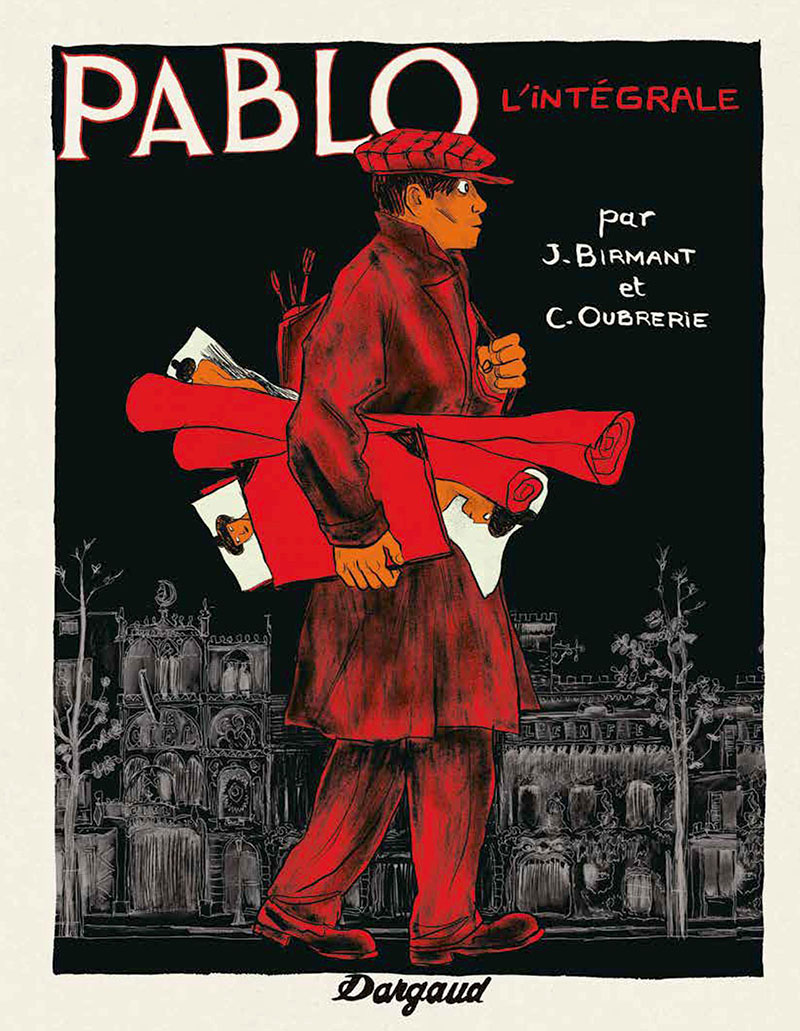 PABLO, Edition Integrale, Julie Birmant and Clément Oubrerie © Dargaud
For the artist's funeral at Père Lachaise, his partner Julie Birmant asked mourners not to send flowers and wreaths. Instead, she requested drawings or personal notes. It was Birmant who, last year, revealed that Oubrerie had been battling ALS. On the eve of her own exhibition at Angoulême, she told le Figaro's Olivier Delcroix, "Clément has suffered from from Charcot's disease for two years now. It's pretty much the worst disease imaginable. For anyone who contracts it, life expectancy is short. But we're going through it together and we've moved out of Paris to Oléron, by the sea. For now, Clément can still work … but I don't know how for much longer. He's a true superhero and, while he's very limited, he still creates. I'm so glad this exhibition is happening now. Because it belongs to both of us; it represents twelve years of creating together." In June of 2024, after many years together, the pair were wed. But Oubrerie's I do was the last phrase he spoke. After that, he used his phone to communicate.In June of 2024, after many years together, the pair were wed. But Oubrerie's "I do" was the last phrase he spoke. After that, he used his phone to communicate.
If this were a Wikipedia page, it could easily be nothing but a list of awards. For, from Oubrerie's debut, the plaudits never ceased. His work was honoured by bookstores, radio stations, festivals, libraries, newspapers, critics' polls – and the public. Rarely was he off the shortlist at Angoulême and he was nominated more than once for an Eisner. The Aya series he created with Marguerite Abouet won countless prizes, not to mention an endorsement from the French ministry of education.
Behind all those awards lay a long apprenticeship, a ceaseless curiosity and an astounding workload. Oubrerie had studied at the ESAG, the École supérieure d'arts graphiques. But he never graduated. Instead, he left for New York to join his father – the architect José Oubrerie, a protégé of Le Corbusier. Oubrerie spent two years living in Manhattan, waiting tables and illustrating children's books.
Back in Paris, he spent a decade enhancing juvenile literature. He was responsible for several award-winners, such as the singer Audren's Mon chien est raciste (My Dog is Racist, 2015). Eventually, however, Oubrerie began to think about bandes dessinées. "It seemed to me like a more open medium, one that might let you try something more ambitious. This was around the time of L'Association and all those incredibly brilliant authors of the '90s. But I knew nothing about them; I just wanted to add my little brick to the building."
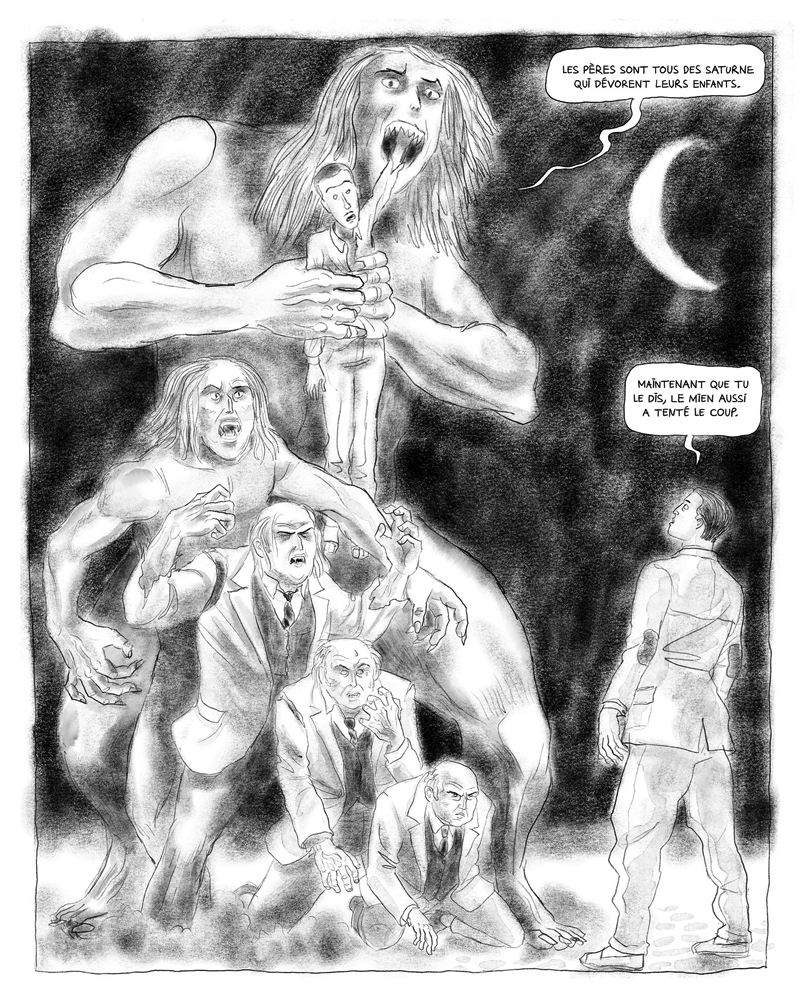 Drawing for Dalí, Volume 3, (after Goya, made in April 2025) © Clément Oubrerie
Once Oubrerie chose the 9th art, he never looked back. In terms of genre, he proved completely catholic, moving with ease between biopics, thrillers, period farce, tales of adventure and straight-up fantasy. In 2008, he made Raymond Queneau's famous Zazie dans le Métro into a graphic novel. He partnered with Joann Sfar on Jeangot (2012), a tribute to Django Reinhardt told with animal characters. In 2015, with author François Bégaudeau, Oubrerie also created Mâle Occidental Contemporain (Contemporary Western Man): a comedy about hapless male seducers and the modern woman. The first of his three Les Royaumes du Nord – a version of Philip Pullman's His Dark Materials – won him Angoulême's 2015 Prix jeunesse.
But Oubrerie's most exuberant, most exciting works were made in collaboration with women. They were not just exceptional writers (Birmant, Abouet, Leila Slimani), but also expert colleagues like colorist Sandra Desmazières. His graphic storytelling, already accomplished, was further elevated by these partnerships. They brought his characters a new depth and comic sparkle; whether they had leading roles or played only minor parts, each became more the possessor of an inner world. Yet all still remained creatures of the frame, tools that helped their author exploit and play with his whole medium. The final results were always, for readers, an extraordinary source of delight.
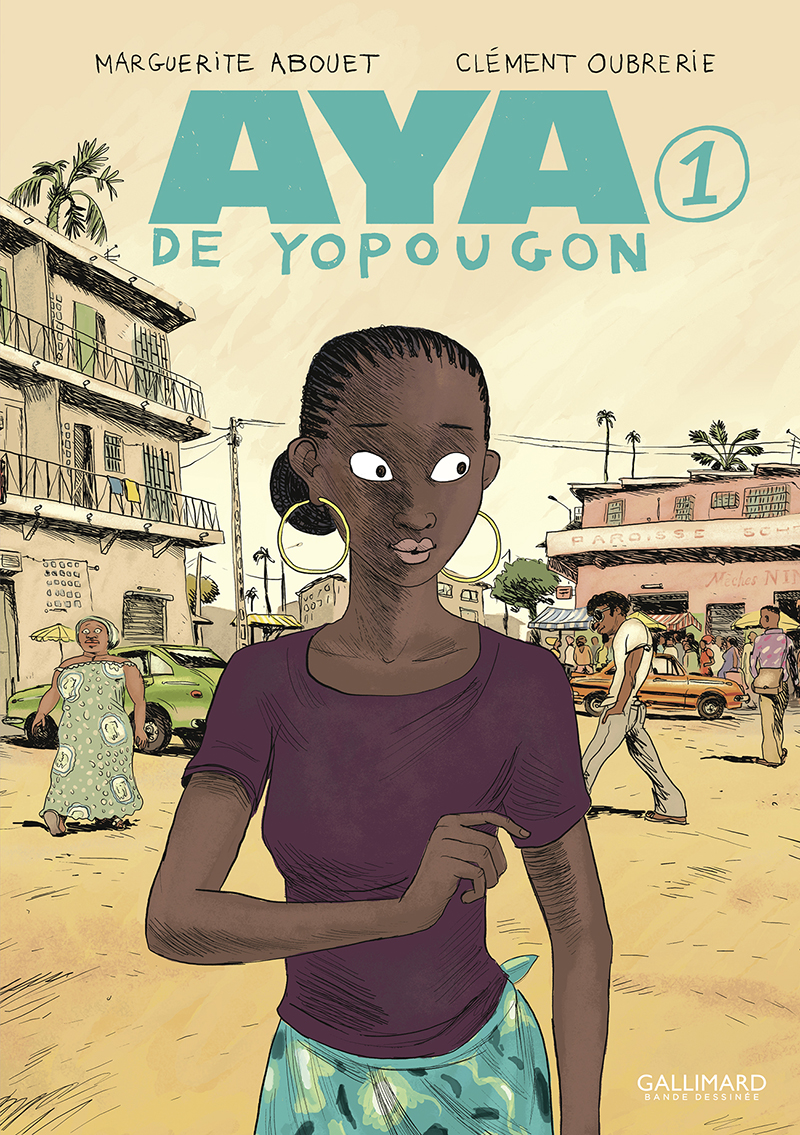 Aya de Yopougon, Volume 1, Marguerite Abouet and Clément Oubrerie © Gallimard
Oubrerie is probably best known for Aya de Yopougon (to Anglophones, Aya of Yop City). This multivolume saga – it appeared from 2005 to 2022 – was the inspiration of his first wife Marguerite Abouet. Abouet wanted to show her African childhood as part of a "normal, happy and very individual place." Set in Côte d'Ivoire during the 1970s, Aya recalls a world in which "the closest thing to television was a grandparent's stories." When the pair started Aya, Abouet was a former punk ("I had it all, including a Mohican!") with a day job at a legal firm. She and Oubrerie were happily expecting twins. When she suffered a late-term miscarriage, finishing Aya helped the couple reconstruct their life.
Their debut album caused a sensation, winning Angoulême's 2006 Prix révélation. "Getting that prize," Oubrerie said years later, "changed everything. It made so much more possible for each of us." Eventually, he and Abouet produced eight volumes – and Aya became a bestseller in seventeen languages.
In 2011, during a pause in the series, Oubrerie encountered Julie Birmant. She was then a young mother married to the artist Jul – who was well-known for Silex and the City. Birmant worked in radio but also loved researching offbeat cultural figures. She had published some of their stories in Drôles de Femmes (Curious Women, 2010), an album penned for artist Catherine Meurisse. Now she wanted to write about Max Jacob, the poet who had befriended a poor, immigrant Picasso. Jul suggested Oubrerie might be interested, so Birmant approached him. He knew only one thing about her subject: that Max Jacob had been a friend of his grandfather's. Intrigued, he agreed to meet – and the rest is BD history.
Between 2011 and 2014, Birmant and Oubrerie created a landmark work: a four-volume biographical comic called PABLO. Each of these tomes centres on a male character: Max Jacob, Guillaume Apollinaire, Henri Matisse and Picasso himself. But all their stories are told through Fernande Olivier, Picasso's first love and pivotal muse. "If he hadn't met Fernande," Birmant told journalist Olivier Delcroix, "it's hard to say who or what Picasso would have been. For me, creation never involves just one person. It's always a constellation … no one creates alone."
PABLO set a new benchmark for comic memoirs and for the BD's approach to fine art. Just as Picasso had "translated" Ingres and Goya, Oubrerie translated Picasso, including his ground-breaking "Demoiselles d'Avignon". Twelve years on, the series' erudition and invention are still singular. The only bio-comic that compares to it is Steffen Kverneland's equally original MUNCH.
Oubrerie and Birmant followed Picasso's saga with something very different, the story of Isadora Duncan and her Russian spouse. This was the (much) younger poet Sergey Yesenin – a name still revered all across Russia. Their tale's decisive meeting, though, was not between the lovers. It was Isadora's rendezvous with sculptor Auguste Rodin. To make the books work, Oubrerie had to visualize how Duncan had danced – without much to really help. "Surprisingly, there were very few references. There is some actual film, but it's in bad shape and moves at the wrong speed now. What I did have were the memories of two artists who knew movement: Rodin and his assistant [Antoine] Bourdelle. The key became a set of drawings Bourdelle had done, sketches he made while Isadora danced. "All her movements were based on natural gestures which, in terms of drawing, really interested me." The result was a more experimental, two-part, work, published as 2015's Il était une fois dans l'Est (Once Upon a Time in the East) and 2017's Isadora.
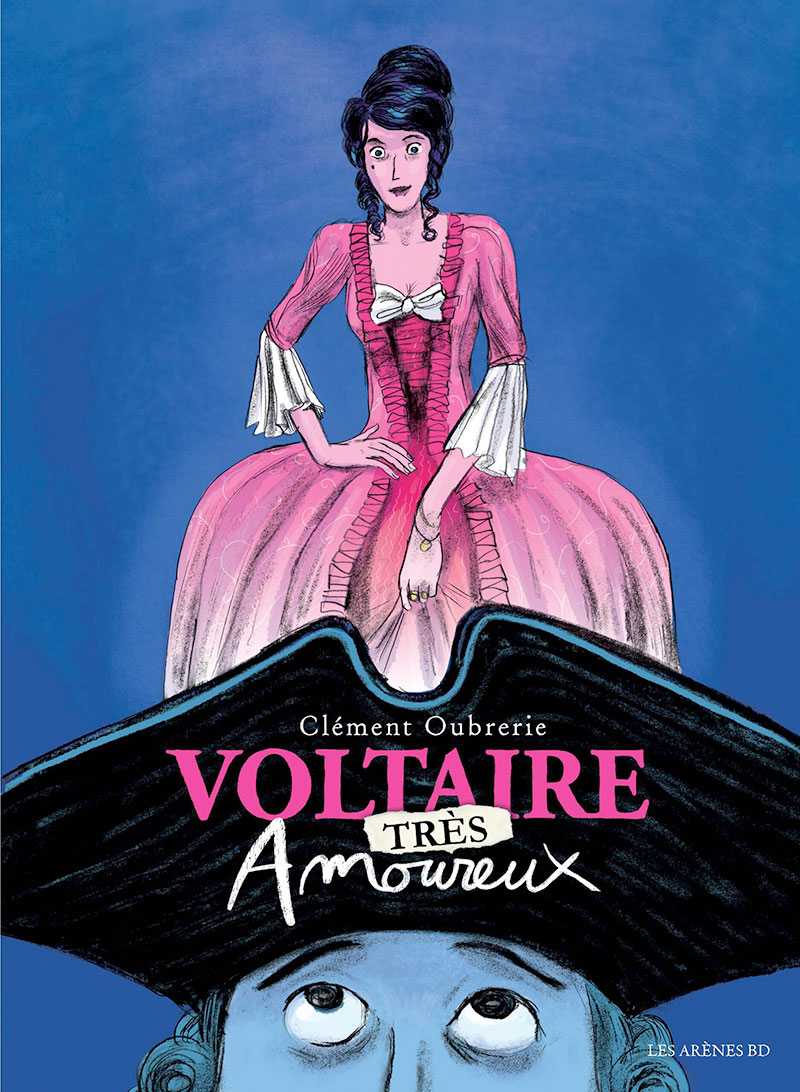 Voltaire (très) amoureux ("Voltaire in Love", Volume 2), Clément Oubrerie © Les Arènes
Oubrerie's capacity to balance projects was prodigious. After Isadora, in 2017, he began to publish Voltaire Amoureux (Voltaire in Love). Despite its frivolous title, Voltaire was a personal response to the murders at Charlie Hebdo. The great thinker's "Treatise on Tolerance" – after the attacks, a bestseller in France – gave Oubrerie the basis for his tribute. He researched, wrote and drew Voltaire's Volume 2 at the same time as creating 2018's thriller Cyberfatale. Credited to "the collective Cépanou", it was supposedly scripted by real agents of French cyber-defense. But Oubrerie also had a third project underway, for he and Birmant were creating a fresh heroine: Renée Stone. Envisioning "the daughter of Indiana Jones and Miss Marple", they set Stone's adventures in Addis Ababa, Cairo, Djibouti and Baku. The books, which appeared from 2018 to 2022, rendered homage to Oubrerie's favourite Hugo Pratt.
Barely had Stone's first album hit the shelves when the artist began another series: 2020's À Mains Nues (With Bare Hands). Researched and written by the novelist Leila Slimani, already a winner of literature's Prix Goncort, it tells the little-known story of Suzanne Noël. A feminist pioneer of plastic surgery, Noël began her work "repairing" Sarah Bernhardt. But her true accomplishment was rebuilding the "gueles cassés" – the faces horribly disfigured in World War I.
Volume 2 of À Mains Nues appeared in 2021. As it did, Birmant and Oubrerie were tackling another odd couple: of art: Salvador Dalí and his partner Gala. In their introduction, Dalí Avant Gala (Dalí Before Gala, 2023), the hero is a shy, unassertive Spaniard, who falls in with fellow students Buñuel and Garcia Lorca. By 2024's second installment, Dalí has fallen for Gala – the glamourous Tatar wife of poet Paul Éluard. Just as happened with Picasso and Fernande, Gala transforms Dalí's views of life and art. His surrealism and morbid sexuality gave the authors extra ammunition for their jokery – and Birmant's spirited script won her Angoulême's 2024 Prix Goscinny.
"Clément always knew how to love the women he drew," Birmant told Le Monde. But Oubrerie merely saw the choices he made as logical. "Everything about this art," he said, "is collaborative … everything from the concept to the colour. Of course there are plenty of heroines in my books, but all the stories have just as many male characters. I don't ever think in those terms at all. For me, the main thing is never to repeat. Whenever a series ends, for example, I change my medium."
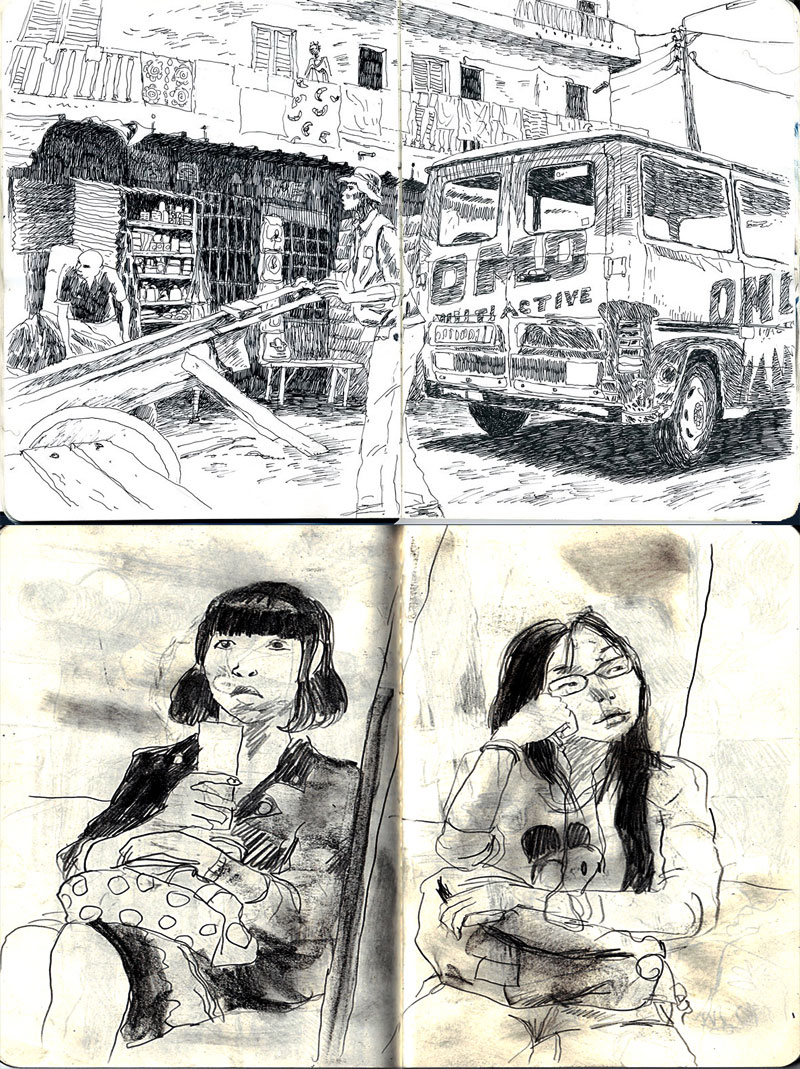 Sketchbooks, Clément Oubrerie, posted to Facebook © Clément Oubrerie
Oubrerie never showed the least complacency. In January 2024, posting on Facebook, he made public his resolution "to fill more sketchbooks". Even at the time of his death, he was working on Volume 3 of Dalí. The artist's need to learn, he believed, never ended. "My technique consists less in actually having one than in a willingness to just start over again. You need to have that patience, because good drawing is all about taking time. I've always loved how, with only a pencil and paper, you can build an entire universe. It enthrals me and that fascination never pales. I think it's a lot like character is for actors; it enables me to inhabit somebody else. I get to live another life, whether that's the life of Voltaire or Salvador Dalí."
May your new life, Clément, be as rich as those you left us.










 English (US) ·