
Jason Bergman | May 11, 2026
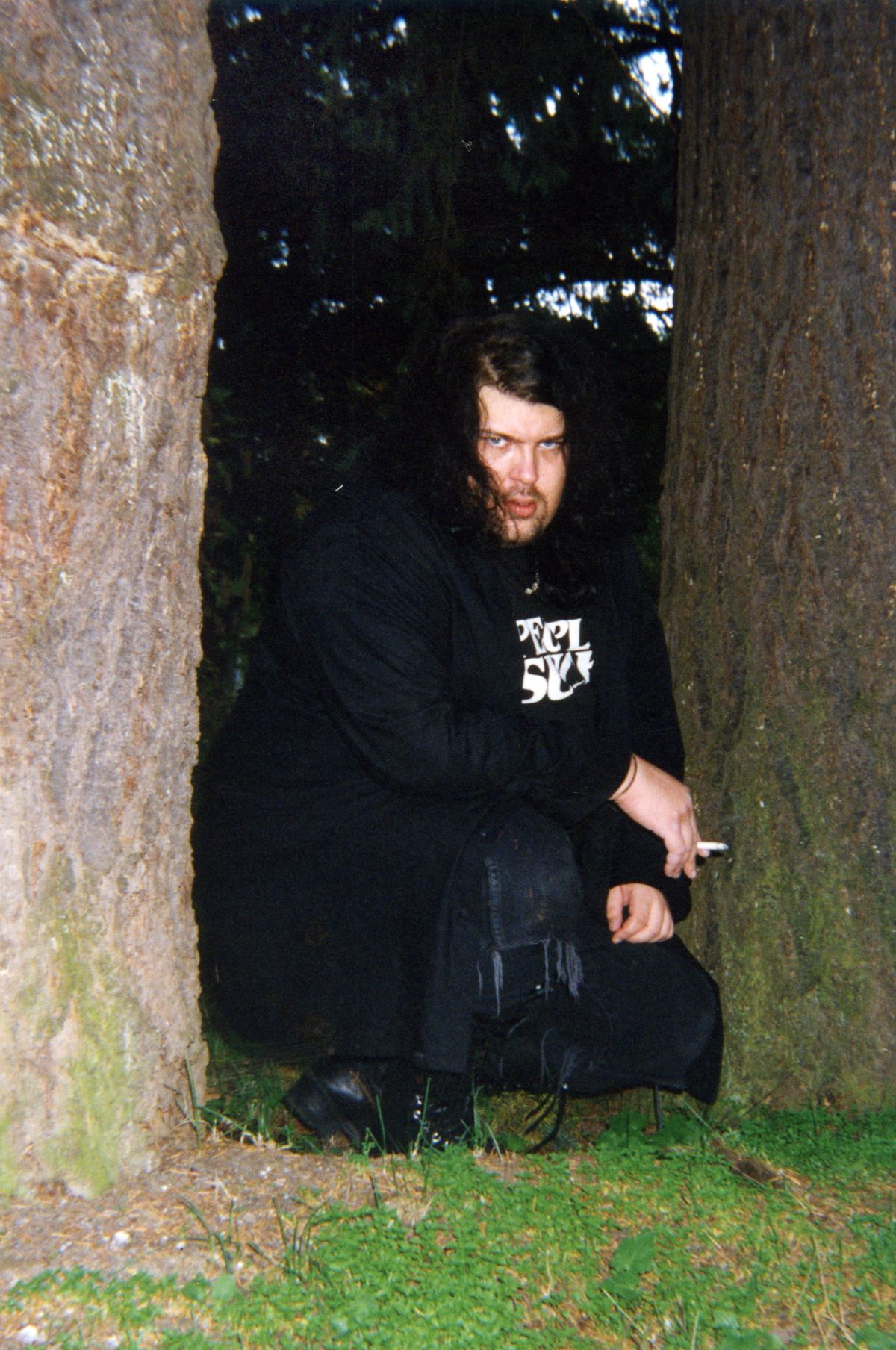 Drew Hayes in 2001 (photo by Robb Horan)
Starting in 1991, Drew Hayes wrote, illustrated, and — for the first 20 issues — published, Poison Elves, a dark fantasy series chronicling the life and times of a frequently down-on-his-luck elf named Lusiphur. When he died at the far-too-young age of 37 in 2007, Hayes had created just under 100 of a planned 300 issue series. Releasing that final issue was no small feat, and it fell largely on Robb Horan of Sirius Entertainment, who had a complicated personal and professional relationship with the bombastic artist. In the years since, Horan has become the steward of Hayes’ legacy, most recently turning to Kickstarter for lavish hardcover editions of the entire Poison Elves run, three of which have been funded so far, with a fourth on the way.
I caught up with Horan over Zoom to talk about the rollercoaster that was working with Drew Hayes, the current plans for Poison Elves, what the end of the series would have looked like, and if we’ll ever see it in print. — Jason Bergman
JASON BERGMAN: When did you first meet Drew Hayes?
ROBB HORAN: I met Drew for the first time by actually traveling out to Bellingham to meet with him directly. He was West Coast, I was East Coast, and even though we had been doing business together, we had not come together at a show or anything like that. I’m going to do my best at recalling things, but yeah, I first met Drew traveling out to Seattle. And it was an eye-opener for sure, but I’d say that the subsequent trips were even more eye-opening.
So by the time you met him in person, you were already in business together? How did that connection happen?
My history in comics stretches back to 1979. I’ve worked in almost every part of the field, aside from being able to draw, which I cannot. So I was a dealer first and foremost. I had worked in distribution and I was a comic retailer. And I was selling a lot of Poison Elves. You know, they were right there with my Faust and Cry for Dawn sales. I had that audience.
![Robb Horan hard at work fulfilling Kickstarter orders (photo by [name])](https://the-comics-journal.sfo3.digitaloceanspaces.com/wp-content/uploads/2026/02/robb_horan.jpg) Robb Horan hard at work fulfilling Kickstarter orders (photo by Isabel Horan).
Robb Horan hard at work fulfilling Kickstarter orders (photo by Isabel Horan).
I was selling it as a retailer primarily, but as marketing director for CFD Productions, I was the wholesale source for those books. I had worked for Comics Unlimited when I was younger, back on Staten Island, and I was a retailer myself specializing in these indies and, what are they calling them now, “outlaw comics.” We called them “bad girl” comics and whatnot. And yeah, Poison Elves and I, Lusiphur were simply my market. So I built a relationship with him through, I’m sure it was a guy named Glenn Hammond, who introduced me to Drew. Glen ran a fabulous business called Raw Comics.
When you met him, was that your overture to become his publisher?
No, I didn’t make that trip until we were ready to sign. We did all of our negotiating from coast to coast. Not until it was time to actually put something down on paper that, you know, as a gentleman, I just felt like, look dude, we’re contemplating something very serious here, I’m going to come out and see it through with you.
What was he like? And what was it like that first time you met him in person?
There are so many answers to that question, right? Drew was a boisterous person. Drew was an explosion of personality. He was a neverending source of humor and self-deprecation. He was also like a personal bodyguard for his friends, loyal and threatening.
So that first time you met him, what was that experience like?
He took me out to a party house [laughs].
Was it the party house?
Yeah, it’s the party house. And you know, you’re going to celebrate a new business deal, you jump right into that sort of thing.
I was going to ask: are all those stories true?
Well, I cannot vouch for all of those stories. But certainly any stories that emanate out of Drew’s location up in Washington state likely have a high credibility rate to it, okay? I made friends with some of Drew’s friends, and, you know, [they] would confirm things for me, and as a publisher, I found it helped to create a network to see if I could find out what he was doing sometimes. So yeah, there’s lots of reasons to believe the stories.
There’s a story in one of his Starting Notes about sneaking into a haunted hotel room?
Yeah, that was actually done with my former wife, Brenda Horan, née Feikema, née Brooks. She was the letterer on the book for a number of years. And yeah, she and Drew, they — I don’t know how often you’ve done Comic-Con in San Diego, but that old San Diego hotel, the white hotel, it’s really antique-y looking and stuff. Brenda had wanted to stay there for years. Jill Thompson was staying there; we gotta stay at this place. So we finally stay at this place one year. I, of course, was not present for this. I was the responsible publisher guy who was over at the convention doing his job. And those two are putzing around the hotel, poking around, and they were both ghost hunters. They’re both really into that scene. And there was some known room in the hotel that was presumably haunted. The punchline to the story though is that these two otherwise adult people made a rational decision to open up a hotel room door that happened to be unlocked — or maybe by Drew — only to discover that there was an actual hotel guest inside [laughs]. So that’s how that went. To the best of my knowledge, the two of them realized immediately that they were in danger of getting arrested and split the scene as quickly as possible. I don’t think they ever saw any ghosts. Unless that guest was a ghost. Maybe they just fooled themselves.
[Laughs] Exactly, maybe that room was actually empty! In Drew’s version of the story, if I remember correctly, they went up there because they were told the hotel didn’t let anybody stay in that room.
Oh, even better, you see? Yeah, yeah. Well, then they were really freaked out when they ran, for sure.
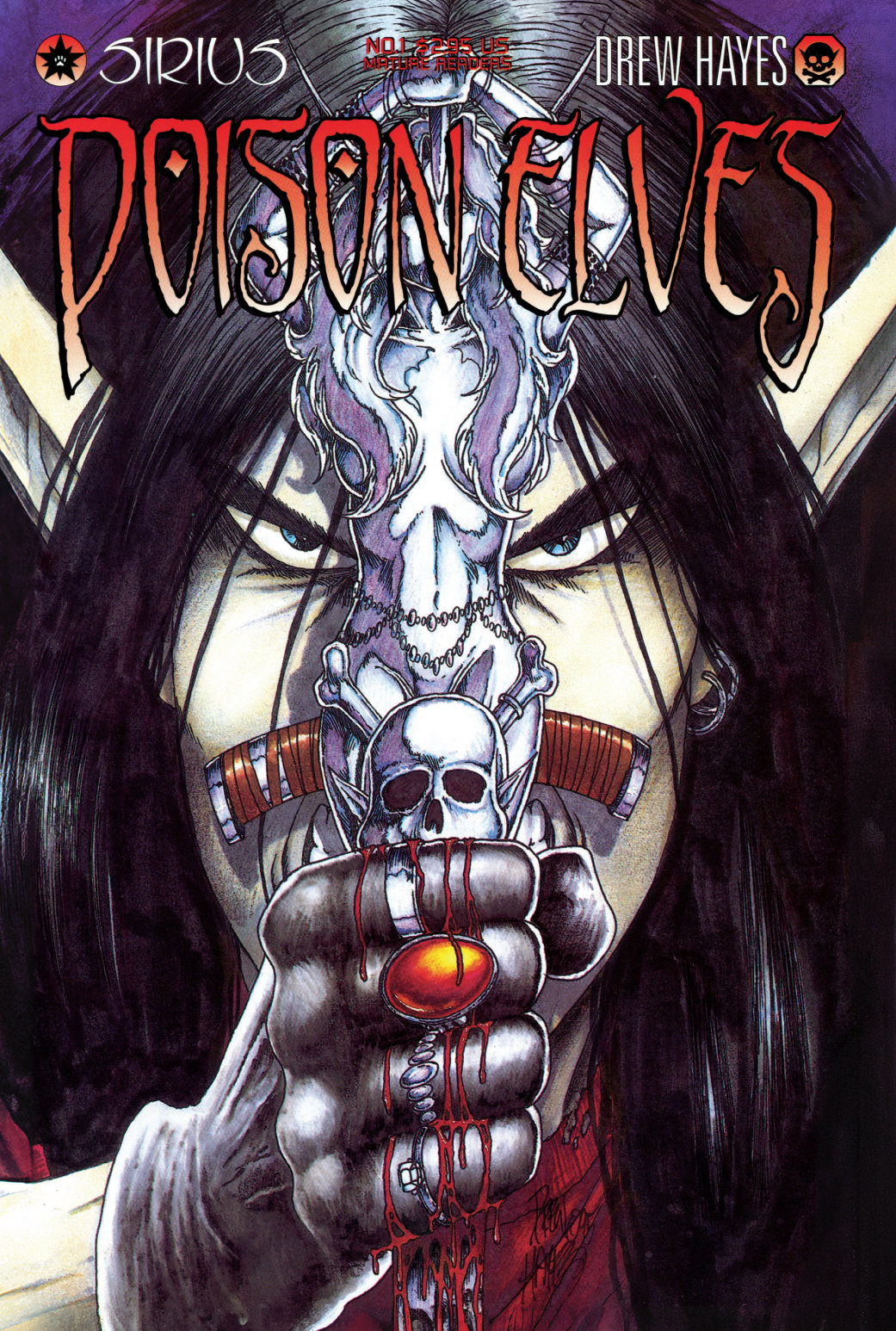 Cover to Poison Elves vol. 2 #1. Art by Drew Hayes.
What was your working relationship like with Drew?
I was thinking about that a little earlier while getting ready for this. I was Drew’s biggest critic, but I didn’t actually critique the book. That was [managing editor] Mark Bellis’ job. Mark Bellis knew what Drew was doing with his story inside and out. I was more familiar with what Drew was doing with his life. And so he and I had lengthy, lengthy time on the phone. That was part of the job as a publisher for me at least. You know, artist management. I spent hours and hours on the phone with all my various artists at that period. And Drew being on the West Coast, I’d be up pretty late sometimes with him. I’ve made whole music mixes based on being on the phone with Drew late at night.
Even for the time, the fact that Drew wrote and illustrated this book on a monthly basis was pretty unique. Was it difficult to keep him to that schedule?
Well, eventually of course he didn't keep that schedule. Early on, his motivation was high, we both did what we said we were going to do. I cleared the deck for him on an administration and financial level, and he sat down and started drawing comic books. I don’t recall precisely how long we managed to keep the monthly [schedule], and as I do recall we built an off-month in right from the beginning. But certainly once we were in past issue 25, I don’t think that we stayed monthly for too much longer after that. But to go to your question: when Drew was inspired, he was inspired, and the work would just come. But he led a big life. He was a boisterous life kind of person. And as his star rose, his ability to have some life rose as well. You can read a lot about that sort of thing in his Starting Notes, I don’t need to go too far down that. His personal adventures could certainly slow the book down. Ultimately, I would not hesitate to concede that I used paychecks as the cudgel to keep him on track. This is how it’s gonna be. You do for me, I do for you, that’s what we agreed to.
Was that effective?
Effective enough that we did such good business that when the five year renewal came, it became a purchase instead of a license.
So you purchased the rights to Poison Elves at that point?
Correct. We signed that deal during the Seattle riots in 1999.
When did you get an inkling that he was sick?
Drew always had health issues. Early on it was sleep apnea and various breathing issues. There was one San Diego Comic-Con where he was suffering terribly. We all felt really bad. His legs were all bloated and stuff. So it was part of things fairly early on that he had health issues. And when I referenced being his biggest critic, I didn’t hesitate at times [to tell him], “Drew you’re still smoking, you’re still doing all this drinking, I really don’t know what else you’re doing, but you’ve got these health issues. Isn’t that tantamount to being suicidal?” And he wouldn’t disagree, we’d try and work through it, and he’d have highs and he’d have lows. But as for the level of health issues that came on after about 2005, yeah, I was not expecting that until he let me know what was going on.
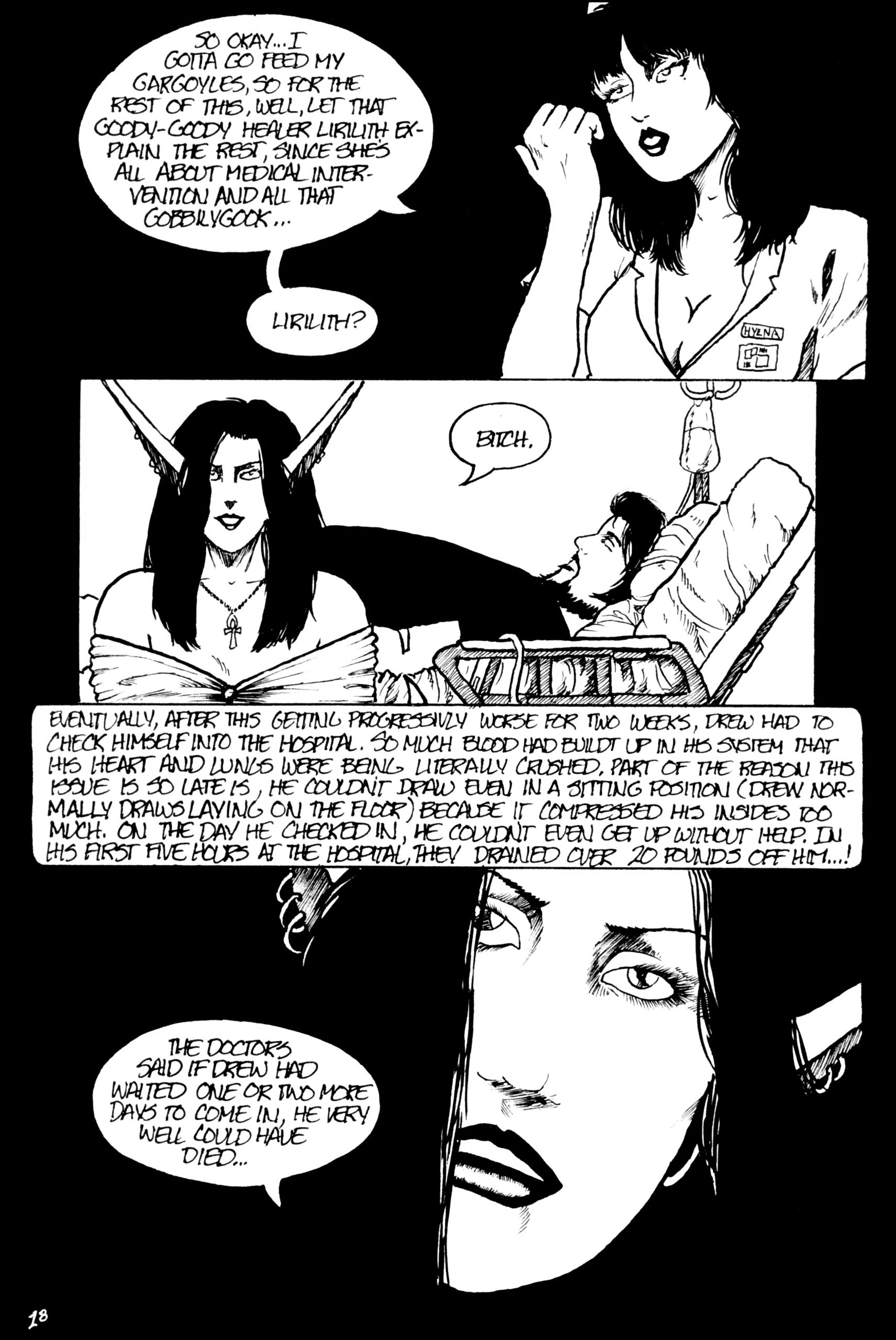 From Poison Elves vol. 2, issue 70. Drew Hayes breaks the fourth wall to tell the reader of his recent health crisis. Art and text by Drew Hayes.
When did he let you know? In issue 70, he full-on breaks the fourth wall to tell the reader that he went to the hospital. Was that a surprise to you?
We got the news after the fact that he had been hospitalized, while he was still hospitalized. It came as a shock. We had to adapt fairly quickly at that time. I had just transitioned from the ‘90s to the 2000s. The indie boom was over. The band was breaking up. It was a whole different world of preoccupations. Before long it was pretty much just me and Drew forging ahead.
Within Sirius Publishing?
Within Sirius, yeah. By 2005 when he was falling sick. I mean, I can see the tragedy unfolding in backwards motion now.
Well, speaking of, when you read those Starting Notes — and I’m thinking of issue 74 now — it’s kind of scary. That’s the one where you say, “Dear Drew, I’m writing to you here because it’s so damn impossible to reach you on the phone.”
Yeah.
Can you talk about what was going on at that point?
I can. I’d thought about how to reach out any way I could. I occasionally remember I have a platform, so I wrote that Starting Note. I meant what I said there. Drew had tuned out at a certain point. During that period — I can’t really frame that period, but I think it’s safe to say that anywhere from 2003 to 2005, but definitely around that era leading up to issue 74, he was impossible to reach. If he didn’t want to talk to me, he didn’t want to talk to me. And it wasn’t just about me, either. He was tuning out. In the digital edition to book three, which I just put the cap on recently, I was researching old Poison Elves ads, and what I found was the advertising for Poison Elves #70 was in 2001. At most. From 2001 to 2007 there were only going to be nine more issues of Poison Elves. I of course did not know that at the time, and only in hindsight can I look back and realize man, we went through so much in that period. I did not know what Drew was doing a lot of times. If you look back at Starting Notes, I’m sure you can see. Drew is on it, Drew is not on it. Drew is here, Drew is not here. You could absolutely see how he was coming and going at that period. But of course it was over several years.
Now, this is not something you’ve asked, and I’ve never really spoken about it, but because Sirius purchased Poison Elves, what Drew had negotiated for, was a regular paycheck. You asked me earlier, how did I keep him getting the book coming out. I would use the sledgehammer of, “You need to pay rent.” Then I offered to give him regular rent and I only got nine books in five years.
Was that because of health reasons, or I don’t know … was he off living that lifestyle. Or do you even know?
I don’t really know. Some of the people who do know are gone also. I can certainly look at some of the underlying conditions and circumstances. He was getting both a stipend from me, because I had a long-term purchase agreement, so he was getting paid for the purchase of the property, while at the same time, with the same deal that he always had for turning in his book for advances. Apparently, with the paycheck coming for the purchase, the books were not as important to get done. He also had various relationships during that period. Again, I refer you to his Starting Notes, I’m not going to go into those, but it’s in writing what he went through. I was being only moderately facetious when I named it, “The Life and Times of a Comic Book Rock Star.” Drew was living that dream. He got the girls, he got the parties, he even had a band, but he had health issues. And he got girls that didn’t necessarily work out as expected. Then the money dried up because he wasn’t turning in the book and the purchase was paid in full. The health issues increased. There’s clearly an underlying condition that has never been discussed, that I’m not an authority enough to be able to deeply comment on. It’s an issue that’s not unknown in comics, or any other entertainment or artistic field. Drew spent a lot of time in hospitals. One time … well, I’m not going to tell that story.
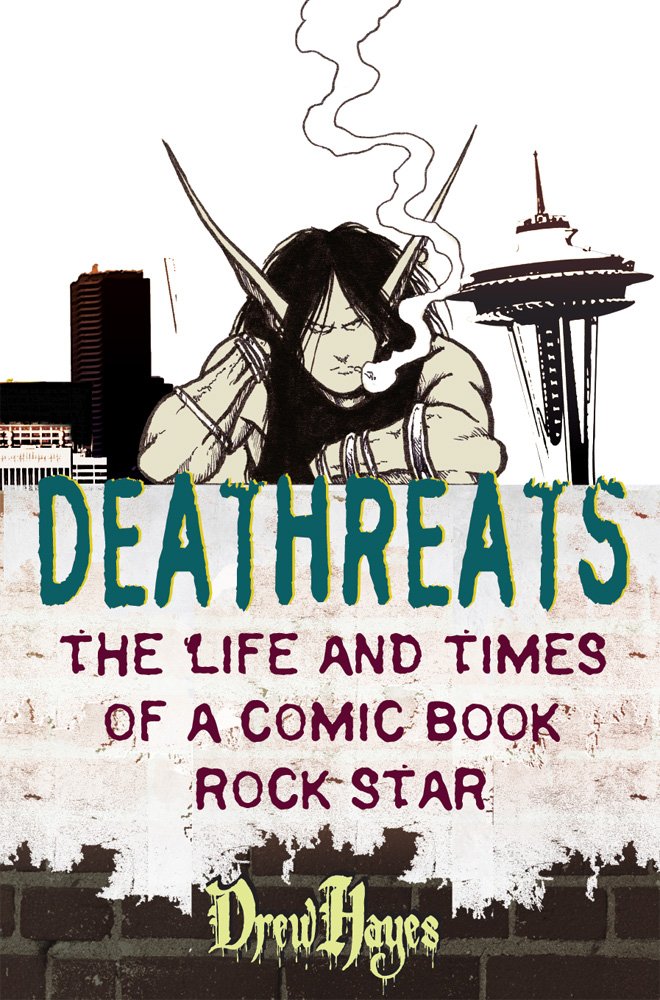 Deathreats: The Life and Times of a Comic Book Rock Star, the collection of Drew's Starting Notes, essays, and other non-fiction errata, published by Sirius Entertainment in 2009.
It’s up to you.
Well, let’s roll it back. This is a lot easier. Drew certainly talked about the time he spent living on the streets. You’ve seen that in print. Did he ever talk about why he was spending time on the streets? You have any recollection?
No.
Drew had drug issues. When he was younger, he had drug issues. I was his support system for a long time. I don’t know, because he stopped communicating. In those last couple of years, sometimes I was, but mostly he was keeping to himself. So I don’t know what he was doing during that time. I’m willing to tell you that when his mom called me to say that he had passed away, the first thing she wanted me to know was that it was from natural causes. Drew had a heart attack while hospitalized with pneumonia.
Drew was Drew, and there’s nothing you could have done to change that. But at the same time, do you harbor regrets?
I regret that the world will never be blessed with 300 issues of Poison Elves. I have become such an immense fan of Drew’s work while creating these hardcovers. Drew’s natural talent was remarkable. I still laugh at random things in the book. He was a self-taught artist and he connected with thousands of people in a meaningful way. Drew wanted to spend his professional life telling a single narrative. He could have done it. We know that there are not many in the field that have. He was inspired by [Dave] Sim, like a poor man's Hal Foster. I can imagine what Poison Elves would have become had Drew had the chance to complete it.
Was Drew’s life reflected in Poison Elves?
Yes, very much so. My partner Larry Salamone, who I started Sirius with, he would always joke that you could tell what was going on in Drew’s life just by looking at the latest issue of Poison Elves. When people talk about how much they enjoy the way Drew writes characters and relationships, that’s because he followed the golden rule: he wrote from experience. Those emotions that are coming across, they’re effective because they’re real. That is genuine self-expression, that is what makes Poison Elves an actual piece of artwork because it was all Drew all the time. You know, he lives on those pages in so many ways. Of course, things aren’t literal, but plenty of it is literal enough, or close enough to the truth, that those of us who had less than a three-month window of knowing what’s going on in his life would be like, "Wow, look at that."
Well, I’m curious because, you know, I re-read the entirety of Poison Elves in preparation for this.
Wow.
And it’s interesting that you say, you effectively lost touch with him towards the end there, because that tracks with the work itself. Because while it has a focus at certain points, much of it is really about Lusiphur the vagabond, and he just kind of drifts from these relationships. With men, with women —
Wow, that’s a pretty heavy insight, even as you’re saying it. Go ahead.
That’s why I’m curious, because he also has these very introspective issues where Lusiphur is literally trapped in his own head, and he has these arguments with himself. I mean, you knew the man. Was he talking to himself, about himself, within the work?
Drew was a highly intelligent guy. But his education was all on the streets. So yeah, he was very introspective, very insightful, a real commentator on the world around him. You know, when I say he was humorous, he was humorous because he could see the humor in every crazy, stupid thing out there. I certainly believe that’s reflected in Poison Elves. Did he talk to himself? I don’t think so.
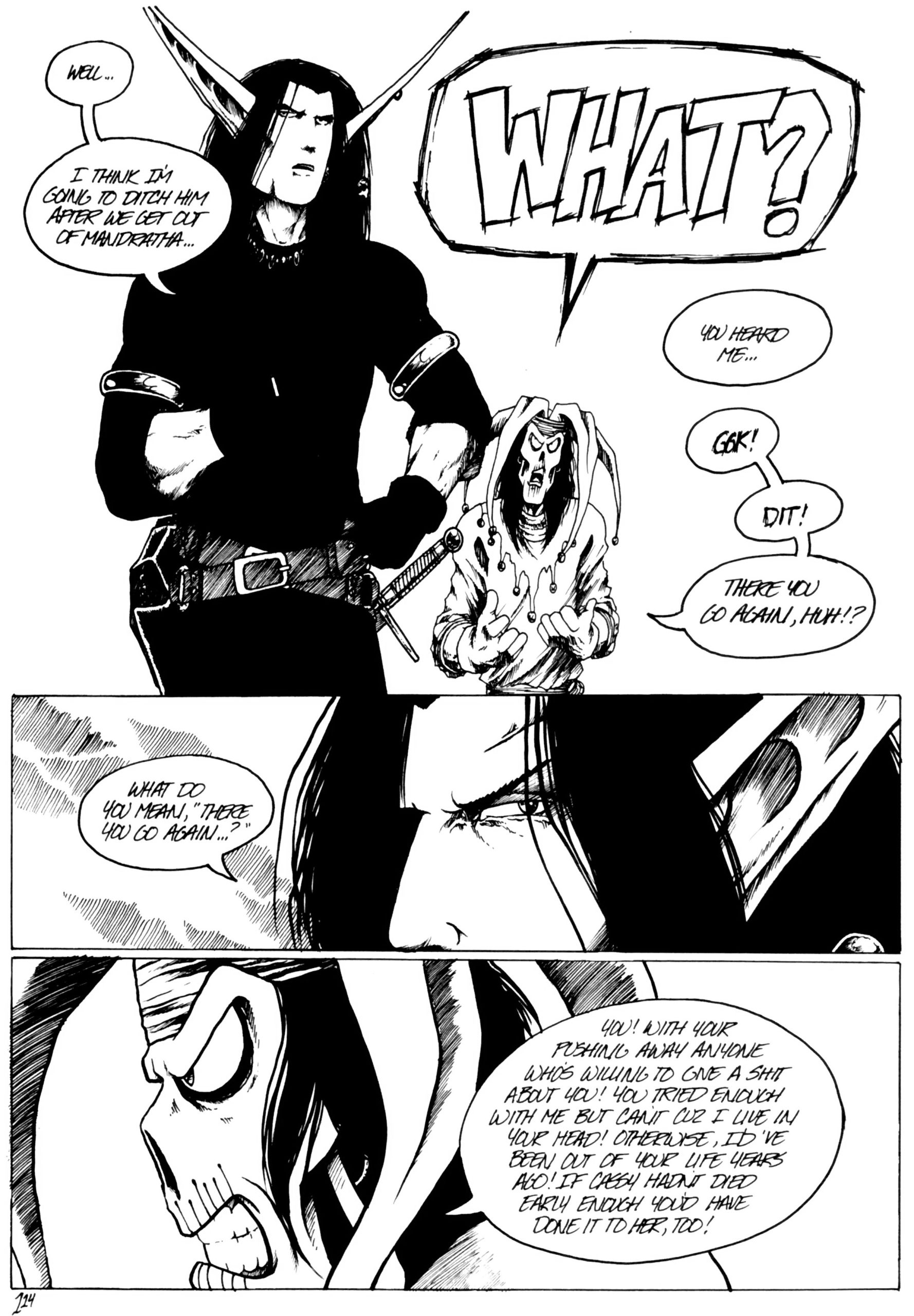 From Poison Elves vol. 2 issue 38, Lusiphur talks to Parintachin. Art and words by Drew Hayes.
When he died in 2007, how did you manage to get that issue 80 out?
Collaborating with his daughter Mary and his mother Sharon made that possible.
How old was his daughter at that point?
She was a child [laughs]. I went out to see her, not immediately, but I went out after Deathreats was released. I don’t know if you know this, but Deathreats won two book awards. It won the Grand Prize at the Boston Book Fair and the Best Autobiography at the Los Angeles Book Festival. So yes, I flew out there when Mary was a little older to present her with those awards. For the book, we scavenged everything that was available, and then Keith Davidsen did the scholarly study of what was in the notebooks and whatnot. We put together what we believed was worth sharing in there. I’ve since shared more. But it was, I can’t really call it a labor of love, but it was a necessity. You know, we had to give the readers something, we had to give ourselves something. If Poison Elves had stopped there, I’d have been satisfied that I had done what I could to create closure at that time. If you combine all the market forces, life forces, and everything else that were occurring at that time, I felt like it worked. It could be better, it could always be better for Sirius. But it did the job. It spoke for Drew, I think. It gave the readers some nuggets of where he had Poison Elves headed to, if only we could have gotten him back on that track to go there. So yeah, it was a piecemeal job putting 80 together, and I credit Keith Davidsen tremendously. I just cracked the whip and said, "That’s going to work, let’s do it."
In your portion of "Sirius Remembers Drew" in that issue 80, you say, "He and I were aware that this day was likely to come and we planned for it. He left his life’s work in my care." Can you elaborate on that, and how you’ve taken that to heart in the years since?
So, I’ve mentioned that I viewed him as moderately suicidal. You’ve mentioned and we’ve all seen he had medical issues. You asked when did I know, and I don't know, maybe I'm being cagey myself that until that first big hospitalization, it was all just like background noise. But we definitely planned for it. It was not an overt bit of like, "Well, Drew, I need to have this under control just in case I lose you." It was certainly nothing blunt like that, but he and I both were attempting to be responsible young adults and plan for our futures. I think that’s the best way to put it.
The other thing you say in there is, "I don’t have any eulogy for Drew because our relationship hasn’t really changed that much. It’s quite a bit harder to reach him on the phone, but I’m damn sure that what he’s working on is going to be awesome."
I don’t think I’d change a word. Yeah.
You’ve taken it on yourself to preserve his legacy.
I didn’t plan it that way. It came as a surprise, and it took me over ten years to figure it out.
So how did you figure it out?
It didn’t really come home to roost until the readers were there to support the first hardcover. Once the readers came to me and said "Yes, that’s what we want," that’s when I realized that’s my job.
So is that why you went with Kickstarter?
No, no. That’s not why Kickstarter. That’s the end result of Kickstarter. You’re asking me when I figured out that it was my job to preserve Drew’s work. That is when I figured out what my job was. Before that, my job was to exploit Poison Elves any way that was appropriate, right? There’s a big difference. And I’m clarifying this while I’m speaking to you, but if you look back at 2012 when we did the Ape Entertainment stuff, that was not me archiving Drew’s work, obviously. That was me attempting to exploit the property that Drew had put in my hands. And I think that the timeline there remains reasonable because it was certainly not a time for me to be doing what I’m doing now. It wouldn’t have occurred to me that it’s time to bring it back aside from the way that we did, which was to try and find some momentum in the actual story and with the readership. So there’s my dividing line based on your question: I have been the publisher, the marketer, and everything else for Poison Elves, but until I got to the first Kickstarter, that’s when I realized I was becoming the archivist, and the keeper of the flame, if you will.
Yeah, so you do the Kickstarter and you put together these gorgeous collections. But you’ve taken a real archival stance on these books. Like, you haven’t fixed typos, you haven’t changed the layouts at all. This is Drew Hayes' Poison Elves.
Pure, unfiltered, unadulterated, best we can offer in the house, Drew Hayes. That’s correct. So much so that in Book 3 I made my first written contribution. I’ve been trying to keep a very low profile on this. What I said to [Creative Director] Michael Cannova when we started is that this is all about Drew. We need to keep that up front. So I made my first written contribution in the back of the book that I’m shipping now. And in there I talk about [how] we could have gone in and fixed the text, but that’s not what we did at Sirius, and that’s not what Drew turned in. I published what Drew turned in. That was the deal. I didn’t mess with his work. That really boils down to control and self-expression. Which again, I consider Drew a pure artist because it was pure self-expression and I would never get in the way of that by making it look better.
Right. So things like increasing the font size on some of those text pages? Never going to happen.
Never going to happen, right. I’d have to edit it to do that, and I’m not going to do that either.
So no typo fixing, nothing.
When we first reprinted the Mulehide years we did that sort of thing. But ultimately, the readers preferred us to give it back to them the way it was.
Warts and all.
Yeah. That’s just who they are. We want Drew the way he is.
So you’ve now done three Kickstarters, and you’re what, three-quarters of the way through Poison Elves?
We’ve crossed past the halfway mark, yup.
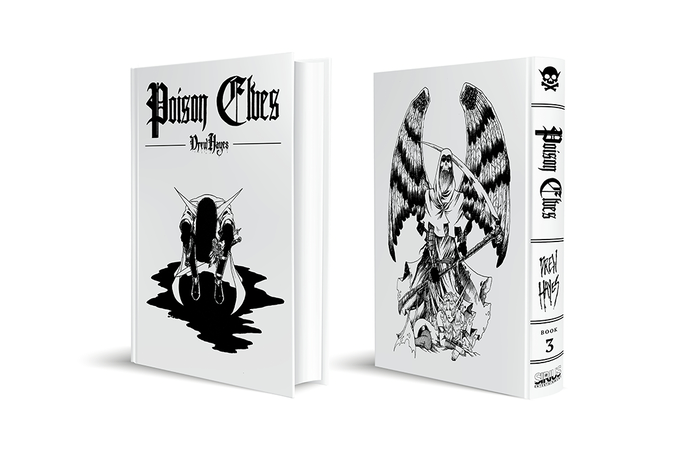 The Kickstarter Poison Elves book 3 hardcover editions by Sirius Entertainment
So is the plan to do all of Drew’s work in this format?
There’s the three books out, there’s two more to go. I announced it right from the beginning: this is a five-book plan, because with the 100 issues that he did, it’s easily divided into 20 issues per [volume]. Once they’re all done, I do have plans for Lusiphur and Lirilith and for Parintachin. He had direct creative input and collaboration on those two books. So I’m looking at putting those together into a single collection. As you can imagine, my ideas for these things continue to change quite a bit, both as I see what’s possible from the readers, and I see what’s possible from the printers and so on and so forth. I’m just going to go ahead and tell you this and give up the surprise. After Book 5 is done, the next one I want to do is called the Lusiphur and Lirilith More Killing Edition.
That does bring up a good point — how are you going to handle issue 61, which was written and illustrated by the Fillbach brothers? Will that be collected in sequence, or separately?
Great question! I intend to leave it where it is in the sequence. It’s a meaningful mile post for those tracking the life behind the book. Its chronological place in the story is irrelevant.
And while we’re on the subject, how did that issue come about?
I did a six issue color series with Fillbach bros. with Safety-Belt Man: All Hell, so I’m clearly a fan. They were unnaturally prolific, so we used the Marvel method as I understood it and booked a fill-in issue so Drew could take a sick day, which he did. Plus, I didn’t do much work-for-hire at Sirius, but this was one, so I’m going to use it.
Once you’ve done these books, you will have collected all of Drew’s work, right?
As I see it. Once Lusiphur and Lirilith and Parintachin are collected, then I am not aware ... well, this is a technical question, young man. [laughs].
At least, all the work that Drew had direct input on.
Everything but one piece. There’s one piece … all right, I do have another collection. In the Kickstarter, I surveyed the readers, and I have been building a small collection of tribute works for Poison Elves. I would like to do a tribute art book. In fact it would be a combination [art and tribute book]. Since Drew’s color output is pretty limited to the covers, and some trading cards and stuff. There’s not a ton of color Poison Elves work to choose from, and some of it is not available to me clean anymore. I would like to collect those color pieces, and I would like to add as many color pieces as I can get from willing professionals in this day and age. I’ve actually nailed some really impressive stuff all ready. But there is one story that Drew had published with another publisher that I am trying to get the rights to.
Poison Elves or something else?
Non-Poison Elves. I don’t need the rights to Poison Elves, I got all the Poison Elves in the world. Drew did do another story, a very short story, that was published by another publisher. I have spoken to that publisher about putting it into this color tribute book. I don’t want to give that surprise up. You’re a research guy, you can figure out who it is. It’s not that hard.
But once you’ve done the archival work, do you plan to start a new series, or continue to exploit Poison Elves in any way?
There’s two parts to that question. I’m going to answer the second part first. I absolutely will continue to take Poison Elves in any direction I find readers, or any other entertainment consumers consider to be a good idea. I’ve got a lifetime investment into Poison Elves and for the first time ever I’m finally seeing some return on it. I like the momentum. I’m not planning on getting beyond the cottage industry, I’m very happy with the level I’m at at this point. But I would certainly like to do other things. You know, Poison Elves comes from the role-playing game world. I want to get Poison Elves exposure in the RPG world, so I've started talking to people about that. I don’t know that stuff at all, but I know those people are out there, I know that that audience is out there, I would like to introduce them to Poison Elves.
Will there be a continuation story? You’re almost two years ahead of things that I’ve planned out, marketing-wise. But I’m not going to disappoint you. In 2012 when Ape Entertainment invited me to write the Poison Elves series — more like insisted, “Robb is the guy who has to do it,” and so I did it. I invested a lot of time and effort into that. That was when I became a Poison Elves expert. And I certainly would like to at least finish what I started. Ape had contracted me for eight issues. At least seven of those issues were completed, and I had written all eight issues. I had a single story arc that ended after eight issues, but offered a variety of follow up possibilities. Three issues were actually released, as I recall, just the three issues made it out. So you’ve got four, five and six, exist, I have those. Seven was mostly complete, and eight was getting started. I hesitate to say that yes, I’m going to put those out, or yes, the readers really need to see those. I got a little bit of brow-beating at the time when those books came out. Not everybody was happy that we were doing it, and I can’t forget that. It was my reminder, “You’re not Drew Hayes.” But nonetheless, now that I’ve given them what they want, and what they deserve in archiving Drew’s work, would you like to see more? I’m going to pose the question to them. This is literally a survey question for book number four. Because I can put anything I want on the digital deluxes. I can put the entire Ape series on there as it exists, but of course, I’d rather see it on paper. The answer to your question is, I will fill any demand that I can find.
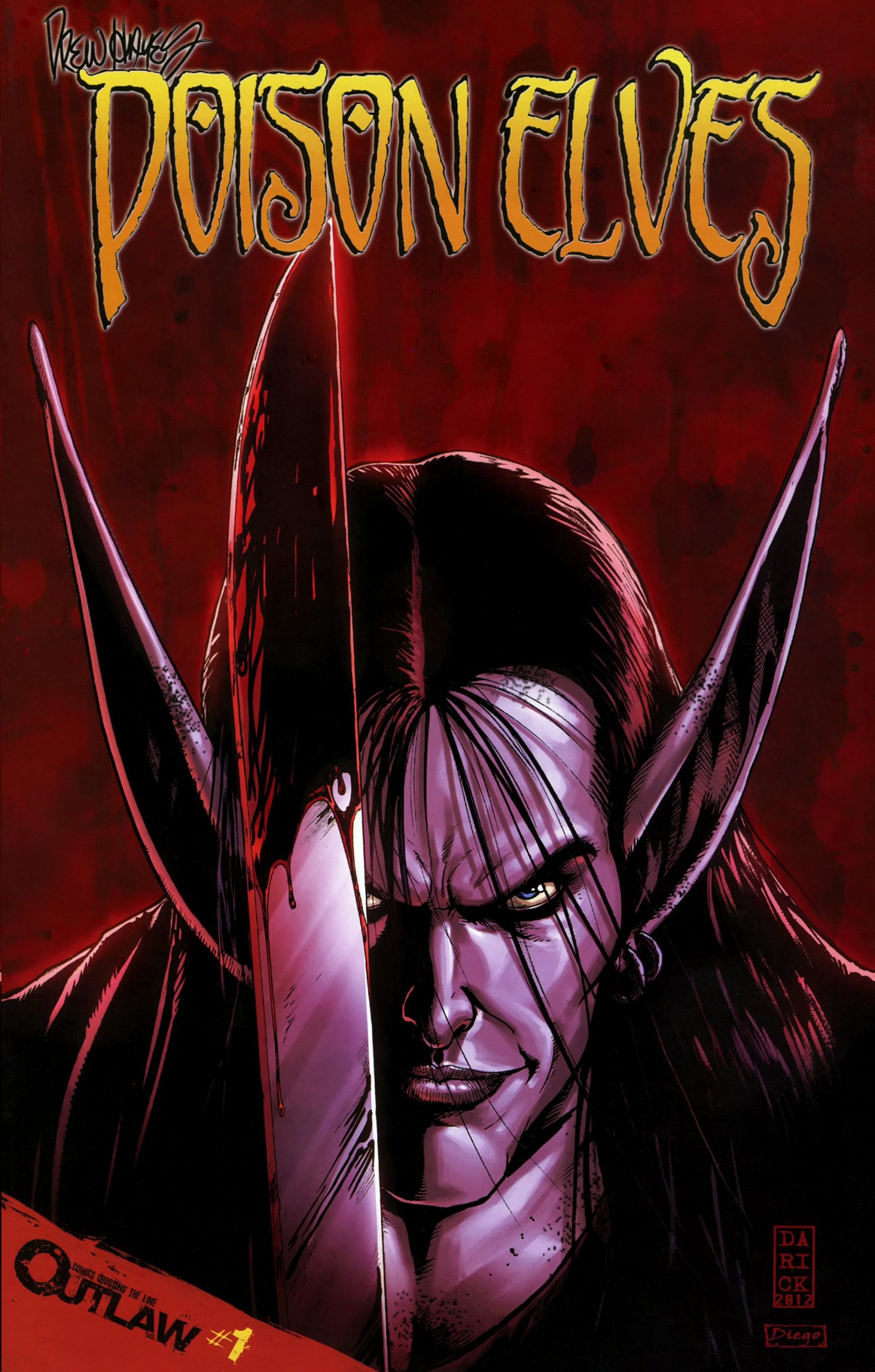 Cover art to Poison Elves volume 3, published by Ape Entertainment. Art by Darick Robertson with colors by Diego Rodriguez.
What did happen with the Ape Entertainment Poison Elves volume 3? Why was it never completed?
To me, Ape looked like they were printing money in 2012 with Sesame Street, Kung Fu Panda, Penguins of Madagascar and Richie Rich comics. Publisher David Hedgcock contacted me because he was a genuine Poison Elves reader. It’s accurate to say that it was his vanity project at Ape. Ape had nothing else like Poison Elves. David’s passion for Drew’s work had a big influence on the hardcovers as well. Ape experienced some financial hit that I’m not privy to, but just before it all came down, David made sure I was paid for what was delivered even though it was never published. They also transferred all the new Poison Elves material back to Sirius when they ended operations. Yeah, I’d like to publish that.
At the time Drew passed, he had been working on this other series which he called Bug, or Deliah.
You tell me, before I say anything. If you’ve looked at the Deliah and Bug work at all, what’s your impression?
My impression is I would have liked to have read that book by Drew Hayes. He’s clearly passionate about it. He’s got this penciled, half of an issue, a couple of prose chapters, and a bunch of notes and sketches. I’m guessing it was what he was doing instead of Poison Elves for a while?
That’s correct. Yup. And there’s the happy ending. As tragic as it all was, Drew and I were very close towards the end. When he was back on scene, he was totally back on the scene. His excitement once he was out of the hospital, and his excitement focusing on this stuff, it was infectious. But it didn’t stop the reality that, I can’t pay you for this yet [laughs].
And before I forget, when he’s talking about Bug, and I believe this is in issue 80, when he’s talking about Bug/Deliah, and you include the actual letter he sent to you with it, he says, “Not the mice and bunny thing.” What was “the mice and bunny thing?”
[Laughs] The mice and bunny thing, I’m pretty sure if I recall correctly, the image of the dinosaur whacking off is right in that vicinity.
Yeah, it’s on the same page.
It was part of that. Let’s just leave it at that.
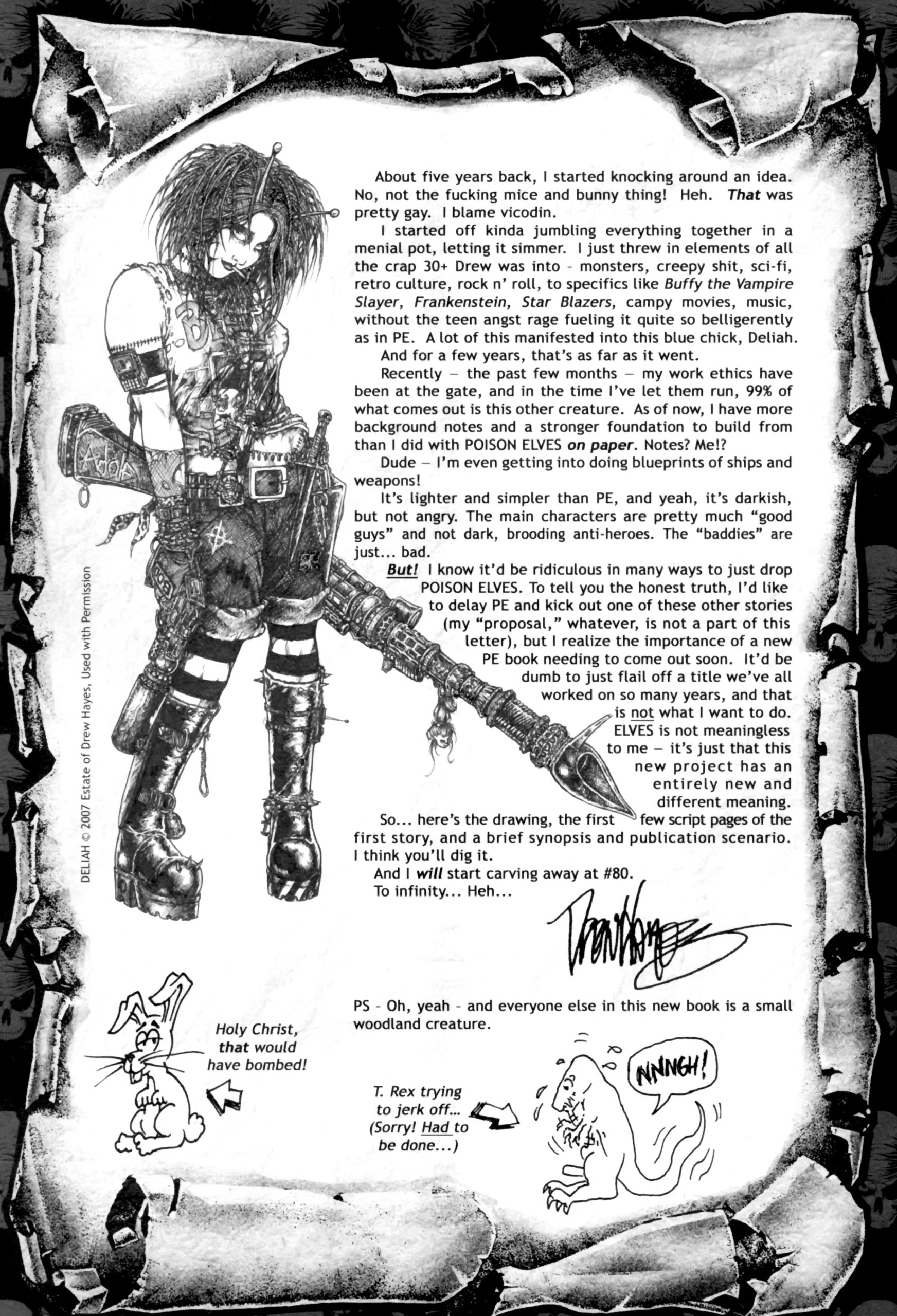 From the posthumous Poison Elves vol. 2 issue 80, Deliah (or Bug). Plus the "bunny thing." Art and text by Drew Hayes.
Was it a pitch that he ever sent you?
No, no, it was just him writing up crazy nonsense and enjoying himself. Nothing that exists in a way that I could get it out there in a way for everyone to experience. I don’t know if you ever saw in the Poison Elves 80 limited edition, we included a mini-comic book called Songs in the Key of Satan.
Was that from the album he put out? Because he did put out a CD, right?
We put out a CD, Drew did record a rockabilly album. But no, this stuff was not intended for that. If I had the mice, bunny dinosaur thing like I had Songs in the Key of Satan, I’d have published it by now.
We’ve covered the questions I have, but I do want to ask you: is there an end to Poison Elves? Like an actual written ending that Drew was building towards, and do you see yourself getting there?
Wow. The answer is yes. Drew, right from when he and I first started to do business together, he told me the end of Poison Elves. So yeah, like Game of Thrones, or maybe not like Game of Thrones, or maybe just like Game of Thrones, Drew knew his ending. Getting there was a journey. We were expecting 300 issues. Sure, he could have plotted it better, but he definitely knew and understood where it was heading. He knew his ending. And I did for the most part as well. Details, as details go, as George Lucas can no doubt tell you, sometimes don’t appear until they appear, you know? Keith Davidsen and I, we actually took a cruise together to Jamaica where we took all of Drew’s books, all of Drew’s information, and we spent an entire cruise, when we weren’t drinking, talking about where it was going. We created a timeline, and an arc that brings the story to the end. I have not looked at that in over ten years, but I can assure you that Keith and I were fairly satisfied that if given the opportunity, we could get us there. And yeah, we put a little spin towards it at the end. Like any big fantasy, there’s more than one climax and more than one epilogue. Lusiphur does die. Everybody should know that by now that yep, Lusiphur dies. I’m willing to say this, Drew never really put in print to my knowledge that by the end of Poison Elves, the entire human race is dead as well. So that might be the big reveal that I’ve never coughed up before. The humans are on their way out. That’s really Mogré-Ür’s solution, is the humans are going. So if that’s a scoop, God bless you.
Do you think you’ll get there?
I need to find the path to get there. If the question is, am I going to produce new comic books? I hope not. No, that sounds ridiculous. That would be really a wonderful end cap, because I do want to produce more comic books. But that’s not on my personal list of what I want to do next, a Poison Elves comic. I have another comic in mind I’d like to do. But Poison Elves, should the readers be there, I would certainly encourage, and entertain, and guide anything I could to make it go forward. But I’m too old to start doing that shit all over again [laughs]. So in other words, there’s got to be a Poison Elves expert out there besides me that would need to unlock the keys to the kingdom to get there. It could be done, but I’m the archivist now. And you know, I’ve always thought that novels might be a good approach, too. But I’m not writing those either [laughs].





 English (US) ·