
Tegan O'Neil | March 19, 2026
A few words on the subject of Christopher Cantwell, then? An interesting fellow.
In the first place, he is directly responsible, as co-creator, co-showrunner, and frequent writer, for one of the best television programs of the new century, Halt and Catch Fire. Now in 2026 it’s possible you might never have heard of it, because that’s the way of the world. It lasted four seasons on AMC, from 2014 to 2017, and in my memory every moment past the first was a blessing from a merciful god. It wasn’t a popular show. It struggled with unfair comparisons to Mad Men at the same time when AMC transparently, palpably needed it to be a Mad Men-sized hit.
But, it should be remembered, Mad Men didn’t start out a hit either, it had terrible ratings at the beginning. In hindsight it's a juggernaut. Of course it all seems silly now, how much attention people used to pay to the production of seasons of television. Once upon a time these things were tethered to actual metrics. That’s not really how TV works anymore! Now, of course, it’s a black box of almost certain systemic fraud. All absolutely opaque.
You’d probably jump at the chance to write Iron Man, too, if that were your day job.
Christopher Cantwell wrote two years of Iron Man, 2020 to 2022. Well received, as I recall. Featured Hellcat as a prominent supporting character. In fairness to Cantwell, I tried reading the Hellcat spinoff he produced in the aftermath, and didn’t care for the mordant tone. Patsy Walker stories should be delightful farce, dammit. We owe her that much, don’t you think? The poor woman has been through enough as it is without ever having to be sad on panel again.
Where was I? Oh yes. Establishing the bona fides. Christopher Cantwell is a talented man. After Halt and Catch Fire I have no doubt that he could be a success in any field of writing he chose. He chose to use whatever notoriety he’d garnered in the world of television as a chit for breaking into comics. He chose to lower himself to the position of getting razzed about writing slightly different versions of certain Bronze Age Avengers in the pages of The Comics Journal. No one writes two years of Iron Man by accident.
In this house we have no choice but to stan a king.
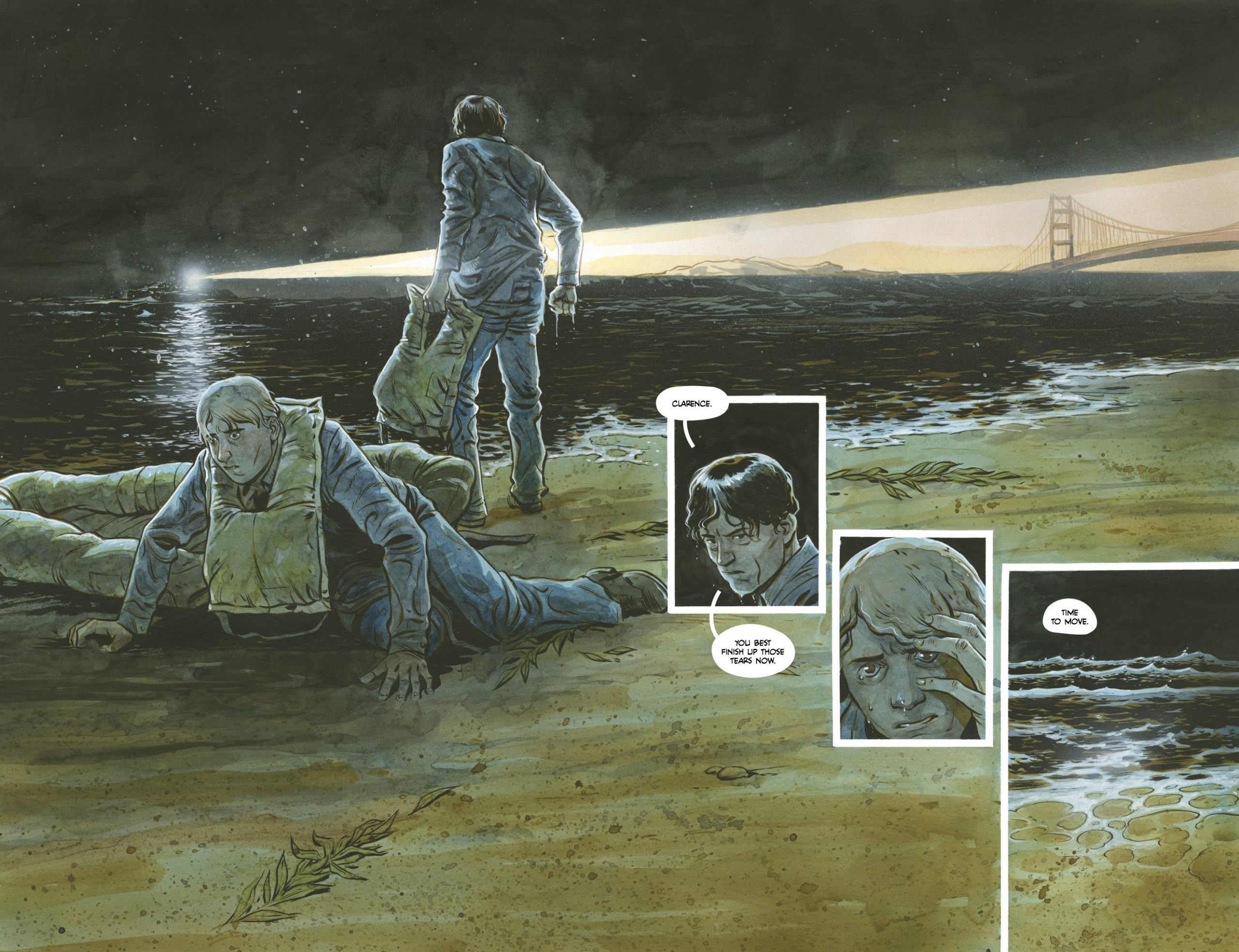
But we’re not here today to talk about Iron Man, no. We’re here to talk about Out of Alcatraz, a recent release from Oni, five issues across the middle of last year and recently compiled. Cantwell is writing a taut bit of noir for Tyler Crook to draw. If you’re not familiar with Crook, he won the Russ Manning Award in 2012, which is still worth something where I come from. He’s worked steadily for a decade and a half without ever condescending to draw Spider-Man and his ilk, I believe, which is a neat trick. He spend a few years drawing the BPRD for Dark Horse, created Harrow County with Cullen Bunn, and drew a pile of Black Hammer stuff.
What’s Black Hammer? I dunno but there’s sure a lot of it! It looks weird, which is half the battle as far as comics are concerned.
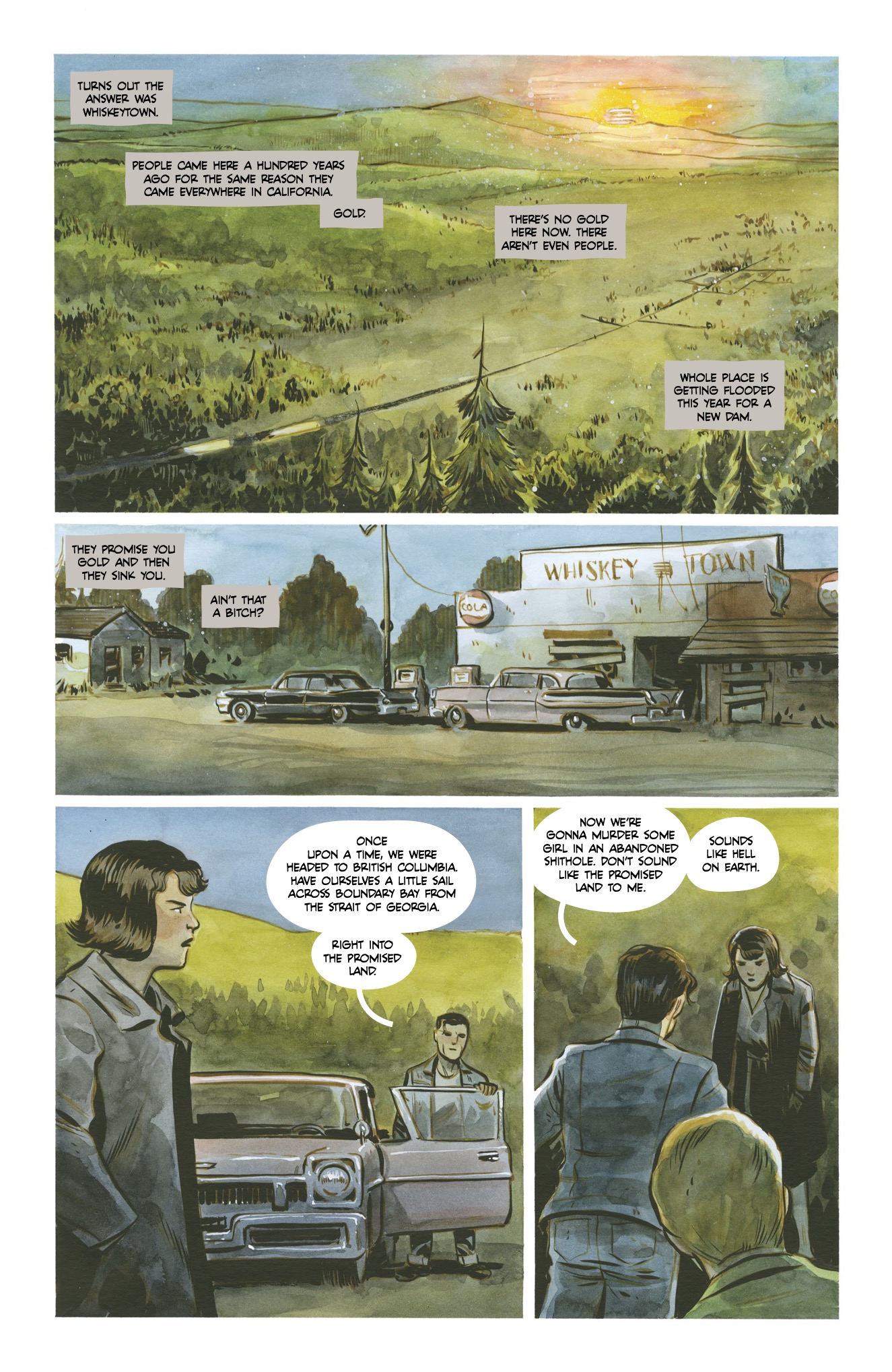
In any event, the Russ Manning Award continues to be a better predictor than the Heisman. Out of Alcatraz is situated firmly in the real world, specifically Northern California. It looks and feels like Northern California, through and through — Crook captures the endless empty yellow dirt sprawl juxtaposed against monotonous rows of monoculture forest. All fed from the waters of the Shasta gulch, as Stephen Malkmus once so colorfully described. Now, I’m from Northern California, I’ve spent most of my life in Northern California, and if there’s one thing you have to understand about Northern California it is that most of it is really fucking boring. Look at a map: all the fun and interesting stuff, be it big cities and oceans or mountains and snow, happens around the edges. The middle of the state is a giant flat-ass gully. It’s a fertile flat-ass gully, certainly. But otherwise the middle of the state is a vast tract of mostly agricultural land, sparsely populated, and frighteningly conservative.
As you may have gathered from the title, Out of Alcatraz is a prison break story, and what’s more, its a speculative piece about arguably the most famous prison break in American history, the June 11, 1962, escape of Frank Morris and John and Clarence Anglin from Alcatraz. Although the most likely narrative continues to be that the three men drowned in the San Francisco Bay on the night of their escape, they never found any bodies. You can’t blame people for letting their imaginations run wild.
 They shut Alcatraz down the year after the escape, though the escape wasn’t the main reason. If anything, the sensational escape just shone a light on existing problems. It was too expensive. They replaced it with a similar maximum security facility in Marion, Ill. that didn’t need to have everything brought in on a boat. It’s a lot harder to romanticize a flat box in the middle of Marion than an island castle like Alcratraz, for sure. Have you ever been to Alcatraz? It’s a lonely place, but sure, it looks cool. Of course it lingers.
Anyway, that’s just the history. This series picks up where the history leaves off, following the three prisoners in the wake of their escape. There’s a pair of federal agents on their tail — well, sort of. One federal agent and a retired friend, actually lover, and they’re chasing a vaporous lead on their days’ off because they want to spend time together. Being two men in love in the early '60s they weren’t going to get so many good chances to do that.
Once the prisoners get off the island they have a plan, a hook-up with a line to get them out of the country, heading north to work off their freedom on a farm in Canada. That’s the plan, at least. You shouldn’t be surprised to hear it’s not so simple as all that. Their great advantage is that most people think their dead, but their faces are still plastered all over the post office. So of course they run into trouble. They’ve got an agent, of sorts, a woman they’re paying to get them out of the country. She’s got her own reason for needing to get out of town. Everyone’s running from something.
All the better for your standard noir. Now, I’ve never made any secret of the fact that crime isn’t my favorite genre. I don’t like seeing people make bad decisions! Feels suboptimal. Add to that the fact that crime as a genre has been straitened in comics of lately, with the inimitable duo of Ed Brubaker and Sean Philips standing as the most prominent creators in the field. The problem with the success of Brubaker and Philips’ crime books is that the backwards nature of our industry means they haven’t really opened up the shelves for other creators to work in the field. No, their success was unique enough as to simply make them synonymous with crime comics. Theirs is the single yardstick. In fairness that’s not what they set out to do, and it’s churlish to hold their success against them. But, I also find their approach mind-numbingly astringent in high doses. Lots of suboptimal decision making drawn with great subtlety. Out of Alcatraz is precisely what you want to see, then, if you’re maybe looking for more crime on the shelves, if not that far off from the Brubaker and Philips mold.
It’s a page turner. Because every move is a bad move when you’re on the run, their luck starts at terrible and gets worse. Two out of three of the escapees are violent thugs, and the third is a flake. They get bogged down in Redding, Calif., by a peckerwood rancher who wants to blackmail our guys into killing his wife. Take it from hard-earned personal experience: there is no worse place in the world to get bogged down than Redding, Calif. I don’t even like driving through it. The story is true to my lived experience in that regard. There’s even a brief stop by Whiskeytown, the reality which is so much less interesting than the name might imply. As with much in Northern California.
It ends, as you might expect from the genre, on an unsatisfactory note for our ostensible protagonists. The feds trailing them, and the underworld agent responsible for selling them to the Canadians, end off moderately better. Honestly, if I have a problem with the story’s it’s that the ending doesn’t quite satisfy — a bit symmetrical? It ends up half noir just desserts, half fairy tale. Read it and judge for yourself. There’s a structural limitation at play with this kind of historical fantasy. You can’t invent a solution to bigotry in a story set in 1962. There were no escape hatches, but the story really needs there to be a kind of escape hatch.
As I say, it’s a good looking comic, even if the ending fell flat for me. Such is life. It’s still a serious work of no small ambition. It looks like a million bucks. I’d like to see more from this team. A nasty travelogue across a countryside of colorful vistas filled with a whole lot of deadly nothing. That’s the problem with Northern California: it looks great from the back of a car as you’re whizzing through. It’s only when you have to stop the car and take a piss that you realize how awful and empty it all is.











 English (US) ·