
Hagai Palevsky | June 23, 2026
As I write these words, the social media discourse du jour has reverted to an old reliable subject: should authors read? Or, rather — is it a position of privilege to argue that a writer, in order to qualify as such, should read, both for professional enrichment and for pleasure? Admittedly I have fairly little interest in the discussion itself, but the notion that the two functions, reading and writing, are separate from one another brings me back to a question I think about from time to time, being the seeming dichotomy between creator and critic, especially in comics. I don’t adhere to the idea that a critic must create in order to attain credence or validity, but more and more I find myself wanting to see cartoonists engaging with the works of their peers in a critical fashion, in earnest and on record.
In this context we may look, just for a handy example, to Chris Ware, who shows up occasionally in the vaunted pages of The New Yorker or The New York Review of Books to offer an "appreciation" of this book or that. By and large, these appreciations are fawning; by and large, they’re not very good. Ware is a favorite cartoonist of mine — Jordan Wellington Lint in particular is one of the three best comics of all time, in my opinion — and part of what I find interesting about him is that the qualities that make him a good, interesting cartoonist and storytelling (the fretful, neurotic need for love and constant connection) are precisely the same qualities make him a poor, uninteresting critic, for one specific reason: in his comics, he projects these insecurities entirely onto himself, or, rather, onto the level of the human individual. When he writes about the comics of others, he feels compelled to take on the role of "ambassador" or "advocate," projecting the same insecurities outwards onto "comics" as a whole, to prove to his assumed audience of skeptics that, yes, comics can be art, comics can be serious. I need to be loved and respected is, regardless of time, a compelling sentiment; comics, as an art form, need to be loved and respected, twenty-something into the 21st century, is a tedious insistence that betrays its own insecurity.
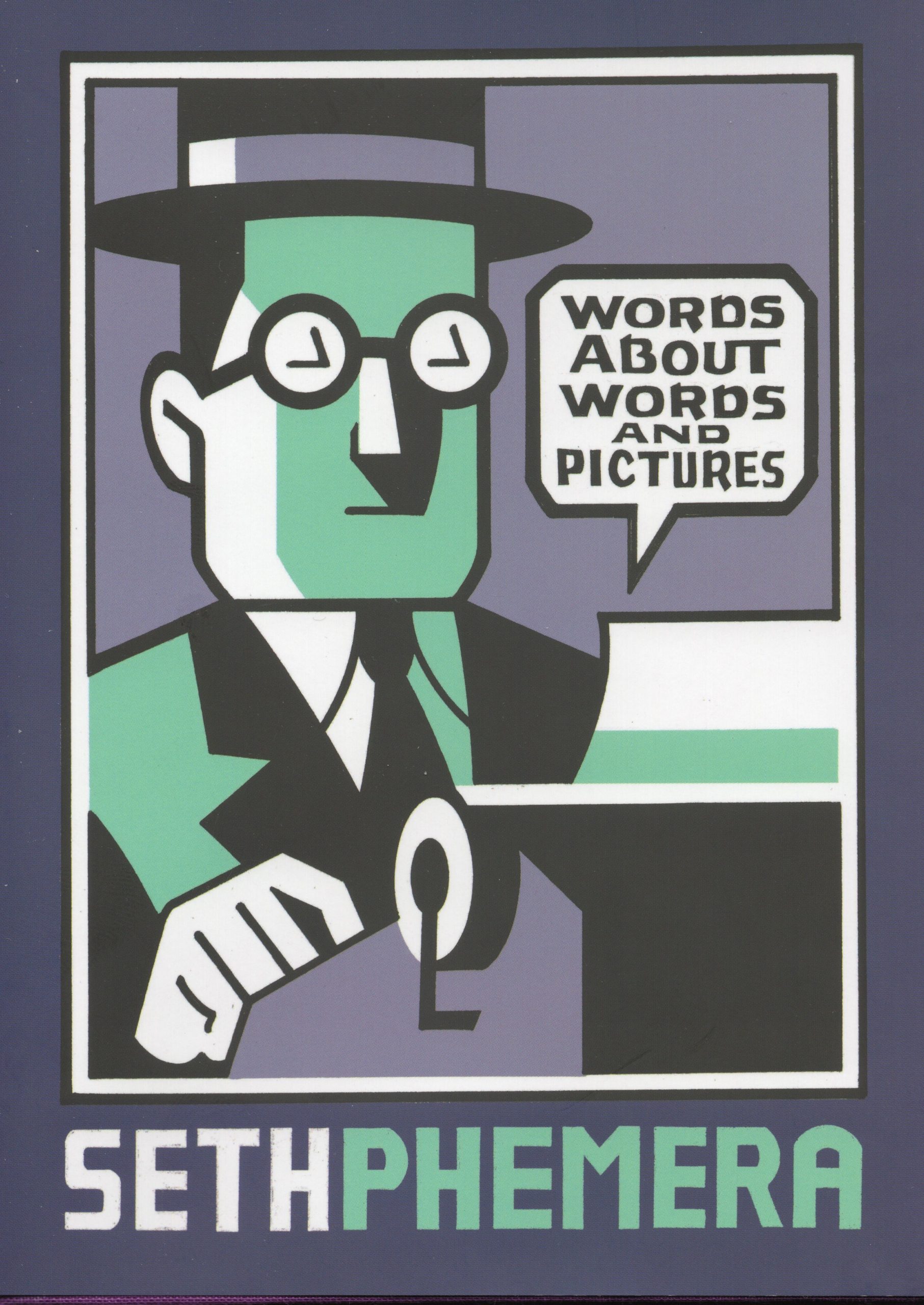 Chris Ware, believe it or not, is not the subject of today’s musings; that distinction goes to a friend and peer of his (and another favorite cartoonist of mine). If prominent cartoonists writing about comics in longer form than a pull quote are a rarity, then a cartoonist putting out a whole book of essays (words about words and pictures, as the cover puts it) is rarer still. Sethphemera, published last year by the Mexican small press Máquina de Aplausos, offers just that.
Seth, one might say, is a uniquely interesting candidate for such a project. In his comics, he has propped up the city of Dominion as an attempt to comment on Canadian history and culture without being beholden to historical fact; in his book designs for projects like NYRC’s Chris Reynolds collection The New World or Drawn and Quarterly’s John Stanley Library hardcovers, he has been criticized for positioning his own aesthetic sensibilities above those of the comics compiled. All of which is to say, one might, at first glance, assume Sethphemera to be a careful construction, not just a collection of writings but an opportunity to articulate, at length, an aesthetic theory-of-everything.
Soon enough, however, the cartoonist interjects, in the form of a short introduction comic. Indeed, Sethphemera begins the only way its namesake knows how: first by humbling itself in the eye of the reader (“This book is something of a hodge-podge…”; “Don’t look to this book for any kind of unified artist’s statement”; “I don’t claim to be a Writer with a capital ‘W’”), then by pointing out the lacunae in that makeshift whole (“My lament is for what isn’t here. What I didn’t write,” followed by a list of absences).
Its contents culled from introductions, public speaking engagements, and the occasional long-form appreciation of a specific artist, the prose of Sethphemera is thoroughly colloquial. Even when a piece is meant for print, the cartoonist writes with a distinct eye for cadence (often he will use a full-stop where a comma is more "proper," clearly aiming for the intensity of the spoken pause). Instead of going back and editing when a thought occurs to him pertaining to an earlier part, he will simply “oh, by the way” an amendment. There is little pretension to it; writing, to Seth, is clearly an extension of dialogue, i.e., of speaking. This is particularly palpable in the introductions and prefaces, where the approach appears to be less about the specific merits of the book in question than about, plainly put, whatever comes to mind. (As is the case with Ware, Seth does appear to be concerned with the respectability and stature of comics as a form and an industry: note the way that references to comics as "serious art" always come with an explicit tie to their past as "pure junk.")
When Seth proclaims himself to not be “a Writer with a capital ‘W,’” we may infer that part of what he means is that he is more a fan than a critic. I do not mean to say that Seth is not astute or observant — his breakdown of John Stanley’s vignette structure as a means of retaining novelty within a formula, for example, is both insightful and intuitive — but his manner of reading inspires a certain ambivalence in me. As a reader, when he writes things like “I feel like I have walked Mariposa’s elm-lined streets” (in reference to Stephen Leacock), I can’t help but feel a certain envy. As a critic, however, his enjoyment betrays an unwillingness to analyze. Often he will say something to the effect of “I’m not exactly sure why it happens when it does — but when it does, you know it” — a sentiment somewhat forgivable in an introduction, being a text that’s usually complimentary and positive by design, but less so in more critical venues like, in the case of the above, this very same Comics Journal.
Similarly, Seth devotes very little time to the actual craft of cartooning, and what distinguishes this creator from that on the technical level; his ruminations on theme and atmosphere are distinctly un-visual. See, for example, the write-up on Jack Kirby. The short essay is devoted to a rather unlikely choice within Kirby’s body of work, 1977's The Eternals Annual #1. The only real discussion of Kirby’s art is the following: “No one, and I mean no one since Picasso, has drawn with such confidence. [Kirby’s] drawings are so monumental they feel practically carved out of stone; his writing is vivid, too.” A summary of the comic, the preamble of indecision, the stature of Kirby within the industrial context — these are all allotted more space than the cartooning. This is a surprising sort of reticence, both because of that professed admiration and in light of Seth’s keen sense of aesthetic. The same phenomenon occurs in his 1998 introduction to Dylan Horrocks’ Hicksville, as he lingers on Horrocks’ and his shared preoccupation on the what-might-have-been while saying strikingly little about craft — in the context of “collected essays by Seth,” one gets little indication indeed of Horrocks’ cartooning style.
The question, then, is this: if not for an up-close and in-depth discussion of the craft itself, what remains? In Seth’s mind, there are several possible answers. A prominent contender is, simply put, the joy of discovery. Several of the book’s essays linger on the cartoonist’s first encounter with the book: the time in his life, the bookshop, the person who recommended it. The work itself is just one component, charged with the significance of the circumstances surrounding it to an almost mystical extent. Unsurprisingly, these moments are some of the most charming parts of the book: little as they reveal about the works they presume to discuss, they reveal the depth of Seth’s sentimentality. To Seth, the given work is as much part of the reader’s life as it is part of the artist’s; each book is made to feel like a milestone.
It is in this way, too, that Seth gets to talk about himself. Though Seth largely refrains from discussing his own work in these pages, the reader does get the sense that some artists are more significant than others, simply because he specifies an element of their work that ripples into his own. The thematic rumination of the Hicksville introduction paints a clear line from Horrocks’ cynicism to the subsequent fantasism of Seth’s own Great Northern Brotherhood of Canadian Cartoonists. Of the illustrator Thoreau MacDonald, he writes, “One of the most prevalent themes that recur in [MacDonald’s] diaries, and in his work in general, is the recognition of things lost […] almost all his drawings are tinged with the undercurrent that this world he loves was passing away”; of Chris Reynolds, “Few comics place such an emphasis on the setting as Mauretania Comics [does]. Often the stories are actually about the setting and if it isn’t the main focus, you can be sure that it is a crucial element […] Much of the characters’ intuition is linked to the feelings that places evoke. Mr. Reynolds seems very much in touch with the environment,” and that “[t]ime has a strange fluidity in his stories —past, present, and future are not entirely separate […] No one seems to ever leave the past fully behind. It’s not as though they are trapped by their pasts — nor is it purely nostalgia — it has more to do with the perceived feeling that the ‘past’ exists somewhere as solidly as the events that are happening in the ‘present.’ Perhaps it is memory that is lingering more than time.” Little by little, we can see where the excited reader becomes the influenced artist.
When discussing "comics" as a whole, such as in the sole interview in the book (conducted in 2006 by Marc Ngui), Seth tends to speak with an excessive dogmatism; his recurring statement that “comics are more like poetry than they are like prose or film,” for example, inevitably betrays a limited definition of both art-forms. The above statements are thus infinitely more valuable to me, as they shed the "edict" tone, purporting to speak for no one outside of Seth himself.
For this reason, Seth’s essays are at their best when they enter an outright diaristic mode. A recurring motif in Sethphemera is Seth’s hunger for his own artistic lineage; he is palpably excited to be considered as part of a sequence, a historical tapestry. Crucially, however, this tapestry is not measured strictly in publication or in hours spent at the desk, but in human life. Just like he remembers the people who recommended a certain book to him, he is mindful of the artist’s life and humanity outside of the work. An obituary of the Canadian cartoonist James Simpkins — creator of Jasper the Bear, an icon of 20th century Canadiana — quickly goes from Seth’s first encounter with Simpkins’ work to his last meeting with the man himself, on a visit to his nursing home. Seth (with writer Brad Mackay) visited in order to interview him for a book, but clearly saw that, although Simpkins was still active and affable, his memory was not sharp enough for the task at hand, leading Seth to decide, instead, to be present in the moment and enjoy the man’s company on a purely informal level. Similarly sweet is the essay on the Canadian cartoonist Merle Tingley, which starts on a talk that Tingley did at Seth’s elementary school when the latter was in the first grade and ends with Seth, now in middle age, having the honor of announcing Tingley’s induction into the Hall of Fame of Canadian cartoonists and awarding the man with his medal.
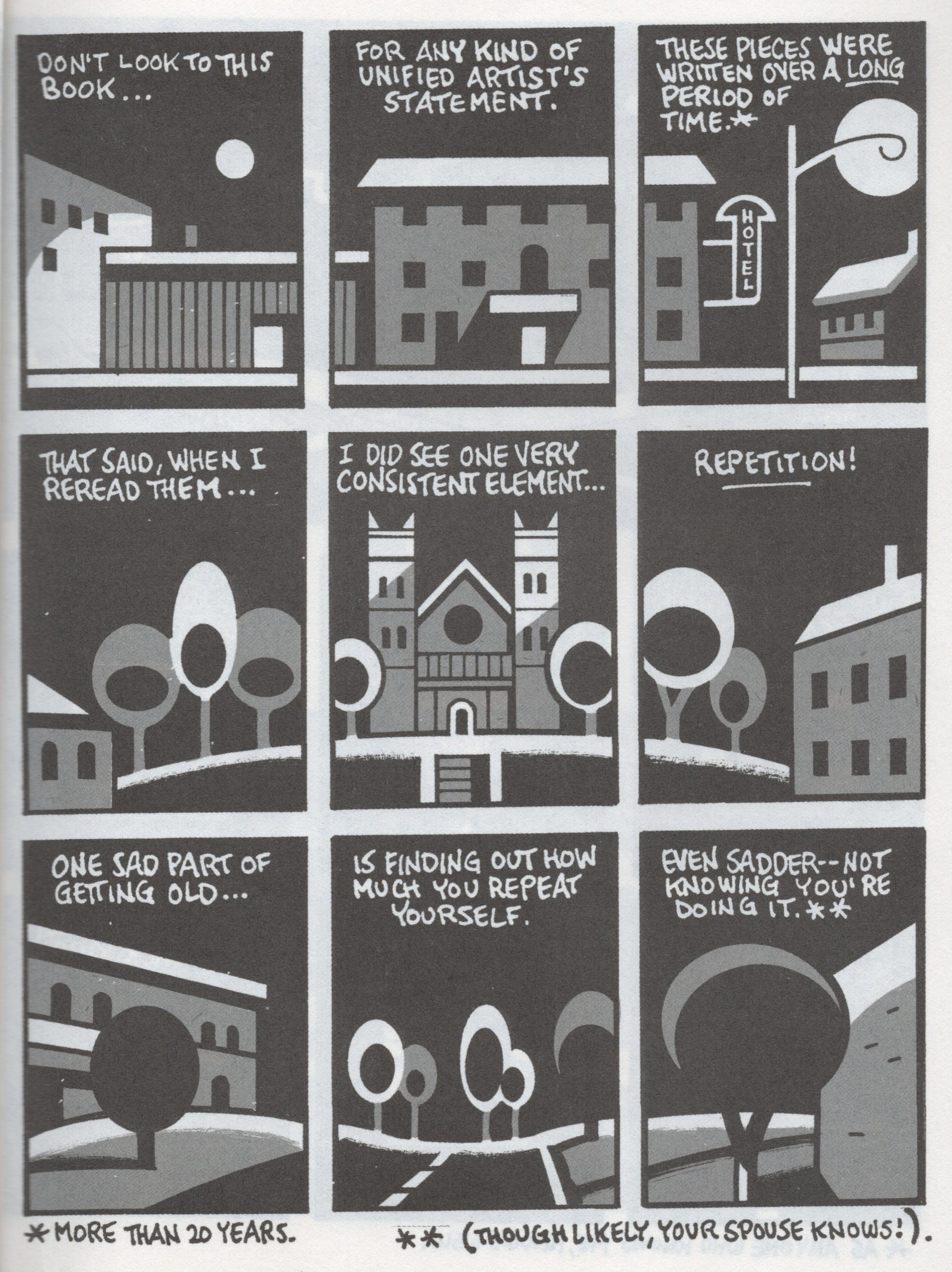 From Seth's introduction.
Sethphemera contains two essays on Charles Schulz, which, viewed together, perfectly illustrate the collection’s peaks and valleys. First comes a preface to a zine of Schulz’s short-lived run of one-panel cartoons pre-Peanuts. Seth here takes a contextualizing perspective, viewing Schulz’s corpus as a whole, which in this instance is entirely detrimental — the natural impulse to view these cartoons through the prism of the mother-of-all-newspaper-strips that came afterwards essentially prohibits him from engaging with the work on its own terms.
The second piece, however, focuses not on Schulz’s own work but on Seth’s position in relation to it, as the designer of Fantagraphics’ Peanuts library. Over the course of its seven pages, Seth relates the story of a 2003 trip to Santa Rosa, California, along with his wife Tania and Gary Groth, to meet with Schulz’s widow Jeannie in order to go over Seth’s prospective designs for the Fantagraphics reprints. Seth, ahead of the meeting, is simultaneously confident in his vision and fraught with awe and anxiety. Later, having managed to get her approval, he tours the Schulz complex: the studio, the museum, the baseball diamond, and the ice rink and café. At the lattermost location, he sits with Groth and Tania, only to suddenly leave and walk away from the other two, overcome by a feeling that he “should be alone here,” and begins to roam the ice arena. There, for the first time in the visit, he feels an almost spiritual elation:
A certain melancholy descended on me: a pleasant sadness not unlike that feeling when Charlie Brown says ‘Good Grief.’ I knew Sparky had looked at this ice a thousand times and here I was, doing the same thing in the same place. As I looked out over the dimly lit ice I faced the simple facts: this place was just a mundane place like anywhere else in the world. Whatever I was looking for here — this was as close as I was going to get to it.
It’s significant, I think, that Seth ascribes this feeling not to the studio or museum — spaces focused on the artist and his work — but the ice rink: here, for once, he can connect to the human element, the habitual and emotional rather than the professional.
“Dozen Stories” marks the end of Sethphemera’s autobiographical movement. The talk, performed on numerous occasions, offers twelve vignettes that make up Seth’s life in miniature, in a purposefully-disorganized manner reminiscent of Joe Brainard’s I Remember. He talks about his discovery of comics via Peanuts; he looks back on art school — his one professor who essentially hinted that his hard work and earnest interest will never amount to actual artistic merit, and the fellow student who took an interest in comics as well (at a time when higher arts education had little time for comics as a practice), only for Seth to understand that this schoolmate’s aspirations were largely irreconcilable with his own.
Among the "shortcomings" Seth points out in the introduction to Sethphemera is the fact that the book includes little writing on his peers and contemporaries. Among the names he lists, three appear in “Dozen Stories,” albeit as characters rather than subjects-of-discussion: a recollection of Seth and Chester Brown as young upstarts in the ‘90s shows the struggle of Anglophone alt-comics (certainly of the Kurtzman-Crumb lineage) as a whole, being a self-individuation born out of contrast, less an artistic impulse that emerged of its own accord than an often-kneejerk kontrapunkt to the shackles of puerile commercialism. Chris Ware serves as a humorous foil, offhandedly making Seth aware of mental constraints the latter always assumed to be universal; while Joe Matt is the recipient of a loving letter from Crumb, telling the younger cartoonists to ignore his detractors and focus on telling his own truth, and to not worry about repeating himself so long as he digs deep into his own personal truth — a message that would serve as something of a mantra for Matt, Seth, and Brown for years and decades hence.
What’s valuable about “Dozen Stories” is its "zoom out" approach: Seth is usually not the focus of these anecdotes so much as he is an observer, not acting so much as reacting. “Cartooning,” Seth observes, “is a solitary pursuit,” yet the cumulative thesis of “Dozen Stories” paints the artist as a product of his environment; it is precisely the friction between self and surroundings, ultimately, that builds character, one step, one story, at a time.
Tucked toward the end of Sethphemera is “Creating a Personal Vernacular Canadian Design Style,” a 2011 article written for the printed-arts magazine The Devil’s Artisan. At sixty pages, it is the longest piece in the book, handily divided into two parts. The first part is a survey of a few items of 20th-century Canadian-themed ephemera that Seth has accumulated over the years, breaking down the Canadian "image" into several motifs that recur frequently enough to take on a note of inherence. These are: a vast sense of space; symbols of officialdom; and — the most abstract of the bunch — "modesty" (which later he accepts may manifest as plain "dullness"). Early in the piece, Seth concedes that he has not constructed this theory from the bottom up so much as collected items that reinforce his viewpoint, and so these are not requisites; this, in itself, betrays a certain weakness of thesis, but Seth grants that much of his approach, studied and considered though it might be, is based on his own sometimes-inscrutable intuition.
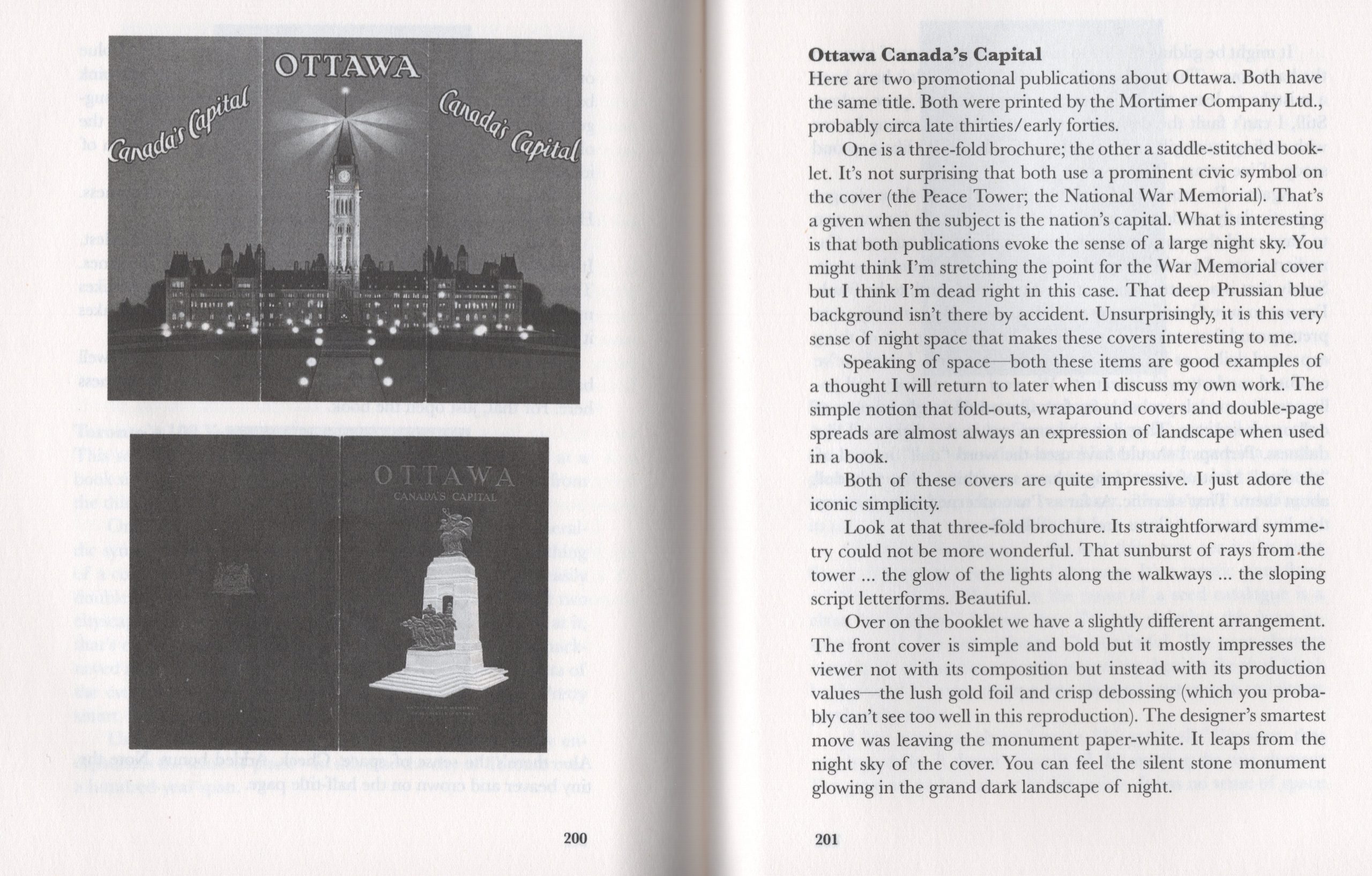 Facing pages from "Creating a Personal Vernacular Canadian Design Style."
One thing that readily leaps out is that, of the eleven items listed in this section, the vast majority are issued either by the government or by another party with a vested interest in the permanence of locale (a bankbook distributed by the Bank of Montreal; a souvenir sketchbook given out to guests of a certain hotel); furthermore, only one of these items is credited to a specific artist (Thoreau MacDonald, who also gets his own write-up earlier in the book) rather than a government or business organization. On the whole, then, the “commonplace sources” from the “lowbrow end of the design spectrum,” which Seth submits as his exemplaries, portray Canada in terms not "vernacular" so much as iconic, mythicized, and, consequently, at least somewhat nationalist — being a sanitized, "depoliticized" vision sanctioned and handed down by the state. Consider the following passage:
It used to be said that Canadians had a distinct connection to our huge landscape. Maybe that was true when most of the population was rural, but it's probably not so true nowadays when the majority of us live in cities. Nonetheless, we like to think we have a connection to the landscape. That whole "Idea of North" business. It doesn't matter if we do or if we don't. The truth is we have decided we like to define ourselves by the vastness of the Canadian landscape and so, as far as l'm concerned, it does define us. God knows I spend most of my time hidden away in my basement studio — I'm not out canoeing or trekking the Canadian Shield. I don't know if I can actually feel the Arctic frontier hanging over my head — and yet I genuinely do feel defined somehow by the landscape of this country. I've made a primary association there and it works for me. It's the first thing I look for in these vintage designs. Does it transmit the idea of open space — does it reference the landscape in some manner?
As can be plainly seen, Seth is aware of the fallacious nature of the ur-Canadian aesthetic — yet it is a fallacy that appeals to him enough to disseminate it, in a rather Baudrillardian fashion, as a chosen truth. This transition from desired reality to enforced conception mirrors what is perhaps the key tension in Seth’s work, not just as a designer but as an artist in general: the porous — and predominantly psychological, that is, subjective — boundary between fact and fiction.
Part two of “Creating a Personal Vernacular Canadian Design Style” is an outlier within Sethphemera, in that it is the only occasion where Seth discusses his own work in specific, granular terms. Here, Seth first applies the three "Canadian" attributes to his own work. For "landscape," he discusses not just of the landscape image but also the orientation — his great admiration of the wraparound cover, the two-page spread, and the endpaper as discrete units of opportunity, often used in succession to create a ruminative atmosphere of not just an external landscape but a mental one as well. For "officialdom," the briefest of the three, he appends a gallery of coats-of-arms and similarly-"formal" symbols he has designed (the various Great Northern Brotherhood insignia, for example, and the logo of George Sprott: 1894-1975), though he says very little of substance outside of “I like to use them.” For "modesty," he attempts to reconcile between his appreciation of restraint as a principle and his penchant for luster and ornament. Finally, he observes:
I do try to be boring, though, if that counts at all. I genuinely suspect that my work actually is boring. I don’t see that as a negative. Haven’t you ever sat out on the front steps of the house, say smoking a cigarette on a warm day … just sitting there, utterly bored? Stay a little bit longer. Stretch that boredom out and you’ll notice that eventually that boredom becomes really interesting.
This, of course, applies to his comics even more than to his design work. A fellow critic informs me that Seth’s current autobiographical serial Nothing Lasts, currently serialized in Palookaville, sees Seth’s cartooning become increasingly distillatory and essential, to a degree almost reminiscent — as much as possible, at least, within the confines of Seth’s refinement and polish — of John Porcellino. I have yet to read what has been published of Nothing Lasts, and yet I can immediately see the connection; to his credit, Seth’s montage technique, with his ever-interior narratorial voice superimposed on vistas where time has all but stood still, balancing minute detail with a smooth, ‘iconic’ texture, carries a profoundly ruminative, almost transcendentalist tone — “negative beauty,” as John Burroughs terms it, a beauty that comes from the function of life lived within it rather than ostentation.
Having surveyed these three elements, he goes on to discuss a specific project — The Collected Doug Wright — and how he gave it what he regarded as the "Canadian" feel. What’s interesting about this particular process is its core counter-intuitiveness. Remarking on what he views as a central irony in Wright’s life, Seth notes that Wright’s crowning achievement was a strip about the life of a father even though the man himself grew up fatherless — Wright’s father died in combat in WWI. Seth, on reading a newspaper article on the Vimy Ridge Memorial, commemorating the fallen Canadian soldiers of WWI, felt inspired to model the book, in a way, after the memorial — even though, as he himself notes, Wright’s father was not Canadian and wasn’t killed at Vimy.
From here he describes the process in detailed steps: first, having calculated how many pages are left in the book outside of its dictated contents (strips, illustrations, and accompanying essays), he searched for as many photos of the monument as he could find, then proceeded to storyboard, in essence, a visual poem based on the monument; then, having determined the visual compositions of each of his spreads, he proceeded to search for illustrations by Wright, with Wright’s cast of characters, that matched these compositions. As the cartoonist himself writes, “No one reading the final book would recognize my opening sequence as an ode to the lost soldiers of World War I, and it wouldn’t have made much sense if they could — for the reader, these pages had to be a coherent visual sequence about Doug Wright and his main character, Nipper.” At the same time, however, he says this design choice “would give a deeper underlying meaning.”
Perhaps unconsciously, the latter part reveals the somewhat problematic nature of Seth’s Canadiana endeavor — though the work of Wright the son is, as Seth puts it, “quintessentially Canadian,” the two Nipper books I’ve read indicate that this is more an ambient circumstance than an active intention; it is a life viewed through one’s stomping ground rather than a life that is about that stomping ground. To give it a note of patriotic collectivism, even if it has to be pointed out, is to hijack, at least mildly, its core aims.
When I was in Dublin a couple of years back, I went to the Museum of Literature, where at the time there was an exhibition on William Butler Yeats. I knew very little about Yeats at the time, but the one thing I remember distinctly is a critic of Yeats being quoted as saying that Yeats’ endeavor wasn’t to portray Ireland so much as to shape Ireland in his own image. I can’t help but feel the same about Seth. At the end of “Creating a Personal Vernacular Canadian Design Style,” he acknowledges that his love of Canada is something of a default: “I love Canada and I’m happy that I am a Canadian. Not in any strident, nationalistic sense. I think I love Canada simply because I was born here and I’m familiar with it. It’s part of my memory.” And yet the aforementioned hunger for an artistic lineage here finds its political counterpart — a search for a collective framework, a collective significance, that wins out entirely, even though Seth himself seems largely reluctant to grapple with the problems that emerge from narratives of patria.
On the human level, Seth’s comics are moving to me specifically because of how sobering they are, a sobriety that is accrued and deepened over time: when the characters are successful in their life’s work, they stick around long enough to see that success fade away and give way to resentment; when they are unsuccessful, the feeling hounds them for years, and when they engage with it at all it is from a losing position.
In this regard, we must not conflate the man and his work. Note the placement of “Creating a Personal Vernacular Canadian Design Style” within Sethphemera: the pieces before it are almost exclusively about other artists, with the occasional bit of autobiography; the pieces after it are occasions of honor: a commencement speech, an induction speech, an award acceptance speech, and a talk as part of Carleton University’s distinguished Munro Beattie Lecture series, reserved for prominent Canadian writers. Viewed together, there is a clear arc: from influences, to working artist, to respected artist. Moreover, a recurring motif in the book’s pieces, especially as time wears on, is how utterly gratified he seems with the passage of time. He iterates and reiterates the strides that comics — both the field itself and the way it is viewed by the public — have advanced and grown, in his eyes, since he first took an active interest in them. The front endpapers of the book show a young boy in a Boy Scout uniform lying on the floor and reading a saddle-stitched comic book, surrounded by similar pamphlets; the back endpapers show a middle-aged man, sitting in a chair, reading a comic as well. These are both Seth, obviously, in the past and in the present; the manner of his surroundings may have changed (in the latter spread the books he is surrounded by are for the most part dignified hardbacks, with a glass of wine atop one of the stacks), but the enjoyment on his face is still palpable.
As far as my critical utopia goes, where prominent creators openly engage in critical discourse, I don’t know that Sethphemera is up to the task, nor that Seth is a particularly good critical essayist; he is too dogmatic, too keen to force his view of comics onto a form far too vast to squeeze in without popping a button or two, and at the same time too afraid that analysis would break the spell of enjoyment.
At its best, however, the collection is precisely the all-encompassing artist’s statement that Seth swears up and down that it isn’t; the patchwork structure, largely unedited and untouched, offers a basis far more spontaneous and instinctive, and thus far more authentic and confessional, than it otherwise might have been, in a more regimented work. What frustrations that emerge stem from the man himself, rather than the specific work at hand, and the work at hand is a surprisingly well-rounded portrait.
“Where you grow up shapes your thinking,” writes Seth toward the end of “Creating a Personal Vernacular Canadian Design Style,” and although he means it in the strictly geographical sense one can’t help but apply it in the broader sense — with its blurred boundaries (between life and art, between art and artist, between self and peer), Sethphemera shows its reader at least a sliver of where Seth the artist "grew up." From the reality of experience to the smithy of his soul — whatever I was looking for, Sethphemera is probably as close as I’m going to get to it. And I think that counts for something, anyway.













 English (US) ·