
Aug Stone | June 11, 2026
You can tell this is going to be a beautiful book just by the lovely hardback cover. An elegant shade of green befitting its heroine, aristocratic adventuress Petra de Karlowitz. With a passion for aviation and anonymity, Petra takes to the skies from her home in Holland to thwart the Germans during the tail end of World War I. But this is only the beginning. Over the course of a few hundred pages, Petra will traverse all types of terrain — air, sea, mountains, the flatlands of Belgium and Holland, the canals of Venice, the deserts of the Middle East — as she makes her way across Europe, from the grand cities of Paris, Berlin, and Zurich, through the treacherous Balkans, and on to Turkey before ending up in Palestine and the Russian town of Petrovsk.
Micheluzzi recounts her exploits in vignettes that grow longer as the book goes on, but the empathy expressed in the early tales for those in the trenches continues throughout as our heroine boldly seeks to help the oppressed and those in need, as well as her allies in the war effort. And my goodness are these gripping to read. Fearless and playful Petra has a keen intellect and innate sense of what needs to be done. In addition to being an ace pilot, she also knows how to fight on the ground and at sea and is often seen doing so as she comes into contact with all manner of subterfuge — a madman of the English aristocracy, a duplicitous nun, the crew of a German submarine, etc.
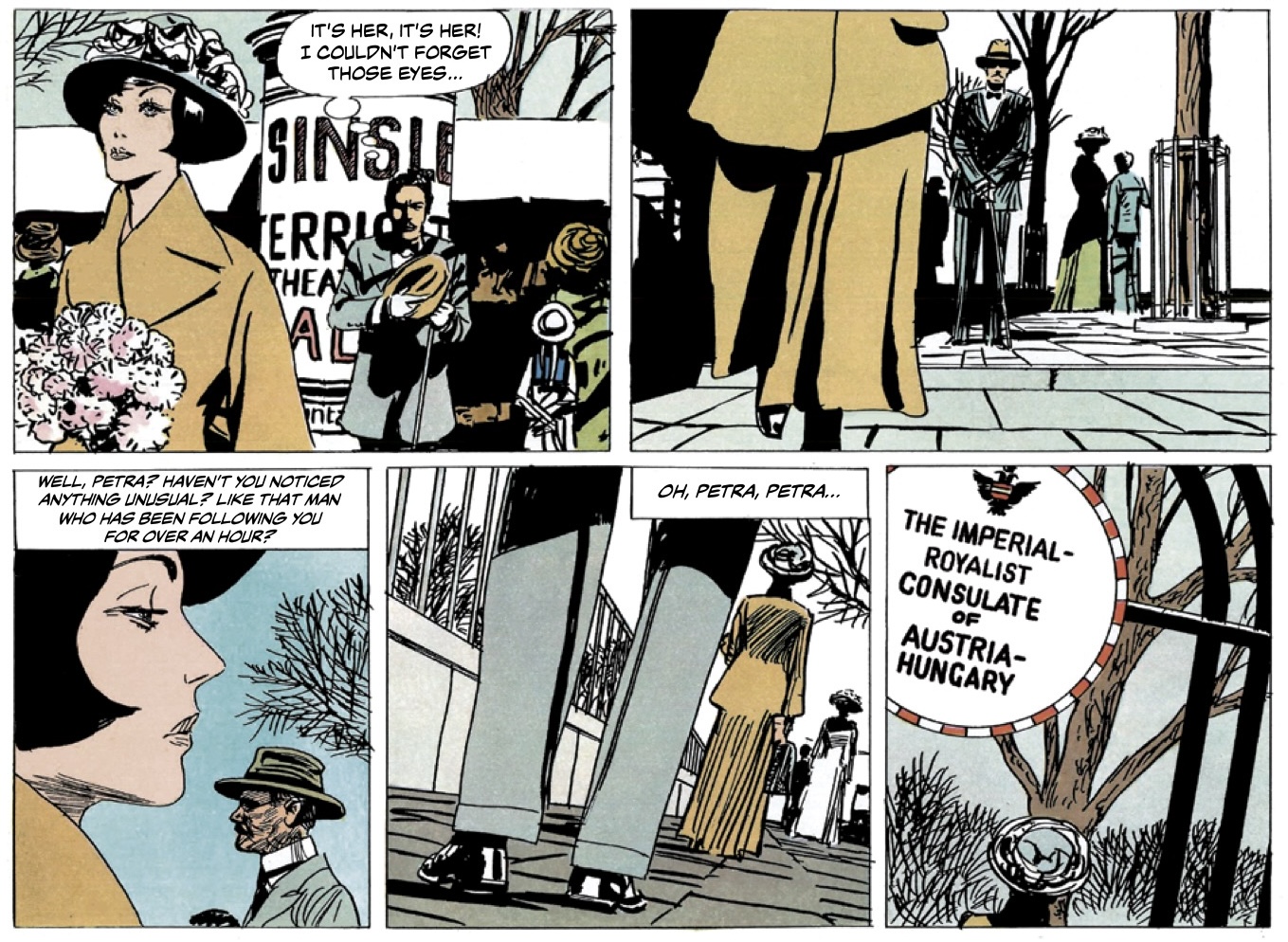
Despite even those on her own side questioning her actions, she trusts herself to come out on top. She has a great sense of style, too, always looking good. Besides her dress sense, her eyes are remarkable. Alive and attention-grabbing, they are perpetually aglint, never just one single color, an example of how much care the artist puts into his work. Micheluzzi himself even comments on her eyes in a caption in "Robbery At The Consulate": "See them once and you’ll never forget ‘em." He’s addressing an old lover of hers that has resurfaced, and this is an authorial technique Micheluzzi is fond of — occasionally talking to his characters on the page, and sometimes Petra. His main interlocutor, of course, will even answer out loud or in a thought bubble.
Although the action occurs between the beginning of 1917 and the end of 1918, the pages themselves were originally published from February 1977 to February 1981 in the magazine Il Giornalino, finishing its run at Alter Alter during the first half of 1982. While there are a vast quantity of war comics out there, Micheluzzi’s mastery and particular slant really sets his creation apart. His knowledge of both history and geography is impressive. Either he’s intimately familiar with these locales or has done a heck of a lot of research. The stories are peppered with details such as street and place names — in "Spies In Venice" he even provides a map showing where the action takes place — as well as the inner workings of all types of war machinery and espionage tactics. Nung, Petra’s elderly Chinese companion, is shown to be a master safecracker. Culturally too, Micheluzzi is alert to nuances such as the plight of Montenegrin rebels or the fact that not all nationalities in the Austro-Hungarian empire supported the Hapsburgs, giving depth to even minor characters.
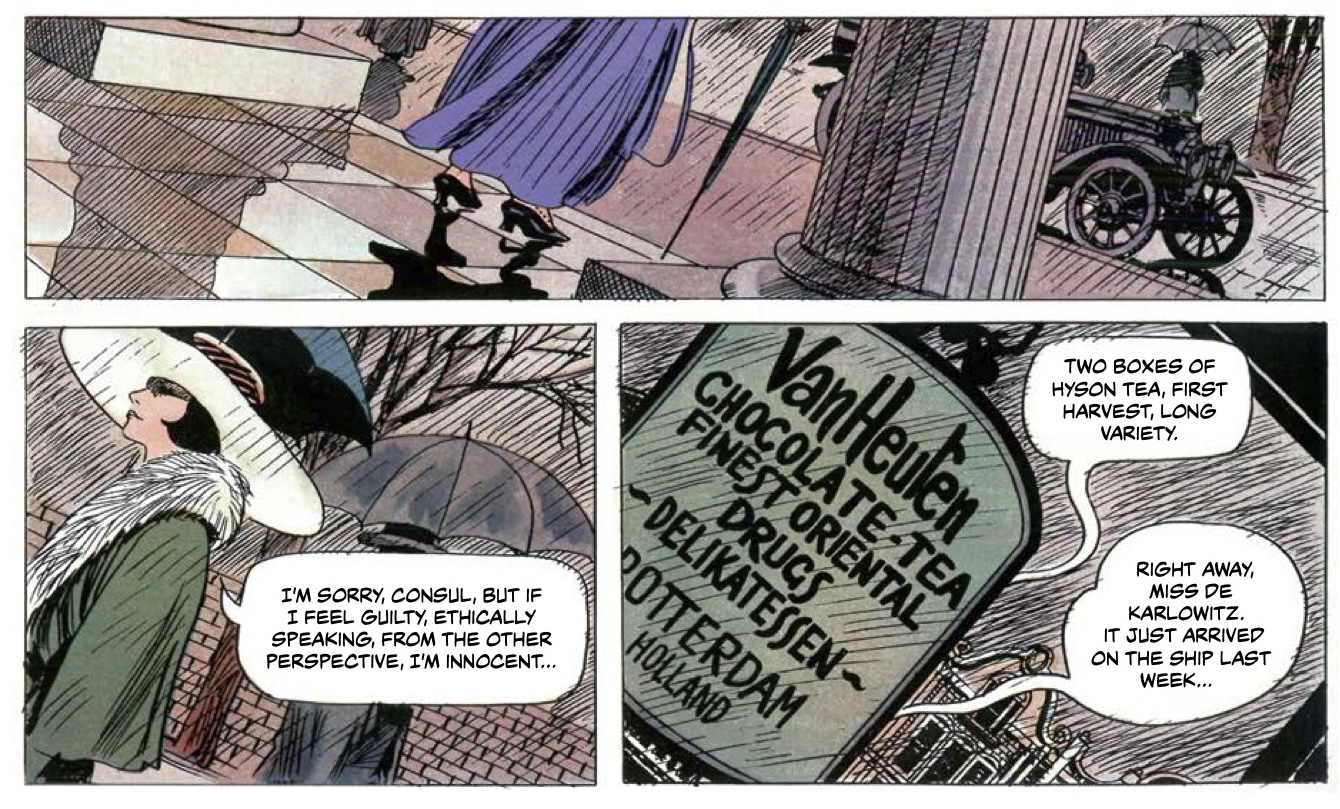
Visually, Micheluzzi offers a unique lens as well. Interesting angles are often employed and incidental panels add to our sense of scene, such as on page 15 where the scope is from below Petra’s knees as she takes her leave from the German consulate followed by two panels very much on a slant, or page 109 where a panel of six poles of a dock submerged in water breaks up a scene’s pacing. Micheluzzi employs a soft, muted, color palette — skies more often than not are blue-gray — as well as uncommon tones such as the light in an arcade that is described as "a sickly chartreuse." One also admires his use of crosshatching and the appearance of shadowy figures.
While Petra’s early adventures are standalone stories, and all can be read as such, they do turn into a continuous saga after her time in Venice. With a coy "One day perhaps I’ll tell you..." from Mme. de Karlowitz, Micheluzzi refuses to explain how she’s ended up in Turkey after we last saw her in Montenegro, but it doesn’t much matter as we’re swept along in her intrigues. However, when the run switches from Il Giornalino to Alter Alter for its final installments, there's not only a change to black and white but also unfortunately a drop in quality. The tales get a bit samey and are not as action packed. There are some weird sexual situations too, changing the tone, and while more clothes come off, the writing doesn’t. The artwork also feels odd with strange shading on faces and skin in the last story, "Aurora! Aurora!" Micheluzzi jokingly hints at the idea of Petra taking on a life of her own in a playful "interview" between himself and his heroine but perhaps he really was losing control of the character. However, while unsatisfying, these final stories should not take anything away from the work as a whole, which is wonderful, and should be regarded as a treasure of European comics.













 English (US) ·